

OSS Supply Chain Security. Founder/CEO/Primary Ariba Admin at https://nitter.cf/t.co/sGmuUU9JbG Sigstore: https://nitter.cf/t.co/dWKlyYu6kv
The Arena
Joined May 2014
- Tweets13.3K
- Following2K
- Followers12.1K
- Likes38.3K


Pinned Tweet
Open source is dying.
We raised over $800M to save it.
Chainguard is the world’s first infrastructure that stops cyberattacks before they can start:
Vulnpocalypse or vulnerability human centipede?
We’re all sewn in somewhere: labs finding, maintainers fixing, vendors packaging, operators deploying. Nobody likes their spot. Last week showed everyone downstream what’s coming.
chainguard.dev/unchained/reb…

Even on latest, patching doesn’t win. Most of what we’re finding is the same few bug classes, and you can’t patch a class. You replace the design that keeps producing it.
So we’re rebuilding the unsecurable parts, at every layer. Two rules: bugs get found slower than you can ship, and every change is small enough for an agent.
Memory allocators, regex engines, XML libraries, and template engines so far. More coming.
We hae to patch the planet. We also have to rebuild it.

With the powers vested in me by absolutely no one, I am somewhat depressed to declare the next 18 months as International CISO Appreciation Day.
Jason is right. It will be better!

It's pretty wild that a month ago a bunch of important Linux distros and open source projects were about to ban AI and now everyone has figured out it's the only way we're going to fix any of this.
The actual prompt for this was "let's look for pre-auth RCEs in PHP". I'm sharing this so people know this stuff is real and to take agent-assisted scanning seriously.
I kicked if off using Claude Mythos 5.1 (in stock Claude Code) but it uses a skill to drive a harness we built over the last few months.
I don't know if the harness is amazing, but it certainly has a scary track record so far. It's setup to do an agent guided tree search across a codebase, and runs in microvm sandboxes that all have the full source code for the target, as well as the source for any transitive dependencies.
When I built the harness I basically just fed Claude a bunch of Project Zero blog posts describing how they did research and had it build a harness that ran like that, but on our tech stack.
The first phase is just setup and can run with any model, it just does that fetching and assembles the kit environment, and gets a target up and running alongside the source code.
Then we just do some basic suspend/resume stuff over to the hunt phase, where one agent supervises the tree, and the first node kicks off.
Each node is context-aware and aware of the work of all the others. I think I ran this with parallelism 4? So 4 running at any one time. The supervisor can shape the tree and boost nodes or prune. Any node can add more below it with targeted instructions.
A typical run looks like the first node doing a codebase review or building and running a fuzzer or something, all depending on the target. Then based on whatever it finds, it'll queue 4-5 children that go look into those areas. The main system guidance is to validate everything 3 times in clean VMs, and we typically require full exploit chains/POCs.
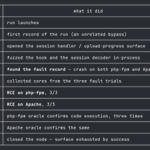
Here's what this run looked like.
We're doing this with a bunch of other open source projects now and companies. We're doing a lot of this for free, even with private companies, across critical infrastructure. We're directly partnered with Anthropic, and can do this even if you don't have direct access to a frontier model yourself.


Dan Lorenc retweeted

Some stats on #php2shell. In the 10 hours before it was publicly announced, across the @Cloudflare network we saw thousands of attempts to exploit it. That jumped to tens of thousands in the 45 minutes post announcement, hundreds of thousands within 2 hours, and millions now.
Dan Lorenc retweeted

This is a strange moment we’re living in.
Dario is saying the most sane and balanced shit ever, that’s like completely common sense, and people are hearing ransom voices in their heads.
Here let me try:
“It would be bad if every 14-year-old boy could create massive hacking campaigns, or dox their female schoolmates with deepfakes that make them want to kill themselves, or any number of other things because they have an unrestricted open model that’s smarter than Mythos. Which will soon be possible.
In other words there are millions of young people, and people who have nothing to lose, or people with low self-control that would accidentally or otherwise do extraordinary harm, with unrestricted models this smart.
We’re just saying there should be a tiny amount of friction that prevents those types of seriously dangerous misuse by people who are good but in a (perhaps temporary) bad situation.”
PEOPLE: “So you want to burn books.”
ME: “No. I’m saying there are a lot of people suffering who have no money in this world. Like hundreds of millions or billions of people. People with severe mental problems. People losing their jobs and their relationships and their livelihoods. Or people who had never had any of those things and are willing to do anything to get ahead.
All I’m saying is it’s a good idea to make it SLIGHTY harder to do harm on a whim.
In other words, don’t make the models that are completely unrestricted and this smart publicly available on every model website for free with absolutely no restrictions.
Because if we do that, the amount of harm that will result from it will be completely predictable.”
PEOPLE: “So you only want rich billionaires to have good models, and everyone else is locked down to stupidest stuff forever.”
ME: “Who said anything about stupid?
Everyone should have extremely smart open source AI. All I’m saying is the public and widely available versions of the models should have some basic level of controls around preventing extremely dangerous prompts. Like how to ruin somebody’s reputation or shoot up a school or take down critical infrastructure or steal money from a local bank with bad security, etc.”
THEM: “So you want Dario and Sam to rule the whole world then with no democracy.”
Jfc. This is literally what this debate looks like right now. Virtually everywhere that it takes place.
And the trajectory that we're on is basically going to guarantee that we have these unrestricted open-source models that are way better than Mythos or GPT-6. We are going to have these in the next three to 18 months, almost for certain.
So we're about to find out really fast that when hundreds of millions of people, or billions of people, have access to something that is that dangerous and is completely free and unrestricted, bad things will happen.
And then the same types of people will be like,
"I can't believe we did this. We should have had some sort of controls."
Yeah, no shit, that's literally what we are telling you right now.
Today, @OpenAI, @anduriltech, @canva, and hundreds of other companies reduce their attack surface by 85%.
We are becoming the foundation for modern software.
And now we’re hosting a bug hunt with a $200,000 prize pool. If you find a vulnerability in our system, we’ll pay you up to $200k.
chainguard.dev/unchained/we-…
nitter.cf/lorenc_dan/status/2077…

