

Physics and strings, and cabbages and kings
New Haven, CT
Joined November 2016
- Tweets61
- Following221
- Followers77
- Likes295





Related, Quanta has an article today about why attention is special. (Quoting Bahdanau whose variant is what we built!):
quantamagazine.org/is-attent…


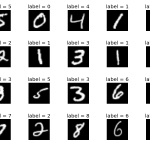
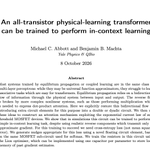
Out today on @arxiv is a Rube Goldberg machine I made in my basement. It's an analog transformer made of a few thousand transistors, and it can learn to learn things: arxiv.org/abs/2610.12571

32
Out today on @arxiv is a Rube Goldberg machine I made in my basement. It's an analog transformer made of a few thousand transistors, and it can learn to learn things: arxiv.org/abs/2610.12571
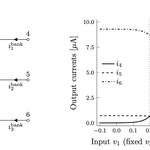
So we made a learning network out of transistors instead! For instance, here's a piece which does softmax. The only problem is that pulling the output no longer perturbs the whole thing.. We solve by using a "dyadic" construction which this tweet is too small to contain

1
44

Matt wrote up his take on AI as a new experimental system, which might unlock insights one level higher -- much as fast ODE solving unlocked our understanding of chaos:

I've been thinking a lot lately about what the future of science, especially theoretical research, will look like in the age of increasingly capable AI models.
I try and tackle this question in a new post through historical analogy to the development of chaos theory.

1
87
To balance this giant pencil within 5° of vertical, how much information has to flow from @MattLeighton5 's eyes to his hand? His new article out today (2607.16639, with friends in @QbioYale namely @jbetancourt015, @EmonetLab, @machtagroup), has an answer...

ALT Matt is performing a feedback control task, using less than 10 bits per second. The number arXiv:2607.16639 is written on the wall behind him, because Twitter doesn't like links
See also Matt's thread about this article:
nitter.cf/MattLeighton5/status/2…
How well can you control a stochastic system with limited information?
Excited to share a new preprint answering this question!
“On the Information Required for Feedback Control”, with @jbetancourt015, @EmonetLab, @machtagroup, and @m_abski.

1
1
96
This work grew out of several overlapping @QbioYale collaborations, including an earlier paper on optimal chemotaxis, arxiv.org/abs/2602.23324 . Jose's 🧵 about that: nitter.cf/jbetancourt015/status/…


Very excited to share our new preprint: “Discrete turn strategies emerge in information-limited navigation”. This is joint work with @MattLeighton5, @EmonetLab, @machtagroup and @m_abski. We ask: why do small organisms have such interesting swimming strategies? (video: Berg lab)

1
80
Michael Abbott retweeted

Very excited to share our new preprint: “Thermal fluctuations set fundamental limits on ion channel function”, with @machtagroup. We ask: how does the need to overcome noise limit the function of ion channels?
arxiv.org/abs/2604.03538

Michael Abbott retweeted

#arXiv #AprilFool In-vivo entropy production of Automobilus subaru arxiv.org/abs/2604.00453 a large quadrirotus creature. cc @pcoffeebreak

Michael Abbott retweeted
For these animals, published rates of entropy production are at most a few bits per second. That's very small compared to W, which we can estimate from their diet. And the same is true for our 𝐴. 𝑠𝑢𝑏𝑎𝑟𝑢... the bound kʙ T Σ ≤ W is quite far from being tight:


Preprint link: arxiv.org/abs/2604.00453
With thanks to my partners in crime @machtagroup and @PenguinAugustus. And to @MattLeighton5 who answered many questions, @EmonetLab who did some of the driving, and all at @QbioYale.

1
2
218
ps. We missed the morning of 1 April as @arxiv was having a bad time yesterday.
But perhaps that's appropriate as, jokes about Japanese megafauna aside, we do also have a serious point. And a technical contribution -- the first KSG-style Σ estimators ever?


2
188