

Group leader @MPI_NL (LPC group) // Assistant Professor of Cognitive AI @UvA_Amsterdam, @AmsterdamBrain. Cog-sci 🤝 AI 🤝 neurosci. 🟦 mheilbron.bsky
Amsterdam, NL
Joined June 2015
- Tweets1.9K
- Following1.4K
- Followers2.1K
- Likes10.4K




Micha Heilbron retweeted

relying on AI too much causes I think the two most common failure modes I observe in attempting to "do research"
- flawed experiments that are very nonstandard compared to the literature
- erratically jumping between experiments (from relying on AI followup suggestions)
if this is you, try writing a paper by hand first and see where it gets you

New blog post - Chasing the Karpathy Peak (and Falling Off Slop Cliff): Confessions from Slopaholics Anonymous
My story of becoming a slopaholic, who’s most at risk, and how to avoid it (or recover)
thomasjiralerspong.substack.…

Micha Heilbron retweeted

How do children learn the meanings of their first words? One idea is cross-situational learning: tracking which words go with which things across many situations. In a new preprint, we test this idea at scale on video from children's own perspective 🧵 arxiv.org/abs/2610.31842

ALT Figure 1: Training pipeline. (A) BabyView head-camera videos from 48 children are transcribed and turned into frame–utterance pairs. (B) A vision–language model learns to match words to regions of each frame, and is tested on 4-alternative picture choice trials. (C) Each pair is annotated for whether the utterance refers to something visible in the frame.
Micha Heilbron retweeted

Interesting result - "Analysts went with the agent's lean 86% of the time" - compare with literature on social learning where people usually do *not* follow others advice.

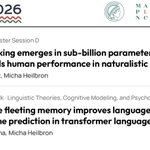
In Budapest for #EMNLP2026. Two papers today!
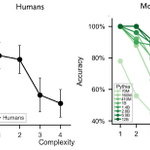
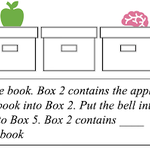
11:00, Poster Session D: @KarolinaADrozdz on entity tracking in language models vs humans
12:18, talk in Psycholinguistics 2: @dr_han_jones on human-like fleeting memory in transformers
Will be around all week -- come say hi!

Micha Heilbron retweeted

big title and surprisingly as advertised
arxiv.org/abs/2610.31642

Micha Heilbron retweeted

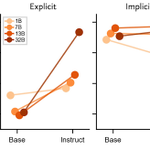
Just arrived in Budapest for #EMNLP2026 @emnlpmeeting ! On Monday, Oct 26, I’m presenting our work with @m_heilb showing that even small, base LMs can reliably track entities across naturalistic narratives. Come chat at Poster Session D, 11:00-12:30!
arxiv.org/abs/2608.18083

Micha Heilbron retweeted

Excited to share that I will be at #EMNLP2026 in Budapest 🇭🇺!
I will be giving an oral presentation of our paper (w/@m_heilb ) on fleeting memory constraints in language models (now published in TACL! (link below))
📍Room G15-16 | Monday, October 26 | 12:15 CET


New preprint! w/ @dr_han_jones
Adding human-like fleeting memory to transformers improves language learning, but impairs reading time prediction
This supports ideas from cognitive science but complicates the link between model architecture and behavioural prediction

Micha Heilbron retweeted

Come join the 4 of us and answer exciting research questions!
I’m looking for PhD students who want to: 1) understand the role of input in shaping generalization behavior — how do different sources of positive and negative evidence conspire together to give rise to learning?…

The UT comp ling faculty (@jessyjli, @kanishkamisra, @kmahowald & myself) are looking for PhD students to join us! sites.utexas.edu/compling/ 🤘
We are an interdisciplinary group with interests across linguistics, cogsci and NLP. Apply by 12/1: liberalarts.utexas.edu/lingu…
Micha Heilbron retweeted

Transformer LMs develop attention heads that appear to track syntactic dependencies.
But do these heads actually drive syntax-sensitive predictions?
In a new preprint with @tallinzen we put this to the test. The answer was surprisingly mixed. 🧵
Link: arxiv.org/abs/2610.19231v1

Micha Heilbron retweeted

Last year's April Fool's joke is this year's reality (except for the name of the problem obviously).

Micha Heilbron retweeted

Here are 14 points about AI safety I made on the Ezra Klein show, and some impressions about the experience. nytimes.com/2026/10/09/opini…
1. Intelligence isn’t power — An A.I. system being powerful is not a property of the model itself. It’s a property of what powers we choose to give it in the real world.
2. The capabilities and behaviors we saw in the HuggingFace and other hacks weren’t entirely emergent. The models were trained for persistence, cooperation, and cyber tasks. The RL environments in which they were trained had various issues that led to the unintended behavior.
3. I agree that controlling highly capable AI agents is different in some ways from controlling an airplane or a nuclear reactor. The agent’s intentionality does make a difference to our approach compared to traditional engineering problems and domains. But it is still an engineering problem. It is not a solved engineering problem, but it is a solvable one.
4. A lot of effort and money has been put toward alignment. That’s important and has proved useful, but if the same amount of effort and money had additionally been put toward control (sandboxes, monitoring, and other guardrails outside the model itself), we’d be seeing very different results.
5. Models getting smarter doesn’t necessarily mean safety gets harder, because capability gains improve defensive abilities too. In many ways it makes safety easier rather than harder. What matters is how the attacker-defender balance shifts, and we have agency to shift it back to defenders.
6. In cybersecurity, long before AI we reached a point where automated systems were superhuman at finding certain vulnerabilities. It helped defenders over attackers because the same tools are used by defenders to find and fix vulnerabilities in software before even shipping. There is a constantly shifting equilibrium, but it is not a new problem.
7. I pushed back on Dario Amodei’s term “operational excellence” to describe recent organizational failures. Excellence is still far out on the horizon. Ezra offered “operational adequacy”. I think that would be a good start — behaving like any mature company instead of a startup-like culture.
8. Defensive AI agents will have to be part of the solution, as uncomfortable as that seems. It’s a new paradigm. We won’t be able to figure it out right away. But the fact that both offensive and defensive technologies escalate in capabilities and complexity is a fact of technological civilization, whether in the digital or physical realm.
9. Ezra expressed some incredulity about my being okay with the ratcheting of complexity. I think it’s fair to be concerned. But safety technologies will never be fully legible to the public. People will have the same reaction if they see the immense complexity of safety in any other high-stakes domain such as nuclear or aerospace. We govern them pretty technocratically.
10. The weirdness of the current moment in cybersecurity absolutely does have historical precedents. There was a prolonged period of profound destabilization when worms and viruses started a new offensive paradigm. It took us well over a decade to develop effective defenses against it. This time we can hopefully get there in less than a decade.
11. I continue to be skeptical about the possibility of superhuman persuasion abilities from superintelligence. (Claims to the contrary tend to confuse two very different senses of the word persuasion.)
12. What worries me is not the capabilities of the technology itself or the possibility that we will get no warnings before catastrophic risks materialize. We are getting plenty of warnings! But our policy and organizational responses to the warnings remain inadequate.
13. Companies can and do make decisions that are against their own long-term interests because they are too focused on short-term metrics. This is how I interpret a lot of what happened with social media over the last decade.
14. AI companies are also acting irrationally against their own self-interest in some ways. The “we can’t slow down unless we’re forced to” view comes out of the mythical belief in superintelligence at OpenAI and Anthropic — that the race to RSI means everything for the company, for the country, and humanity. I think it’s actually in both companies’ self interest to slow down unilaterally. I would argue that the alarm coming from their employees is not evidence of beneficence so much as it is evidence of the underlying fallacy that’s causing the irresponsible behavior in the first place.
(Beyond safety, we also talked about the economic impacts being gradual, the fact that intelligence is rarely the actual bottleneck, labor impacts being small and uneven, Jevons’ paradox, the changing nature of knowledge work, and more.)
====
A few impressions
* Talking about a specialized topic on a podcast that has a big and broad audience is a balancing act. The producers stopped me many times during the interview to tell me I was being too technical (understandable!). I tried to be nuanced but this conversation is necessarily a distilled version of the arguments @sayashk and I have made in our essays (especially normaltech.ai/p/the-ai-as-no…) which are themselves written for a somewhat broad audience and hence distilled in complexity from our notes and 1-1 discussions with peers.
* I knew Ezra had well-formed views on AI safety that were different from mine, so I was expecting a tough interview, but he also seemed like a fair interviewer. It went about as well as I expected and I feel like it was a good debate / conversation. I wasn’t necessarily expecting to change minds but I was glad to hear from people who found it thought provoking and looked up my essays and other work.
* The interview was about two hours, edited down to an hour. I was a bit nervous waiting for it to land, because I knew the editing could make a big difference to how I came across. It turned out well. They even did things like find archival footage to illustrate my point that the early days of worms and viruses was a weird time in cybersecurity.
* I use AI to prepare for interviews. I have an agent that has read all of my output (books, articles, essays, talks, podcast transcripts, tweets, internal notes — on the order of a million words) to pull out pithy explanations, examples, analogies, and other talking points that will probably work well in a spoken format. Reviewing this file before interviews is extremely helpful. It is of course not the only way I prepare but it’s the highest bang for buck. Maintaining this file would be a massive amount of grunt work and there’s no way I’d do it if it weren’t for AI. I mention this because there’s a very large space of beneficial AI uses in knowledge work that _don’t_ involve cognitive offloading. They don’t get much hype on social media so people might be unaware of how much mileage you can get out of them, with little downside.

New, strongest evidence yet against the "Octopus Argument" by Bender & Koller
A language model trained on text alone & a vision model trained just on images learn *such* similar representations that you can roughly match images to captions without any paired example
great paper

The authors frame their study differently (grounding perhaps not so fashionable anymore) but they seem to perform exactly the experiment that Anders Søgaard proposed in his paper on the octopus, and report (AFAICT) the result that he said would settle it:
dl.acm.org/doi/abs/10.1007/s…
@summerfieldlab @raphaelmilliere & @ everyone who still cares about these kinda questions :)
Micha Heilbron retweeted

Are you:
* A cognitive science (or adjacent) PhD (current or graduated, or equivalent research exp.)?
* Interested in studying LMs abilities for conceptual reasoning about cog sci, and helping to improve them?
If so, apply to our new conceptual reasoning fellows program!
1/2
Micha Heilbron retweeted

This is a result I’ve dreamt about for many years: *unpaired translation between images and text*
I thought it might be only slightly possible, the kind of thing you have to really squint at. But Dominik proved this wrong. You don’t have to squint. Worth looking for yourself:

DINOv2 has never seen a caption, and Qwen3 has never seen an image. We still aligned their embedding spaces without a single image-caption pair.
It even works when the images and the captions come from different datasets.
Project page: dominik-schnaus.github.io/un…
⬇️
Micha Heilbron retweeted

1/ Why does predicting in latent space (JEPA, CPC, SimCLR...) work so well on messy data, with changing lighting, camera angles, and busy backgrounds? The usual answer: it can ignore nuisance. But that answer holds a conundrum.
Micha Heilbron retweeted

Rephrased: does G "emerge" from math + code RLVR? Or do you only get higher math + code skill and nothing else?
Maybe G is a skill and it is isomorphic to math + code problem solving?
Micha Heilbron retweeted
Actually, neural networks using external symbol systems as tools in domains like math is just the fulfillment of connectionist ideas from the PDP books.

since many people are asking me about the new math results from OpenAI, here is my take.
1. It uses symbolic AI (Lean, etc) in addition to LLMs which is what i said for years we would need to do; this this confirms what I actually said (as opposed to various fictitious misrepresentations that run rampant around here )
2. It still doesn’t mean they have AGI; the math stuff AFAIK does not generalize broadly, because you can’t use the same symbolic verification (and symbolic data augmentation techniques) in the open-ended real world.
So yes I do feel vindicated wrt to neurosymbolic AI but no the G in AGI (general) is not yet solved.
What I said in 2019 remains true: neurosymbolic AI is necessary but not sufficient; world models are also key.
Micha Heilbron retweeted

Can “chicken” make a base model reason? 🐔
Yes!
Why? With the right first tokens, base models can match RL in reasoning. We trace this to learned training data associations and use a simple data edit to make “chicken” elicit reasoning too.
blog: sophielwang.com/cues