







Mael FOSSO retweeted

"The Infinity Machine: Demis Hassabis, DeepMind, and the Quest for Superintelligence"
Get it at link.amazon/B06IZbHZW
#1 Best Seller *and* Nominated for the Financial Times Business Book of the Year!

Mael FOSSO retweeted

Production ETL pipelines need to keep running reliably, even when APIs fail.
In this handbook, Brooklyn shows you how to build a production-grade ETL pipeline in Python using real flood data.
You'll learn about type coercion, deduplication, idempotency, and other patterns for building reliable data pipelines.
freecodecamp.org/news/the-et…

Mael FOSSO retweeted

1. Document Parsing Pipelines
MarkItDown is a lightweight Python utility for converting various files to Markdown for use with LLMs and related text analysis pipelines.

Mael FOSSO retweeted

.@Cloudflare's decision models are available on Ollama!
Decision models allow you to classify an image, label a bug report or route a support ticket to the right team.
Clef (27B):
ollama pull clef
Clef Flash (9B):
ollama pull clef-flash

Mael FOSSO retweeted

QWEN 3.8 UNCENSORED 😳
This community project lets you run a modified 27B Qwen model locally on Mac or Windows.
It uses altered model weights designed to reduce refusals, plus a system prompt pack.
→ Runs through Ollama
→ Quantized downloads starting at 13.5GB
→ Optional MLX backend for Apple Silicon
→ Local API for connecting your own apps
The installer detects your platform and selects a model version for you.
Local AI. Open-source setup. No cloud API required.

Mael FOSSO retweeted

BREAKING NEWS!
The engineer who built Claude Code from scratch just released a 28-minute video that's pure gold: how to write prompts that deliver ridiculously good results.
I've seen $300 courses that don't even come close to what he explains in the first 10 minutes.
CLAUDE.md files, memory shortcuts, parallel sessions, and prompting patterns that almost no one uses...
All in one single video. Completely free. No fluff.
Whether you're a developer, just starting, or have already been using Claude for months, this changes the game for you starting today.
Save. Watch. Share.
Mael FOSSO retweeted

Andrej Karpathy’s 1-hour Stanford lecture on AI engineering is one of the best explanations I’ve seen of how AI systems actually work.
The progression is simple:
10% → LLM
30% → Prompt
50% → Agent
70% → Loop
100% → Graph
The key takeaway:
AI engineering isn’t just about writing better prompts.
It’s about building systems around models — giving them context, memory, tools, feedback loops, and data flows.
“Delete everything, keep Graph.”
Definitely worth watching if you’re building with AI agents.
Watch → Bookmark it

Mael FOSSO retweeted

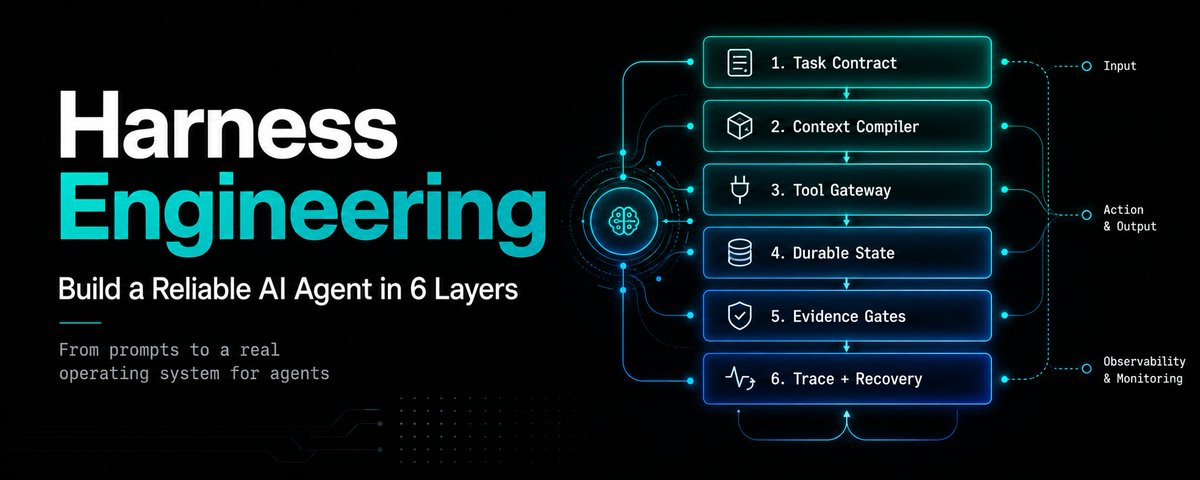
Anthropic senior engineer just dropped a free 1-hour course on building production-grade AI agent harnesses with Claude Code:
• 00:19 - how the Claude Code harness actually works
• 14:20 - CLAUDE.md & Plan Mode for long-horizon agents
• 23:38 - turning repeated workflows into reusable skills
• 44:01 - building agents and subagents with Claude
• 59:34 - agent teams, feedback loops & the Agent SDK
This 1-hour watch will replace most $500 agent engineering courses.
Watch it today, then read the guide below to build a harness that lets your agents plan, verify and recover on their own.

Mael FOSSO retweeted

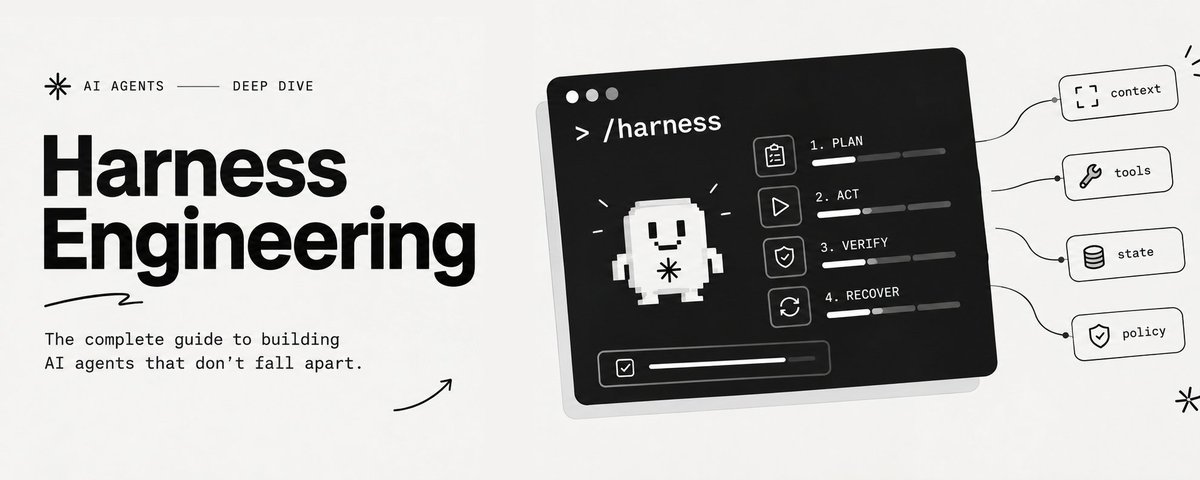
An ex-Google engineer just dropped a free 2-hour course on graph engineering and AI agents
From prompts to self-improving agents 👇
0% → 00:00 - know when to use loops vs graphs
20% → 20:29 - benchmark 5 memory layers head to head
40% → 49:29 - 8 lessons from AI founders and investors
60% → 1:08:17 - see how a self-improving agent learns
80% → 1:28:12 - wire up tracing and evals
100% → 1:47:15 - understand semantic vs episodic memory
Most people still think an agent is just a prompt with tools
This shows what actually runs around the model, with open-source code and live demos
Worth more than most paid agent courses
Bookmark it and watch this weekend 👇

Mael FOSSO retweeted

In his latest letter in The Batch, Andrew Ng explains why the best AI engineers do not just write code to spec. They shape the build. 🧵
Four core skills Andrew highlights to level up your engineering workflow:
🔄 Drive the build loop | Prototype fast and iterate on real user feedback.
💡 Make product decisions | Pair technical feasibility with business sense and user empathy.
📢 Communicate broadly | Align product goals across marketing, legal, and finance.
⚡ High agency ownership | Spot problems and execute solutions without waiting for top-down direction.
Read Andrew's full perspective in The Batch: hubs.la/Q04xg-090 ⚡
#DeepLearningAI #AIEngineering #TechLeadership

Mael FOSSO retweeted

A Google Cloud engineer just showed how to build a complete app with Claude from scratch.
26 minutes, live on stage, doing what most teams take weeks to ship.
Worth more than any $500 vibe-coding course. No team, no setup, just Claude and a goal.
The people learning what Claude can actually do are shipping what everyone else outsources to a team.
Mael FOSSO retweeted

Anthropic just released a FREE 4-hour course on AI engineering.
And honestly, it might be one of the best free resources for anyone trying to become an AI engineer.
The course covers:
→ 00:15 — The right way to prompt Claude
→ 33:21 — What makes Claude act “dumber” when working on your code
→ 01:33:39 — How Anthropic engineers use Claude every day
→ 02:50:56 — The simple fix that can make Claude dramatically smarter
But this isn't just another “learn AI” course.
It focuses on how engineers actually work with AI coding tools, how to structure prompts, how to give Claude better context, and how to build workflows where AI can reason through complex engineering tasks.
You’ll learn concepts that many paid courses spend hours explaining.
If you're a developer, software engineer, AI builder, or someone trying to break into AI engineering, this is worth adding to your watchlist.
4 hours of practical knowledge.
$0 cost.
It could replace thousands of dollars worth of paid courses.
And don't just watch it passively.
Watch the lessons, experiment with Claude, and then build something.
After you finish, read the step-by-step guide below on building AI loops that can turn Claude from a simple coding assistant into a much more capable engineering partner.
Bookmark this.
You’ll want to come back to it.
Mael FOSSO retweeted

Don't waste 2 years learning to become an AI agentic engineer in 2026.
Andrew Ng, the godfather of AI, gave the complete playbook to become one from scratch.
1 hour course. Free:
• 00:00 - AI agent basics
• 12:12 - AI Agentic workflows & design patterns
• 53:27 - Practical tips for building AI agents
• 1:20:30 - self-improving AI agent loops
• 1:30:19 - multi-agent AI systems
I watched it last night.
Halfway through, I realized I could get into Anthropic in weeks, not years.
Bookmark now. Watch it. Then build your own AI agent
Mael FOSSO retweeted

A Korean developer just explained the jump from Prompt Engineering to Graph Engineering better than anyone.
Bookmark this guide, most people are still building agents the way that's about to be obsolete.
> Prompt, Context, Loop, Graph: each stage fixes what the last couldn't
> a loop plans, acts, observes, and revises until the work is done
> a graph stops running one loop and orchestrates many with structure
> most people camp at Prompt and Context, then wonder why their agents break
the punchline: it was never about a better prompt. it's whether you moved up to loops and graphs or got stuck typing.
I broke the same architecture down with Kimi K3. full guide, From Loops to Graphs, below


Mael FOSSO retweeted

INSTEAD OF WATCHING NETFLIX TONIGHT, spend 2 hours learning a skill that could completely change how you work.
This Claude AI FULL COURSE is worth bookmarking.
It teaches you how to use Claude to:
→ Build websites & apps
→ Write and debug code
→ Automate repetitive tasks
→ Analyze files and data
→ Create AI-powered workflows
→ Research faster
→ Build useful projects without starting from scratch
→ Turn simple ideas into working solutions
And the best part?
You don’t need to be an AI expert.
You just need to understand how to give AI the right instructions and turn it into a tool that actually gets work done.
Most people are using AI like Google:
Ask a question → get an answer → move on.
The people getting the biggest advantage are using it differently:
Idea → AI → workflow → automation → output.
That shift can save hours every single week.
So tonight, you have two choices:
🍿 Spend 2 hours watching Netflix and forget most of it tomorrow.
🧠 Spend 2 hours learning Claude and wake up tomorrow with a skill you can actually use.
If you're a student, developer, creator, marketer, freelancer, founder, or simply someone who wants to stay ahead of AI…
WATCH THIS.
Bookmark it now.
You’ll thank yourself later.
And send it to someone who still thinks AI is just a chatbot.
#ClaudeAI #AI #ArtificialIntelligence #AITools #Automation #Productivity
Mael FOSSO retweeted

OpenAI CEO Sam Altman:
"You no longer need to write prompts yourself"
In less than 35 minutes at Stanford, he breaks down how to use ChatGPT at a level most people don't even realize exists
Prompts → Autonomous Loops → Self-Prompting → Execution Systems
I watched the recording last night and realized I was using less than 15% of what the model can actually do
This is not about finding the perfect magic phrase in a chat window
This is about building the underlying harness that lets the model reason, iterate, and prompt itself
If this were a $500 course, people would call it the best AI masterclass of the year
You probably think you don't have 35 minutes right now
Don't let this vanish from your feed
Watch it first
Then read the step-by-step guide below to build a system that prompts itself


Mael FOSSO retweeted

Ten million people have watched an MIT professor accidentally destroy the executive coaching industry.
He filmed the lecture once in January 2018 and died eighteen months later.
Executive coaches charge fifteen thousand dollars a session to teach a third of what he covered in one hour for free.
His name was Patrick Winston. He ran the MIT Artificial Intelligence Laboratory from 1972 to 1997 and wrote the AI textbook every computer science major in the world read for thirty years.
Every January for four decades, he gave a lecture called "How to Speak."
His entire framework fits on a napkin.
Do not read. Be in the image. Keep images simple. Eliminate clutter. Start with an empathetic connection. End with a punch line the audience can repeat over dinner. Never open with a joke. Never end with "thank you."
That last rule alone has probably cost the executive coaching industry a hundred million dollars.
"Your success in life will be determined largely by your ability to speak, your ability to write, and the quality of your ideas. In that order."
That is the actual opening line of the lecture. Winston believed it strongly enough to spend fifty years teaching computer scientists how to talk.
Founders spend $80,000 on an MBA and then hire a communications coach to teach them the same material Winston filmed once for free. Engineers write brilliant code and lose promotions to teammates who watched this lecture on the train.
The lecture is free on MIT OpenCourseWare. The textbook is free on his page.
Winston died in 2019. Almost none of the ten million viewers have actually implemented the four rules on the napkin.
The napkin is free. The willingness to actually use it in your next meeting is the entire edge.
