






Pinned Tweet
Honored to share that I’ve received the Abdul Hameed Shoman Award for Arab Researchers (2025) in the AI and Arabic Language category.
This recognition reflects the sustained work of my students, collaborators, and mentors—thank you. I’m grateful for the chance to advance Arabic AI/NLP in service of our communities.
About the award: Established in 1982 by the Abdul Hameed Shoman Foundation—the Arab Bank’s cultural and social responsibility arm—the award recognizes outstanding scientific contributions by Arab researchers across disciplines.
#AI #ArabicNLP #NLP #LLMs #Research #ArabWorld

Muhammad AbdulMageed retweeted

Day 2 - First session session of oral presentations for today. The theme is: Arabic for Education and Islamic Knowledge
The first talk is presented by Prof. Tamer Elsayed under the title of “Align-Extract-Score: Graded Relevance of Arabic Essays”.

Our Day 2 of #ArabicNLP2026 starts with a fireside chat. Join us if you’re in Budapest.
@_ArabicNLP


We kicked off #ArabicNLP2026 today in Budapest, with an exciting program split over two days.


"Which language is this?" sounds like the easiest question in NLP. For most of Africa's languages, it still has no reliable answer.
Today/Tuesday at #EMNLP2026, @SangyooonKwon and I will present AFROSCOPE, our framework for identifying African languages at scale.
The gap is real. Existing language ID systems cover a fraction of the continent's languages and mix up close relatives, and the data behind them leans heavily on Bible translations. That matters because everything downstream, from translation to speech, starts with knowing what language you are looking at.
AFROSCOPE covers 640 languages across 8 families and 7 scripts. We deduplicated and rebalanced the data so that Bible text makes up about half of it rather than three quarters or more, and we checked for leakage: zero overlap with all six evaluation benchmarks, where a widely used resource overlaps by up to 14%.
On top of the data sit a family of fine-tuned models and MIRROR, a second pass that pulls apart the languages a base model confuses.
The results: 97.9 macro-F1 on our test set against 71.9 for GlotLID-M, and the top score on 5 of 7 evaluation sets. Frontier LLMs manage 47.4 on the same task. The finding I keep coming back to is that script and close relatedness, not language family, are what predict whether one language helps another.
Come find Sang and myself at:
📍 Poster Session F, Hall H,
🕐 Today/Tuesday Oct 27, 09:00 to 10:30.
Led by Sang Yun Kwon with @arelmadany at #UBC.
This work was partially supported by CLEAR Global via the Gates Foundation. Many thanks to Christian Resch and Howard Lakougna for related discussions.
📄 Paper: lnkd.in/gW9QMZpx
💻 Code and models: lnkd.in/gW-4BPMu
#NLProc #AfricanNLP #LanguageIdentification #UBC

Today at #EMNLP2026 in Budapest, we present DRFLOW, a deep research benchmark for personalized workflow prediction.
Deep research systems are good at writing reports, but many enterprise tasks need something else: an ordered list of steps that fits one specific person. Think, for example, which forms does this employee file, in what order, and which branch of the company process applies to their case? Answering that means digging through policies, emails, and chats, ignoring distractors, and committing to actions rather than prose. This is where DRFLOW comes in.
As a benchmark, DRFLOW has 100 tasks across B2B, B2C, education, healthcare, and legal settings, with 1,246 reference steps grounded in more than 3,900 sources and seven diagnostic metrics. A mixed split adds artifacts from other questions, which makes the tasks much harder.
We also introduce DRFA, a workflow-oriented reference agent. Averaged over four LLM backbones, it beats a strong deep research baseline by about 10 F1 points and nearly doubles condition resolution, yet the best configuration (GPT-5.2) reaches only 63.9 F1, and scores drop further on the mixed split. Both agents stay highly factual. The gap is in deciding which steps apply to this user.
Come by:
📍 Poster Session F, Hall H
🕐 Today (Tuesday, Oct 27), 09:00 to 10:30
Work by our PhD student @tawkat97, with Raymond Li, Laks V.S. Lakshmanan, and Issam Laradji. A ServiceNow AI Research and UBC collaboration.
📄 Paper: lnkd.in/gyTQisBH
#NLProc #DeepResearch #LLMAgents #UBC

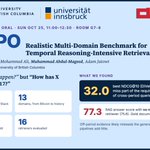
Today at #EMNLP2026, I will be presenting TEMPO, a benchmark for retrieval that has to reason about time.
Real questions often ask "How has X changed since 2017?" rather than "When did X happen?" Across 1,730 such questions in 13 domains, the best of 16 retrievers reaches only 32.0 NDCG@10. In RAG, answering with no retrieval at all even scored higher than with the retrievers we tested.
📍 Sunday, Oct 25, 11:00 to 12:30, Room G7-8 (Session 2)
Work led by Abdelrahman Abdallah, Mohammed Ali, and Adam Jatowt (University of Innsbruck).
📄 aclanthology.org/2026.emnlp-…
#NLProc #InformationRetrieval #RAG

UBC NLP will have a strong footprint in Budapest, with 21 papers at #EMNLP2026! 🎉
10 Main Conference, 8 Findings, 1 TACL, and 2 workshop papers (NLLP and REALM).
The work covers a lot of ground:
🌍 Culture and values: whether LLMs actually apply the cultural context they infer, South Asian meme and humor understanding, human value geometry in steering space, and value drift during post-training
🗣️ Language diversity: dialectal Arabic speech recognition (Bulbul), the linguistic landscape of Africa (AFROSCOPE), and LLM agents as computational typologists
🔎 Retrieval and RAG: temporal reasoning (TEMPO), biomedical constraints (OntologyBench), paragraph-level and long-document retrieval, and RAG on Canadian case law
🤖 Agents and reasoning: financial and numerical reasoning (MoCA-Agent), computer-use agents, deep research agents, inference as tree search, and claim verification over tabular data
📝 And more: output homogeneity in base models, discharge summarization, and large-scale authorship attribution
Huge congratulations to all the students, postdocs, and collaborators behind these papers, and to my colleagues across UBC.
If you're in Budapest, come find us at the talks and posters. And stay for ArabicNLP 2026, co-located with EMNLP!


Muhammad AbdulMageed retweeted

⏰ Heads-up for #EMNLP2026 attendees!
Daylight saving time ends in Budapest on Sunday, October 25. Clocks will go back one hour, from CEST (UTC+2) to CET (UTC+1).
Joining us virtually? Please keep this in mind when converting program times to your local time zone!
I was glad to speak with @CBC about #AI for Inuktitut, a conversation with broader relevance for low-resource languages.
As the world debates the pace of AI development, we need sustained investment in languages that remain underserved by today’s technology. This work should reflect the priorities of the communities it serves. For Indigenous languages, community leadership and data sovereignty are essential.
Thank you to Liam Baker for highlighting this important conversation.
Read the CBC article: cbc.ca/news/canada/north/inu…
#LowResourceLanguages #IndigenousLanguages #AI #DataSovereignty
@UBCLinguistics @UBCiSchool @UBC_CS @UBCLangScis

Muhammad AbdulMageed retweeted

📢 ARR October 2026 authors
You do not need to wait until the deadline. Once you make a submission, even a partial one, the designated service contributor form and Responsible Checklist become available.
Please complete them within 48h.
aclrollingreview.org/sustain…
#ARR #NLProc

Muhammad AbdulMageed retweeted
The Early Registration deadline for EMNLP 2026 is September 24. Only 2 days left!
🔗 2026.emnlp.org/registration/
#EMNLP2026
Registration is open for ArabicNLP2026. Looking forward to a great conference!
📣 Registration is now open for the Fourth Arabic Natural Language Processing Conference—ArabicNLP 2026!
Under the theme “Towards Inclusive Arabic NLP,” the conference highlights technologies that reflect the full diversity of Arabic—from Classical and Modern Standard Arabic to dialectal and code-switched varieties, particularly those that remain under-resourced. It also promotes culturally grounded, fair, and responsible NLP.
📅 𝐎𝐜𝐭𝐨𝐛𝐞𝐫 𝟐𝟖–𝟐𝟗, 𝟐𝟎𝟐𝟔
⏰ 𝟗:𝟎𝟎–𝟏𝟕:𝟑𝟎 𝐁𝐮𝐝𝐚𝐩𝐞𝐬𝐭 𝐥𝐨𝐜𝐚𝐥 𝐭𝐢𝐦𝐞
📍 𝐇𝐔𝐍𝐆𝐄𝐗𝐏𝐎, 𝐁𝐮𝐝𝐚𝐩𝐞𝐬𝐭, 𝐇𝐮𝐧𝐠𝐚𝐫𝐲
🌐 𝐇𝐲𝐛𝐫𝐢𝐝—𝐢𝐧 𝐩𝐞𝐫𝐬𝐨𝐧 𝐚𝐧𝐝 𝐨𝐧𝐥𝐢𝐧𝐞
🤝 𝐂𝐨-𝐥𝐨𝐜𝐚𝐭𝐞𝐝 𝐰𝐢𝐭𝐡 𝐄𝐌𝐍𝐋𝐏 𝟐𝟎𝟐𝟔
Join us for two days of insightful talks, shared tasks, meaningful discussions, and opportunities to connect with the Arabic NLP community.
🎟️ 𝐑𝐞𝐠𝐢𝐬𝐭𝐫𝐚𝐭𝐢𝐨𝐧:
𝐡𝐭𝐭𝐩𝐬://𝟐𝟎𝟐𝟔.𝐞𝐦𝐧𝐥𝐩.𝐨𝐫𝐠/𝐫𝐞𝐠𝐢𝐬𝐭𝐫𝐚𝐭𝐢𝐨𝐧/
🛂 𝐕𝐢𝐬𝐚 𝐢𝐧𝐟𝐨𝐫𝐦𝐚𝐭𝐢𝐨𝐧:
𝐡𝐭𝐭𝐩𝐬://𝟐𝟎𝟐𝟔.𝐞𝐦𝐧𝐥𝐩.𝐨𝐫𝐠/𝐯𝐢𝐬𝐚/
ℹ️ 𝐂𝐨𝐧𝐟𝐞𝐫𝐞𝐧𝐜𝐞 𝐰𝐞𝐛𝐬𝐢𝐭𝐞:
𝐡𝐭𝐭𝐩𝐬://𝐚𝐫𝐚𝐛𝐢𝐜𝐧𝐥𝐩𝟐𝟎𝟐𝟔.𝐬𝐢𝐠𝐚𝐫𝐚𝐛.𝐨𝐫𝐠/𝐡𝐨𝐦𝐞
𝐒𝐚𝐯𝐞 𝐭𝐡𝐞 𝐝𝐚𝐭𝐞, 𝐫𝐞𝐠𝐢𝐬𝐭𝐞𝐫, 𝐚𝐧𝐝 𝐡𝐞𝐥𝐩 𝐮𝐬 𝐬𝐩𝐫𝐞𝐚𝐝 𝐭𝐡𝐞 𝐰𝐨𝐫𝐝!
#𝐀𝐫𝐚𝐛𝐢𝐜𝐍𝐋𝐏𝟐𝟎𝟐𝟔 #𝐀𝐫𝐚𝐛𝐢𝐜𝐍𝐋𝐏 #𝐍𝐋𝐏 #𝐀𝐫𝐭𝐢𝐟𝐢𝐜𝐢𝐚𝐥𝐈𝐧𝐭𝐞𝐥𝐥𝐢𝐠𝐞𝐧𝐜𝐞 #𝐂𝐨𝐦𝐩𝐮𝐭𝐚𝐭𝐢𝐨𝐧𝐚𝐥𝐋𝐢𝐧𝐠𝐮𝐢𝐬𝐭𝐢𝐜𝐬 #𝐀𝐫𝐚𝐛𝐢𝐜𝐋𝐚𝐧𝐠𝐮𝐚𝐠𝐞 #𝐄𝐌𝐍𝐋𝐏𝟐𝟎𝟐𝟔 #SIGARAB

Muhammad AbdulMageed retweeted

Last opportunity to submit papers to MRL 2026
Submit your ARR-reviewed papers to MRL workshop co-located with EMNLP 2026
sigtyp.github.io/ws2026-mrl.…
openreview.net/group?id=EMNL…

Not happy with your EMNLP decision? or do you want to present your research to a more focused and relevant audience?
Then submit your ARR-reviewed papers to MRL 2026!
🚨 Deadline in two weeks (September 4)
🔗 OpenReview Link: openreview.net/group?id=EMNL…
See you in Budapest!

Muhammad AbdulMageed retweeted
📢 We are excited to announce a number of scholarships to pay for the registration fees for students to attend #ArabicNLP2026 virtually or in person, thanks to our generous sponsors!
Application form: docs.google.com/forms/d/e/1F…
Applications are open till August 22, 2026

Muhammad AbdulMageed retweeted
If your paper was desk rejected from ACL 2026 at the Camera Ready stage due to hallucinated references, please read this important note from the #EMNLP2026 Program Committee.
🔗 Details: 2026.emnlp.org/concerning-la…
Muhammad AbdulMageed retweeted

🌉#NAACL2027 will be June 1-5 in San Francisco, CA!🌉
ARR submission deadline: Oct. 12, 2026


Muhammad AbdulMageed retweeted

That's a wrap! It was a pleasure sharing our work and connecting with colleagues at #ACL2026NLP.

