


manapixels retweeted

Anthropic's IPO was filed on October 26, 2026, and I value it's equity at about $1.475 trillion, which will inform my decision on whether to buy or sell its shares. To make your Anthropic choice, though, you should value it yourself, and I will provide a story and input structure to help you. bit.ly/3UTo3Gj


manapixels retweeted

How it started vs how it's going


Readers added context they thought people might want to know
The chart incorrectly lists xAI at 0% open weights. xAI released Grok-1 and Grok-2 weights on Hugging Face. The chart's author later acknowledged a data glitch and updated the site.
huggingface.co/xai-org/grok-1
huggingface.co/xai-org/grok-2
x.com/gitghxst/statu…
manapixels retweeted

The Dutch government aims to cut 25,000 civil servant jobs in an AI-led efficiency drive targeting annual savings of €3.5 billion bloomberg.com/news/articles/…

manapixels retweeted

*MICROSOFT TO OFFER BUYOUTS TO 60,000 WORKERS IN LATEST COST CUT
This is 27% of $MSFT's entire workforce
manapixels retweeted

This is the most serious 48 hours in cybersecurity history.
"Black October" they're calling it
It seems every *hour* there's a new incident, that in a typical year, would be one of the biggest incidents of the *entire year*
SUMMARY OF THE LAST 48 HOURS:
YEAR-LEVEL INCIDENTS (In a typical year, these would be among the biggest incidents of the year):
1. PHP2Shell: a hole in the software behind ~70% of websites. Governments took sites offline.
2. eMudhra: the master keys that prove websites are real were cracked. One was the number 4.
3. California: data on every public school student since 2023 stolen, including disability status
4. Railway: hackers stole customers' secret keys from a hosting platform used by millions of developers
5. Zeabur: 321,810 accounts breached. The company is shutting down.
6. LiteLLM: an AI tool downloaded 3.4 million times a day was poisoned with a password stealer
7. GitLab: a 10-out-of-10 severity hole in every version since 2014
8. Cairn: criminals used an AI hacking tool to break into 100+ companies
9. Ahold Delhaize: hackers knocked the owner of Food Lion and Stop & Shop offline
10. Onamae: malware planted on up to 26,739 customer servers in Japan
MONTH-LEVEL INCIDENTS (In a typical month, these would be among the biggest incidents):
11. Signal: a bug could leave your mic and camera on after you hang up
12. NGINX: 3 critical holes in software running ~1/3 of websites
13. HTTP/3: a single connection can crash 7 of the 10 web server types tested
14. Plex: hackers breaking into home media servers
15. SafePay ransomware: FBI warns it has hit 600+ critical infrastructure organizations
16. Palo Alto: ransomware gangs breaking in through company firewalls
17. Bullhorn: platform used by 10,000+ companies knocked offline
18. Medi-Cal: 970,000 patients' data stolen
19. WordPress: hackers stole a plugin maker's keys and used them to plant backdoors on websites
20. AOMEI: backup software's update server handed out a backdoor
21. Meta Muse: Meta's AI agent exposed users' personal and business secrets
22. Tor: 333 relays hijacked to steal logins
23. TiDB Cloud: database company's cloud breached
Also serious:
24. State Bank of India: India's biggest bank confirms a data breach
25. OVHcloud: hackers slipped a password stealer into a cloud company's official tool
26. Siemens: a software hole being used to spread malware
27. North Korea: state hackers launch a new attack campaign on South Korea


manapixels retweeted

It’s actually crazy how you grow up thinking home-cooked meals every day are just normal, then get older and realise how much time and effort it took your Mom to make that happen and how lucky you were to have that.
manapixels retweeted

This is perhaps one of the great ironies of our time: China is increasingly shaping the future of AI, yet very few people in the West have the faintest idea how its key thinkers see it - its philosophers, sociologists or ethicists.
As is too often the case, we - much like the frog in the well - assume our own AI debate covers every possible view, when much of it springs from the same cultural soil, built on assumptions about what defines us that we don’t even know we’re making.
Take for instance the assumption that intelligence is a key part of what makes us human. It’s so intuitively obvious to us that we literally named our species after it - Homo sapiens (Latin for "wise man").
If you think about it, just this assumption explains a large share of the anxiety: if intelligence is what makes us human, then artificial intelligence - or super intelligence - threatens the very thing that makes us us: we’re about to compete with artificial or super “us”. No wonder this feels existential.
But China has a tradition of thought as old as ours, if not older, and every bit as rich and sophisticated, which never placed intelligence at the core of what makes us human, and so meets the thinking machine from a completely different starting point.
Have you, for instance, ever heard of Zhao Tingyang? Probably not, and yet he may be the most original thinker on AI you’ve never read. He’s one of China’s most prominent philosophers, at the Chinese Academy of Social Sciences. While Silicon Valley spends billions trying to make AI share our values, he for one argues that doing so “may very well be a suicidal mistake”.
Sounds pretty important to hear him out, don’t you think?
Or take Liu Yongmou, a philosopher of technology at Renmin University in Beijing. His thinking is almost the opposite of ours. Where we fear machines that become more and more like us, he says that “humanity’s biggest problem is the machinization of humans, not the humanization of machines.”
You could even go back to antiquity, when, in many ways, we started asking questions about AI.
Did you know, for instance, that Aristotle, in the Politics, imagined a world where “the shuttle would weave and the plectrum touch the lyre without a hand to guide them”, and wondered about the social order consequences of this (mostly whether slaves would still be needed)?
There are Chinese equivalents to this. For instance, in the Zhuangzi, a foundational Taoist classic, you’ll find a similar thought experiment, with a completely different worry attached. An old gardener is watering his vegetables by hand, hauling water out of a well jar by jar. A visitor shows him a labor-saving device, and the gardener turns it down for the reason that whoever uses machines ends up with 机心 (jīxīn), a “machine-heart” - a mind that schemes, calculates and loses its simplicity. “It is not that I do not know [the machine],” he says, “but I should be ashamed to use it.”
Two labor-saving machines, two very different questions: where Aristotle wondered what automation would do to the social order, the Zhuangzi wondered what it would do to us, on the inside. Which, you’ll notice, is exactly Liu Yongmou’s worry, more than two thousand years earlier.
In fact, as we’ll see, 心 (xīn), the heart, is a motif that runs deep through the Chinese AI debate. It appears both in the fear, from Zhuangzi to Liu Yongmou, that machines could give us a “machine-heart” and its mirror image: the ambition to give machines a heart of their own. Zhu Songchun, who heads the Beijing Institute for General Artificial Intelligence, wants “to set a heart for machines” (为机器立心, wèi jīqì lì xīn).
“Heart” in the Chinese sense, that is, which differs totally from the Valentine's Day fluff we’ve reduced it to. 心 (xīn) means heart and mind at once: it’s where we feel but also where we think, tell right from wrong and care for others.
And, crucially, it’s in the heart that the quality Confucianism sees as the very definition of a human being takes root: 仁 (rén). We need two words to translate it, “benevolence” and “humaneness”, but in Chinese they’re one and the same: to be benevolent is to be human. It’s not about intelligence.
This is the entire point of my new article: to step out of our well for a moment and peer over the edge of China's.
What you’ll find there will, I think, surprise you, with questions you’d never thought to ask: from Zhao Tingyang warning that AI’s bad consequences can at least be fought, but that “humanity may die of all the good things AI creates”, to whether the fear that AI will make us “useless” rests on the false premise that a person is worth what they’re useful for.
A premise that a 2,300-year-old Taoist tree, which survived precisely because it was useless, demolished long ago. Could our predicted uselessness turn out, much like that tree’s, to be our saving grace?
Chinese thinkers’ answers to these questions are, I think, among the most interesting anyone has given to the defining question of our time. Whether or not you agree with them, they’re the intellectual backdrop of a country shaping much of AI, and with it our future: you might as well know what they think.
Enjoy the read here: arnaudbertrand.substack.com/…

manapixels retweeted

The games we've long wanted, which didn't exist because they'd cost several times more to make than they'd earn back, will soon become possible. As will the games developers wanted to build, but couldn't with the resources available. It'll be a new golden age of gaming.

manapixels retweeted

小孩问庄子,什么是诡辩。庄子反问:我家来了两个客人,一个很干净,一个很脏。我请他俩洗澡,你觉得谁会洗?
小孩脱口而出;肯定是脏的那个!
庄子摇摇头:不对。干净的人爱干净,脏的人不在乎脏,应该是干净的人洗。
小孩赶紧改口:那就是干净的洗。
庄子又笑了:又错了。干净的人没必要洗,脏的人才需要洗,是脏的洗。
小孩情了:那到底是谁洗?
庄子说:干净的人有习惯,脏的人有需要,两个人都洗。不等小孩反应,他又补了一句;其实俩人都不洗,干净的不用洗,脏的不爱洗。
小孩彻底迷糊。
庄子这才点明:这就是诡辩。逻辑都通顺,但答案却不一样,很多人跟你争论,逻辑听着都没问题,但结论可以随意变换。
绕来绕去,目的不是求真,只是把你绕晕。
遇到这种诡辩,不必争辩。
manapixels retweeted

Everything in this city is procedural and endless.
Running in a browser. WebGPU. sael.net/gigacity
100% code (by Opus 5.5)


manapixels retweeted

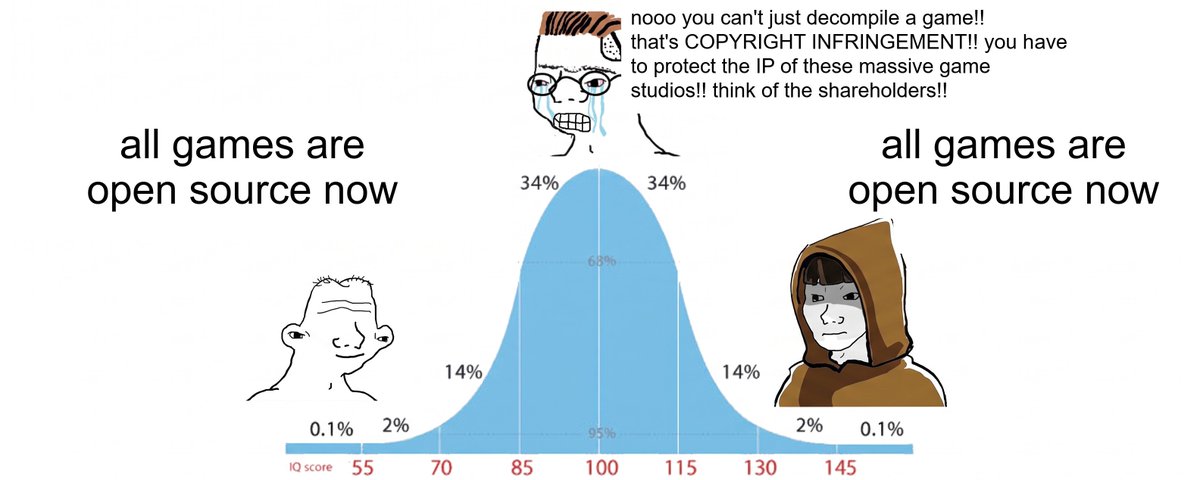
All games are open source now!
I wrote up my thoughts on what this means for the gaming industry and some predictions on where things go from here! Let me know what you think :)
manapixels retweeted

The end of software secrecy is almost upon us. The death of closed source, and the final triumph of open source.
I should have realized this a few months ago when I successfully decompiled the game of Firefighter from an ancient DOS shareware binary. My robot friend was able to tell it had been written in Borland Pascal from looking at the data layout; it gave me back very readable Pascal code with sensibly chosen function and variable names. I transpiled it to Rust and now ship it as part of my heritage games collection.
The thing is, I thought of this as a fun stunt but didn't have any confidence that the technique would scale up to large, real programs. I have since learned that people are now doing this sort of thing with entire AAA games, which are among the most complex software artifacts ever to be shipped as a binary. If they can be decompiled, anything can be.
This has implications. Massive implications. We need to think about what the world is like when, in general, there is no longer a secrecy moat around almost any software at all.
1/2
manapixels retweeted

🇨🇳🔥La actuación de la Academia de Danza de Beijing con motivo del Día Nacional fue absolutamente impresionante: el encanto divino de Dunhuang y la magnificencia de la dinastía Tang.#China
manapixels retweeted
TradingView Template -
VWAP Map + RSI Screener + Trend
Here you go.
was going to make this invite only but just making it public.
Notes in image.
2 public indicators, 1 tool and a 4 pane layout.
You don't need a million indicators this one will give you value development across various timeframes, trend & a sense of momentum as well as show you what stands out.
this has been tremendously helpful for me to use to cut out noise and look for when, where and how I want to do business.
TV template link attached in replies.

manapixels retweeted

I don't read/write code these days, I only instruct an LRM. But it's not because I think LRM code quality is perfect, or even good. And it's not because I think my instructions are always being perfectly acted upon -- I know they aren't.
The thing is: LRMs don't just write your code, they unlock new ways to control what you're doing and maintain understanding of your system, which are about as effective as reading code. You can better test your codebase, you can audit specific components, you can spin up visualizations, you can ask the LRM to red team, etc. You can do all of these things at high speed -- you couldn't before. The benefits of reading/writing code can now be achieved in new ways.
All in all, the ROI of writing code by hand is no longer looking good, not because LRMs got perfect but because they're so fast at doing things that you can develop new workflows around them, workflows that end up being more productive than the old workflows.
manapixels retweeted

Yesterday, my boys and I vibe coded a game together. They tell me what they want in their game and I prompt it into Opus 5.5 to build it.
And of course they picked "Zelda Breath of the Wild" inspired game, where they can explore an open world, do dungeon puzzles, fight mini bosses and a final boss. The twist is that the hero holds a giant paintbrush as a weapon, each color had a different attack and effect (red = fire, blue = ice, yellow = bounce, green = vines). And oh they also wanted to fly on the paintbrush.
We spent our whole saturday playing and iterating on the game. It was great fun.
I told them, the future is all about Imagination, whatever they can imagine, it will be manifested in a digital experience.
At the end of the day, the game had:
- 2 biomes (1 island and a bunch of floating islands)
- Paintbrush-based combat (4 colors representing different effects and mechanics)
- 3 dungeons with puzzles
- An undeground cave
- Unlockable flying paintbrush when you activate 4 crystals around the island
- 30+ enemies and elites
- 1 giant boss
As you can see in the gameplaye video below, its not the most polished video game but it's so satisfying to see my boys getting bewildered when whatever they asked for, the game is built before their eyes.
Of all the games I have vibe coded so far, this was the most satisfying because my boys were actively co-creating it and playing it.
This is definitely not the last game we're making together, they have already started brainstorming their next game, hint: "Peak with grappling hooks and TNTs."
You can play the game here, works only on desktop:
wildbrush.vercel.app/