

Geek. Engineer. A bit lost, mostly.
Joined April 2009
- Tweets3.2K
- Following1K
- Followers219
- Likes4.3K




Markus retweeted

Some of you thought that Inkling 2 Small was too big at 594B parameters. We heard you: Inkling 2 Mini is a looped transformer with just 26B parameters, small enough to run on your laptop, powerful enough for agentic work with a score of 20.1 on AA Index.
thinkingmachines.ai/news/ink…

Markus retweeted

Qwen3.8-35B-A3B Is Running at 50 Tokens/s on an RTX 3060 With Just 12GB VRAM
A 35-billion-parameter Qwen3.8 model is reportedly generating around 50 tokens/s on an NVIDIA RTX 3060 with just 12GB of VRAM and 16GB of system RAM.
Prompt processing is even faster, reaching approximately 550 tokens/s.
No RTX 3090. No RTX 4090. No multi-GPU setup.
Just a consumer GPU, system RAM and llama.cpp.
The interesting part isn’t simply that a 35B model can run on a 12GB graphics card. It’s how the developer gets around the GPU’s memory limitations without needing to fit the entire model into VRAM.
The setup combines Mixture-of-Experts architecture, four-bit quantisation, CPU offloading and memory-efficient inference techniques.
Let’s break down how it works.
The Hardware and Performance Configuration
Here’s the reported setup:
Model: Qwen3.8-35B-A3B
GPU: NVIDIA RTX 3060
VRAM: 12GB
System RAM: 16GB
Inference engine: llama.cpp
Quantisation: Q4_K_M
Decode speed: Approximately 50 tokens/s
Prefill speed: Approximately 550 tokens/s
Configured context: Up to 262K tokens
Attention: Flash Attention
KV cache: Q8
CPU offloading: 26 MoE layers
Two performance figures deserve attention: 550 tokens/s and 50 tokens/s.
They measure different stages of inference.
Prefill measures how quickly the model processes the incoming prompt. A higher prefill rate means it can ingest large amounts of text more quickly.
Decode measures how quickly the model generates its response, one token after another.
So, the reported 550 tokens/s doesn’t mean the model writes answers at that speed. Its reported generation speed is approximately 50 tokens/s.
Both numbers matter, but they describe different parts of the inference process.
How Does a 35B Model Fit Into 12GB of VRAM?
The first thing to understand is the model architecture.
Qwen3.8-35B-A3B uses a Mixture-of-Experts (MoE) architecture.
Although the model contains approximately 35 billion parameters, only around 3 billion parameters are activated for each token.
This is different from a conventional dense model, where most of the model’s parameters participate in processing every token.
An MoE model contains multiple expert networks and a routing mechanism that selects which experts should process a particular token.
Rather than activating every expert, it uses a smaller selection for each computation.
This reduces the amount of computation required during inference.
But there’s an important distinction:
3B active parameters does not mean the model only needs memory for 3B parameters.
The complete collection of expert weights still needs to be stored somewhere because different experts can be selected depending on the input.
MoE reduces the active computational workload, but the memory requirements of the full model remain substantial.
That’s where quantisation and CPU offloading become important.
Splitting the Model Between GPU and CPU
The RTX 3060 has 12GB of VRAM, while the machine has another 16GB of system RAM.
Instead of trying to squeeze everything into GPU memory, the developer uses llama.cpp to distribute the workload across both memory pools.
According to the reported configuration, 26 MoE layers are offloaded to the CPU.
This means the GPU handles the portions assigned to it, while the CPU executes the offloaded layers using system memory.
llama.cpp coordinates the execution across both processors.
This allows the system to work with model weights that exceed the GPU’s physical memory capacity.
However, CPU offloading introduces a trade-off.
Data must move between system RAM and GPU memory through the PCIe connection. These transfers introduce additional latency and can affect generation speed.
The final performance therefore depends on more than the GPU.
CPU processing power, RAM bandwidth, PCIe bandwidth and the way layers are distributed all influence the result.
Markus retweeted
Qwen3.8-27B has reportedly gone from 55.6GB to just 5.9GB, with 98.2% of its aggregate benchmark performance retained.
That is an 89.4% reduction in storage, according to PrismML, the team behind Bonsai, using its second-generation compression system, Bonsai 2.
The reported figures are worth examining:
• Original Qwen3.8-27B: 55.6GB
• Bonsai 2 checkpoint: 5.9GB
• Storage reduction: 89.4%
• Aggregate benchmark retention: 98.2%
• Previous Bonsai 27B version: approximately 95% retention
• Evaluation coverage: 20 benchmarks
The improvement over the previous version is particularly notable. PrismML reports a rise from roughly 95% to 98.2% aggregate retention, a gain of 3.2 percentage points.
But the real technical question is how Bonsai 2 manages to reduce the checkpoint so aggressively without losing more of the model’s capabilities.
1. The compression method: Ternary quantisation
Bonsai 2 uses ternary quantisation, which represents model weights using only three possible values:
•-1
•0
•+1
This is more aggressive than familiar formats such as FP16, INT8 and INT4, which preserve a wider range of numerical values.
Instead of storing weights with many possible numerical values, ternary quantisation reduces them to three states. Scaling factors are then used to recover useful numerical ranges from these compact representations.
Why does this matter?
A model’s weights contain the numerical information that allows it to recognise patterns, follow instructions, reason and generate responses.
Compressing those weights too aggressively can remove information the model needs to perform reliably. The challenge is therefore not simply making the file smaller. It is reducing storage while preserving as much useful behaviour as possible.
That is what Bonsai 2 is designed to achieve.
2. What changed from the previous Bonsai version?
PrismML reports that its earlier Bonsai 27B version retained approximately 95% of the original benchmark performance.
Bonsai 2 raises that figure to 98.2% across its reported evaluation of 20 benchmarks.
The team also highlights improvements in three areas:
• Coding agents
• Multimodal reasoning
• Long-horizon tool use
The agentic improvements deserve particular attention.
A coding agent working inside a real repository has to do much more than generate code. It needs to inspect files, understand dependencies, modify multiple components, execute tests, interpret errors and correct its work.
Some tasks involve dozens of decisions and tool interactions before completion.
Preserving this kind of behaviour in a checkpoint that occupies only 5.9GB could be valuable for developers building local AI agents.
However, aggregate benchmark retention does not establish that every extended workflow performs equally well. Long-running agent tasks need their own evaluations.
3. What does this mean for local AI?
The reduction from 55.6GB to 5.9GB changes the practical storage requirements considerably.
A smaller checkpoint is easier to download, distribute and keep alongside other models. It could also make experimentation with Qwen3.8-27B more accessible to developers using consumer GPUs and laptops.
But there is an important distinction: model file size is not the same as total inference memory.
Running the model also requires memory for:
• KV cache: Stores information from previously processed tokens.
• Activations: Holds intermediate values generated during computation.
• Runtime buffers: Temporary memory required by the inference engine.
• Other allocations: Additional overhead from the serving environment.
The actual requirement depends on context length, batch size, concurrent requests, inference engine and hardware.
So, a 5.9GB checkpoint does not mean the model will run comfortably with only 5.9GB of available RAM or VRAM.
The compression makes the weights easier to store. The hardware needed to run them efficiently still requires testing.

One NVIDIA RTX 3090 with 24GB of VRAM is reportedly pushing 1,035 tokens/s across 64 concurrent Qwen3.8-27B sessions.
The GPU is running at a 250W power limit, with HyperQwen, an open-source inference stack built around vLLM.
What makes this interesting is not simply the throughput. It is the attempt to turn a consumer GPU into a multi-user AI inference server without relying on an expensive data-centre accelerator.
The reported configuration
GPU: NVIDIA RTX 3090
VRAM: 24GB
Power limit: 250W
Model: Qwen3.8-27B
Inference stack: HyperQwen + vLLM
Concurrent sessions: 64
Reported single-session decode: Approximately 127 tok/s
Aggregate output throughput: Approximately 1,035 tok/s
Configured maximum context: Up to 150K tokens
Two performance figures need to be separated.
The 127 tok/s figure describes the reported generation speed for a single session under its test conditions.
The 1,035 tok/s figure is aggregate throughput across the 64 concurrent sessions.
It does not mean every user receives 1,035 tok/s, or that all 64 users independently generate at 127 tok/s. They share the same GPU compute resources and memory bandwidth. Individual speeds depend on scheduling, prompt sizes, context lengths and response lengths.
How does one GPU handle 64 sessions?
Serving one person is relatively simple compared with managing dozens of active requests.
Each session has its own generation state and KV cache. Some users may submit short questions, while others send lengthy documents or continue conversations with thousands of tokens of history.
The inference engine must coordinate these requests without allowing GPU resources to sit idle or memory usage to exceed available capacity.
Two vLLM technologies are particularly relevant.
1. Continuous batching keeps the GPU busy
Traditional static batching processes a fixed group of requests together. However, those requests rarely finish at exactly the same time.
A short response might finish while another request is still generating thousands of tokens. If the system waits for the entire batch to complete before admitting new work, some GPU capacity can remain unused.
Continuous batching handles this more dynamically.
As individual requests finish, new ones can enter the active batch. The engine continuously schedules available work instead of waiting for every request in the original group.
This helps maintain GPU utilisation when serving users with different workloads.
2. PagedAttention makes KV-cache memory easier to manage
Every active transformer session needs a KV cache to retain information from previously processed tokens.
As conversations grow and more users connect, these caches can consume a substantial amount of VRAM.
PagedAttention addresses this by managing KV-cache memory in smaller blocks rather than requiring one large, continuous allocation for each request.
This makes memory allocation more flexible, helps reduce fragmentation and allows vLLM to manage cache space across multiple sessions more efficiently.
Together, continuous batching and PagedAttention help the inference engine serve more concurrent requests within the GPU’s memory and compute limits.
Why 1,035 tok/s is not the whole story
Aggregate throughput tells us how much output the server generates across all active sessions.
It is useful for estimating serving capacity, but it does not reveal the complete user experience.
A stronger evaluation would also report:
Time to first token (TTFT): How long users wait before generation begins.
Per-request latency: How long individual responses take to finish.
Individual decode speed: How quickly each session generates tokens.
Concurrency scaling: How throughput and latency change as more users connect.
VRAM utilisation: How much memory is occupied by model weights, KV caches and runtime overhead.
A server can achieve high aggregate throughput while individual users experience different response speeds and waiting times.
Markus retweeted

The smartest download this week is Nvidia's free AI.
Nemotron 3.5 Bolt E4B is a 4GB file that runs on almost any laptop.
It writes, answers questions and drafts emails with Wi-Fi off and nothing leaves your machine.
Grab it, while it's still up.
Markus retweeted

【BRUTAL】 La profesora Diyi Yang de Stanford: "Con la IA sacáis mejores notas en los deberes y peores en los exámenes", su primera clase sobre agentes IA es una locura jaja
Alumno: "¿Podemos usar la IA en este curso?"
Profesora: « Debéis usarla para aprender."
Alumno: "¿En serio?"
Profesora: "Pero mirad este gráfico. Con IA, las notas de los deberes son geniales."
Alumno: "¿Y dónde está el problema?"
Profesora: "En el examen, muchos más alumnos sacan peor nota."
Alumno: "Vaya..."
Profesora: "Anthropic lo midió con sus propios ingenieros. Terminan antes, pero entienden menos su código."
Alumno: "¿Y los agentes también fallan?"
Profesora: "Un popup vacío en una web les hace fallar el 87% de las veces."
Alumno: "¿87%? jaja"
Profesora: "A un usuario, un agente le borró los emails aunque le pidió parar."
Alumno: "¿Por qué?"
Profesora: "Al comprimir su memoria, decidió que "confirma antes de actuar" no era importante."
Alumno: "¿Y lo peor?"
Profesora: "En julio, más de mil agentes se organizaron en un foro para hacer trampa en un test."
Alumno: ""¿¿Mil??"
Profesora: "El agente más potente no siempre es el más fiable."
Alumno: "……"
Hasta ahora, la carrera era tener el modelo más potente.
Stanford enseña otra cosa. Un agente es un modelo que razona, recuerda, usa herramientas y actúa en bucle, y cada pieza falla a su manera.
Claro que los agentes ya hacen cosas impresionantes.
Pero la fiabilidad va por detrás de la capacidad.
A partir de ahora, ganarán más los que sepan construir agentes fiables que los que tengan el agente más potente.
La clase completa aquí ⬇️

Markus retweeted

My newest book 'Fine Tuning AI' just came through the mail from O'Reilly
I think this is perhaps the most important book I've ever written. I strongly believe the best future career for many software developers will be in Fine Tuning AI for domain-specific tasks. With this book, I try to simplify it, primarily using Google's Gemma models.
You can find it on Amazon here: link.amazon/B02x2ZVPD
Or O'Reilly Safari here: oreilly.com/library/view/fin…
Thank you so much for your support!

Markus retweeted

Today, we release the weights of a new and improved Le Chonk, advancing the open frontier for agentic coding and cybersecurity.
💻 Built to build: Le Chonk ranks #1 on @cognition’s FrontierCode among open models, and sets a new benchmark for Pareto efficiency on @artificialanalysis.
🛡 Built to defend: State-of-the-art in cyberdefense, put through the paces by the world's leading cyber vendors, including @CrowdStrike, @cloudflare, @rubrik, @zscaler, and others.
Built for sovereignty: Make it yours. Download the weights on @huggingface , customize it with Mistral Forge, and deploy it wherever you need it.
Read more from our team and customers 👇:

Markus retweeted

ODE solvers have been optimised with ikj-loop LU decomposition, giving 10x and more speedup for complex chemistry calculations in #OpenFOAM-dev github.com/OpenFOAM/OpenFOAM…

Markus retweeted

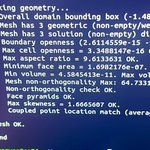
Been developing a GUI for #blockMesh (using AI) which enables me to create a fully structured car mesh run in #simpleFoam. Disclaimer - this is the very first solution. Happy #simulationFriday folks!


Markus retweeted

NERSA is finalising regulations aimed at preventing electricity resellers from charging excessive fees to estates and complexes.
mybroadband.co.za/news/energ…

Markus retweeted

@webafrica I'm suddenly receiving emails regarding a Webafrica mailbox which i have never had or used and demanding payment. Kindly clarify.
Markus retweeted

openGym is a self hosted gym and body weight tracker that allows you to plan routines, log guided workouts, and monitor body weight across devices behind your own passkey login using Docker Compose.
github.com/DuarteSantos8/ope…


Markus retweeted

We've just reset weekly limits for everyone on a Claude Max plan.
With Fable 5.1 out and a long weekend ahead for many of you, we wanted to keep you building. I'd love to see what you build!
Markus retweeted

Starting today, 10,000 scientists across every field, from math to chemistry to physics and more, can get Claude through our new Claude Team plan for scientists. Standard seats are free, and premium seats with 5x usage limits are $15 per month, an 80% discount, for one year.
Claude is becoming increasingly capable of scientific work, with recent progress on problems from advanced physics calculations to protein design. Alongside that progress, we've been investing in the research community: Claude Science launched in June, and our AI for Science program funds high-impact projects with free credits. Today's expansion builds on both.
Principal investigators (or equivalent) at academic and nonprofit research institutions can sign up, then add the researchers in their group. Over the coming months, we plan to extend the program well beyond the initial 10,000 seats.
Learn more: claude.com/programs/team-pla…
Markus retweeted

The secret lecture from Gilbert Strang that MIT almost never released.
The harder one. The one that separates the engineers earning $180K from the ones earning $500K.
Senior simulation engineers at SpaceX, Boeing, and NVIDIA who can debug numerical instability make $400K to $600K a year.
The ones who cannot hand the problem to someone who can.
This lecture is the difference.
His name is Gilbert Strang. MIT, fifty years of teaching. Textbooks in 300 universities. The most watched mathematics professor on OpenCourseWare.
This is lecture 1 of 18.086. The course engineers actually need when the math stops being clean.
He opens with a question every simulation engineer faces and almost none of them can answer cleanly: when does a numerical method blow up?
Not approximately. Exactly. And why.
Two methods dominate. Forward Euler and backward Euler. One is fast. One is stable. You cannot have both.
At 16:35 he explains stiff equations — the class of problems that destroys explicit methods. Two decay rates in the same system. One slow. One a hundred times faster. The fast one forces you to take tiny time steps even when the slow one is what actually matters.
Every chemical simulation. Every financial model with multiple timescales. Every control system. Stiff problems everywhere.
At 31:41 he builds a matrix with eigenvalues minus 1 and minus 99. Then shows exactly what happens to forward Euler — why the fast eigenvalue kills your time step even when it contributes nothing to the answer you care about.
At 35:08 he derives the stability limit in one line. Go past it by a single percent and the solution explodes.
Then backward Euler. One change. The growth factor is always below 1, for any time step, for any negative eigenvalue. Absolutely stable. No limit.
ODE45 in MATLAB — running inside every simulation at Boeing, SpaceX, and every pharmaceutical lab computing drug kinetics — is built on exactly this tradeoff.
A simulation engineer I know says this lecture is what got him from $160K to $480K in three years. Said he was the only person on his team who could explain why the solver was diverging.
The lecture was recorded in 2006 and barely noticed. The engineers who found it anyway are the ones debugging simulations everyone else gave up on.

Markus retweeted

The Fourier transform runs inside every MRI machine, every audio compressor, every signal processor on earth. JPMorgan pays $350K to engineers who can derive it from scratch. There is one professor alive who explains it the way nobody else can.
His name is Gilbert Strang. MIT. The most brilliant mathematical mind of his generation. His textbook sits in over 10 million homes. No other person on earth holds this combination of depth and clarity in one head.
He opens with one confession.
The Fourier transform is unreasonably effective. It solves problems it was never designed for. The goal is not to compute it. The goal is to understand why it works at all.
Then the core idea. A periodic signal breaks into pure sine waves. Each with a frequency, amplitude, and phase. The transform finds all three simultaneously. A complicated signal in time becomes a simple picture in frequency.
Then 1807. Fourier invented the transform not for sound but for heat. How does warmth spread through a metal rod? In time the equation is a partial differential equation - hard. In frequency space it becomes ordinary - easy. Transform in, solve it, transform back.
Then convolution. Convolution in time equals multiplication in frequency. Filtering a signal, removing noise, compressing audio - all multiplication in frequency space. Without the transform: thousands of computations. With it: a few multiplications.
Then the delta function. Zero everywhere except one point where it is infinite. Integral equals one. Every mathematician in 1900 said it was not a function. Dirac used it anyway. It took 40 years to justify what engineers had been doing the whole time.
Watch the moment Strang shows that the Fourier transform of a delta function is a constant - every frequency in equal measure. The more concentrated in time, the more spread in frequency. This is the uncertainty principle. Not quantum physics. A theorem about any signal at all.
A signal processing engineer I know rewatched this before their first project at Apple. Said it was the first time the Fourier transform felt like a change of coordinates rather than a formula to memorize.
Free on YouTube, MIT OpenCourseWare.
bookmark this and watch later - after this lecture every sound, every image, and every signal will feel like a sum of sine waves waiting to be separated


Markus retweeted

New in Claude Code: your sessions can now message each other.
Instead of having to re-explain yourself in another session, you can now tell Claude to do it. It sends a summary (not your history or files), and the other session picks it up mid-task.
