

Research on the world’s strongest companies (NFA). Join 2,000+ investors:
Groningen, Nederland
Joined August 2024
- Tweets730
- Following337
- Followers1.2K
- Likes965









Pinned Tweet
Portfolio update
This is my portfolio as of today, October 31, 2026. For the first time in over 6 months, I’ve made a transaction: I bought an additional 23 shares of $AMZN (funded with remaining cash and new capital). This has raised Amazon’s weight in my portfolio by roughly 5 percentage points, from ~26% to ~31%. As a result, it is now my second-largest holding after 3i Group ($III.L), which accounts for 39% of the portfolio.
Have you guys made any transactions in October as well? Let me know. I’m curious where you see opportunities.
This is not financial advice.


I agree. Here’s what I wrote earlier this week about Amazon and Alphabet, and why I decided to increase my already ~26% weighting in Amazon by an additional ~5 percentage points.
My decision to ultimately choose Amazon, and to make its already sizable position even larger, comes down to the following considerations:
1) While I would (very) much like to increase my exposure to YouTube, GCP, and the AI/DeepMind initiatives of Alphabet at the right price, I expect the value capture of Google’s traditional search engine to weaken going forward. Search still makes up a large part of the overall Alphabet package, whose market value has recently risen to $4T.
2) In Amazon, I see a company that, beyond AWS, can also seize opportunities in other areas, including e-commerce and retail. I expect the direct relationship with the end consumer to become increasingly valuable, while the value of digital intermediaries without physical operations, such as Google Search and OTAs like Booking, will start to weaken.
3) In its e-commerce and retail operations, Amazon can apply AI through physical AI hardware (robotics) to widen its moat in these areas even further.
4) Amazon Ads could potentially be affected by AI agents, but I expect a large share of consumers to keep choosing Amazon (at least in part), provided Amazon continues to price its products mostly below the competition. These competitors typically face higher production, service, distribution, and/or logistics costs, and they lack a broad loyalty program like Amazon Prime. Further automation across Amazon’s value chain can help widen this gap with smaller players even more.
5) Weighing all of the above against valuation (a market cap of $4T for Alphabet vs. $2.7T for Amazon), I chose Amazon.
That said, I realize AI carries significant risks. These could materialize as future operating cash flows from today’s investments falling short of expectations. There are also risks specific to the data center layer, including a possible future in which the supply of data center capacity exceeds demand.
In that scenario, I expect the largest and most cost-efficient hyperscalers to still operate these businesses profitably, partly because I expect contracts to be locked in for longer periods. Customers of this capacity have an incentive to pay a premium for security of supply, especially if a capacity surplus proves only temporary, emerging after a prolonged period of scarcity, within the long runway of innovation AI may still have ahead of it.
Given the current dynamics and the rapid improvement in AI quality, I expect today’s data center capacity shortages to persist for at least the next ten years, provided AI keeps advancing and gets built into nearly every product and service, directly or indirectly.
I expanded my Amazon position knowing I can always switch to Alphabet later, for example if its valuation becomes more attractive relative to Amazon’s as a way to buy into YouTube, GCP, and the AI/DeepMind initiatives.
I have to say Anthropic’s $ANT S-1 has made me more positive about the company, at least in the near term. This is largely because $ANT’s cash position came in higher than many had projected. As of June 30, the company held $131,651M in cash, cash equivalents, and short-term investments. Cumulative operating cash flow, a good proxy for cash burn, of negative $9,956M over 2023–2025 was also considerably better than expected. With only $148M in CapEx, that puts free cash flow at negative $10,104M over the three-year period. In H1 2026, $ANT generated positive FCF of $3,447M.
(The OCF and FCF figures above exclude SBC. My focus here is on Anthropic’s liquidity and its ability to meet its financial obligations.)
As a result, I’ve also become more optimistic about the odds of a successful IPO, and with it $ANT's ability to raise additional capital in the short to medium term. That, in turn, increases the perceived value of $ANT's long-term commitments to companies such as $AMZN and $GOOGL. It also improves the odds that $ANT can sustain value-creating growth over the short to medium term, which could support its valuation over that horizon and, by extension, the stakes $AMZN and $GOOGL hold in the company. Therefore, I believe the potential set of value drivers in the overall investment case for both $AMZN and $GOOGL has improved as well.
If these variables and dynamics hold over the short to medium term, they could also be reflected in how the market values these companies, serving as an additional catalyst for the IRR of $AMZN and $GOOGL over the next, let’s say, 1–3 years.
Disclaimer: This is not financial advice. I hold a long position in both Amazon and Alphabet.

I just listened to the $AMZN earnings call. The path I envision for Amazon Web Services (AWS) is steadily materializing. In this note, I share a few thoughts specifically on AWS.
Earlier this year, I wrote that I expect orchestration platforms such as AWS Bedrock to become increasingly important as companies operate across multiple models, and have the incentive to position themselves on the Pareto frontier between quality and cost efficiency (see also the AI update in the July Investment Letter, chapter 6, points [9] and [10]).
AWS is also increasingly benefiting from AI-driven demand for the company’s original core: compute and storage. As AI development shifts toward stateful and agentic AI, the computing power it requires leans more and more heavily on these core services. AI is also generating more and more data, and all of it has to be stored somewhere. As a result, data is becoming increasingly “active” too, and, therefore, customers want to run their inference workloads close to these datasets to avoid latency costs. This is known as “data gravity”. I expect data will increasingly pull compute and applications toward it, which strengthens the position of AWS further.
Beyond rising operating income from its core, $AMZN is also seeing operating margins expand on the AI side, and that curve is steeper than the one the core business followed in the past. This is happening even as underlying costs for components such as memory have risen, along with depreciation from the company’s massive CapEx investments.
The growing demand for compute is also visible in the figures $AMZN shared on Bedrock: Fortune 500 companies are spending nearly 7x more through Bedrock than a year ago, while total token volume grew nearly 17x year over year. According to $AMZN, this makes Bedrock the fastest-growing multi-billion-dollar service in AWS’s history.
Bedrock acts as a facilitator at the orchestration layer. Its lineup of models keeps growing and now includes models from OpenAI, Kimi, GLM, and SpaceX, so customers have more and more ways to get the most out of AI. I expect this to become a key strategic position as AI matures. Companies will streamline their business processes and want to deploy AI models effectively across the quality–cost spectrum on the Pareto frontier. Partly for this reason, I expect value capture to shift over time, at least in part, from the model layer to the data center layer.
According to $AMZN, its chip business is growing at triple-digit rates year over year. For reference: with the Q2'26 results, Jassy said this business’s annual revenue run rate had surpassed $25 billion (and was also growing at triple digits). Revenue commitments for Graviton and Trainium have each increased more than 20x year over year.
$AMZN expects 2026 CapEx of approximately $220B. For 2027, the company expects to invest “meaningfully more” than that.
$AMZN’s management expects AWS to grow more than 40% in both 2027 and 2028, and believes AWS could become a business generating more than $1T in annual revenue within the next 5–10 years.
Over the past four quarters (Q4'25–Q3'26), AWS generated $161 billion in revenue on a TTM basis. If revenue grows 40% in Q4'26, 2027, and 2028, that would mean annual revenue of at least $175B in 2026, $246B in 2027, and $344B in 2028.
From there, reaching $1T in revenue by 2036 would require a 14.3% CAGR between 2028 and 2036. Reaching $1T by 2031 would require a 42.7% CAGR between 2028 and 2031.
Ultimately, it all comes down to how AI develops over the coming years. Suppose AI keeps advancing as strongly as it has recently, unlocking more use cases and more value creation (along with shifts in value creation between companies). In that case, the shortage of data center capacity will likely persist until at least the early 2030s. AWS would then see 1) strong pricing power and 2) strong margins. In addition, 3) the runway for reinvesting operating cash flow would be longer, with 4) a higher expected ROI. In other words, the path AI takes will determine much of the scope of AWS’s absolute value creation.
Based on current developments in AI, I think there’s a real chance AWS will cross the $1T annual revenue mark sometime between 2033 and 2036.
Many of my catalysts for $AMZN relate to AWS. I believe AI will keep advancing and drive sustained, strong demand for the products and services AWS provides. That’s why I see a very promising future for both AWS and Amazon.
These are just a few quick notes on the Q3'26 results and how I see value creation within AWS unfolding. I’ll share more of my thoughts on both AWS and Amazon in a full Q3'26 earnings review later.
Disclaimer: I hold a long position in Amazon. This is not financial advice.
I believe $AMZN presents a highly attractive investment opportunity at its current price of $225 per share, given the company’s strong prospects in the decades to come. I am not selling today.
This is not financial advice.
Yesterday, the In Good Company podcast published a great episode in which Nicolai Tangen (CEO of Norges Bank Investment Management) interviews Bill Ackman about the structural benefits of permanent capital, what he sees as investor’s biggest edge and his perspective on the foundation of strong investment ideas. Some insights:
1) According to Ackman, great businesses are those you can expect, with a very high degree of certainty, to be worth more in ten or twenty years, regardless of whether the stock market stays open. These are highly predictable, strong capital generating businesses (proxy: FCF growth), and are protected by an underlying moat. They also have little exposure to unpredictable external factors, such as commodities, regulation, or interest rates.
2) There are roughly 200 to 300 “really great businesses,” but it’s rare for one of them to become available at a price that also makes it a great investment, according to Ackman. That’s why he runs a concentrated portfolio.
3) Why do so few investors follow this approach, the playbook of superinvestors like Warren Buffett, Charlie Munger, Chris Hohn, and Bill Ackman? Ackman points to a couple of reasons: A) many investors want to get rich quickly and/or lack a long-term perspective; B) most of the capital in the asset management industry is inherently short-term and can be withdrawn quickly, so many fund managers avoid thinking long-term out of concern for how their clients will judge them; and C) many hedge funds focus on the very short term and use leverage, which leaves them unable to tolerate a high degree of volatility. That’s why permanent capital and independence are essential in pursuing this unconventional strategy (“time arbitrage [...] the ability to be a long term investor in a short term world”).
4) These same forces also make price swings more extreme nowadays. The rise of indexation also plays a role here: it shrinks the effective float, which has turned what were historically 3–4% price moves into moves of 30–40% today. Ackman sees major opportunities in this for the long-term oriented investor.
5) Ackman also sees AI creating major opportunities, as well as major threats: “I would say every business today is either AI related, or should be, or is going to be disrupted by AI. So I think that is the assessment that you’ll have to do.”
6) Last but not least, Ackman shares advice on the personal side of becoming a better investor and thinker: try to avoid alcohol and sugar, start exercising, and be deliberate about the people you surround yourself with and the role models you choose. In his view, you learn the most from the people closest to you, so make sure they’re people who move you forward and inspire you to get the most out of life.
Watch the full In Good Company interview here: youtube.com/watch?v=T8nHLUlR…

At the 1997 Berkshire Hathaway $BRK.B Annual Meeting, a shareholder asked Warren Buffett and Charlie Munger how they determine a company’s intrinsic value and which metrics and filters they use at Berkshire to arrive at that number. Their response is included in the pages below.
Along the way, they also discuss their pursuit of perfection in selecting businesses and how that approach naturally leads to a concentrated portfolio. In my view, this is one of the most valuable exchanges in Berkshire’s history.


The best series ever made.
“Der Mensch kann tun, was er will, aber er kann nicht wollen, was er will.”

This week’s episode of Dark Matter was once again really good and complements the other recent episodes of this season, especially E5 and E8, which were also very strong in my view. Congrats to the production team at @SonyPictures / @AppleTV

The Hermès thesis has turned into a perfect storm, with the stock down 42% year-to-date. Since Valentine’s Day 2025, the share price of Hermès International Société en commandite par actions has fallen from €2,957 to €1,239 as of today.
Getting back to its former all-time high would now mean a return of +139%. Right now, that level feels like a fading memory from a romantic night in Paris. Several developments are weighing on this negative sentiment. For one, revenue growth in regions like Asia-Pacific has softened in recent quarters (constant exchange rates):
- Q1'26: +2.2%
- Q2'26: +2.5%
- Q3'26: +0.0%
The French company’s total revenue growth over the past three quarters has been (constant exchange rates):
- Q1'26: +5.6%
- Q2'26: +6.7%
- Q3'26: +4.3%
Besides slowing sales growth in Asia-Pacific, recent developments in France are likely to play a role as well. In summary, Hermès is caught in a perfect storm.
The big question is whether and when Hermès can return to double-digit revenue growth and regain full strength. The company currently trades at 28x trailing twelve-month earnings, which is relatively low compared to its recent history. If Hermès reignites its growth engines, that multiple could rebound. However, if the current negative forces continue and intensify, the multiple could compress even further.
The key question we have to ask ourselves as investors is whether Hermès ranks among our best ideas. Accounting for opportunity cost is essential here: each dollar invested in Hermès is a dollar that could be deployed in a more attractive opportunity.
How do you guys view the future of Hermès? Is it among your top ideas? Why (not)? $RMS.PA

Andy Jassy, CEO of Amazon $AMZN, on the incredible demand for compute and the company’s $220B infrastructure investment:

The third season of Netflix’s The Gentlemen (IMDb: 8.1/10) is now in production $NFLX
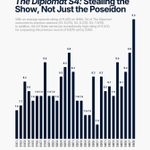
The cast is stealing the show in The Diplomat’s new season, not just the Poseidon.
$NFLX

I just published a new investment letter, including an overview of my current portfolio, my thoughts on three core themes for building a sound portfolio strategy, and why I favor a concentrated portfolio over a diversified one.
massivemoats.substack.com/p/…


This episode has video on Netflix.
An exclusive deal between two of my favorite companies @AcquiredFM & @netflix 🤝


Some thoughts on Hermès $RMS.PA.
If France’s current trajectory continues to deteriorate over the coming years, what could that mean for French companies like Hermès? Beyond the risk of higher taxing on successful companies, could political instability and social unrest gradually change how consumers worldwide perceive “Made in France”-brands like Hermès, as they do not want to be associated with France its decline?
Hermès’ French origins sit at the center of its brand identity and anchor its IP moat: Parisian elegance, craftsmanship, and heritage. So what happens if France continues to loses its prestige?
Can Hermès transcend its national context and stay insulated from a weaker image of its home country? Or would the brand’s status slowly erode as the nation loses its allure and, perhaps, even its culture?

I believe the market currently overestimates the value capture at the model layer and underestimates the value capture at the data center layer.
Jensen Huang (CEO of NVIDIA $NVDA) on why future AI usage will take a lot more inference than the LLMs we know today:
