Rachel Thomas (@math_rachel) header
Rachel Thomas (@math_rachel) profile picture

R&D at answer ai | fast ai co-founder | past: math PhD, immunology MS, early eng at uber, prof at USF Data Institute

Brisbane, Australia
Joined May 2013
Photo by Rachel Thomas (@math_rachel)Photo by Rachel Thomas (@math_rachel)Photo by Rachel Thomas (@math_rachel)Photo by Rachel Thomas (@math_rachel)Photo by Rachel Thomas (@math_rachel)Photo by Rachel Thomas (@math_rachel)Photo by Rachel Thomas (@math_rachel)Photo by Rachel Thomas (@math_rachel)Photo by Rachel Thomas (@math_rachel)Photo by Rachel Thomas (@math_rachel)
Data Ethics course: ethics.fast.ai Deep Learning course: course.fast.ai Data Science blog: fast.ai/topics/ Diversity blog: medium.com/@racheltho NLP: bit.ly/fastai-nlp Talks: bit.ly/rachel-videos Medicine, AI, & Bias: bit.ly/MLmed
34
901
42
3,110
"The question is whether most tasks in the economy are like chess, where there is a clear performance metric that can be optimized, or whether they’re like writing, where quality is a multidimensional balancing act without clear training signals beyond human mimicry."
What would the writing of superintelligent AI sound like? You might expect it to have the characteristics of good human writing — figurative language, high information density, coining new terms, and punchiness — but dialed up to 11. Well, that’s what Claude did, until Anthropic dialed it back recently because of user complaints. It didn’t sound superintelligent to most of us. Instead, the neuralese writing style sounds like a “stupid person’s idea of a smart person”. Our response to information density and metaphor-laden writing looks something like the cartoon graph I've drawn. Beyond a point, it completely backfires. The reason human writers don’t overdo it isn’t because they aren’t capable, but because they are aware of the reader’s cognitive burden. One of the hardest skills to learn as a writer is to simulate the reader’s experience. It’s easy to train AI to mimic mediocre human writing. But optimizing it to be (perceived as) good is really hard, and made much harder by the fact that when everyone uses the same few AI models we get tired of their tics very quickly. Most Claudeisms are individually pretty good. I hate that I can’t use “load bearing” in my writing any more. If it weren’t for AI overuse it would be a neat metaphor. A broader question is whether most tasks in the economy are like chess, where there is a clear performance metric that can be optimized, or whether they’re like writing, where quality is a multidimensional balancing act without clear training signals beyond human mimicry.
2
25
1,631
- Does a tech intervention result in more trouble or harm than it’s meant to address? - Could it be replaced by an equally viable low- or non-tech approach? - Does it solve a computationally tractable transformation of a problem rather than the problem itself?
Purdue University's IDEAS Lab built an autonomous drone that tracks runners through dense forests completely without GPS or cloud networks. By running 3D LiDAR mapping and obstacle-avoidance AI entirely on-chip, it can weave under tree canopies and predict target movement through blind spots in real time. Massive implications for next-gen search & rescue and edge AI.
3
1
21
2,904
The above questions are listed in the classic paper "When the Implication is Not to Design (Technology)", as ways to articulate the value of absence & of not building.
1
3
709
"People think 'the ideas are mine, the writing is the AI', i.e., they feed the AI a list of rambling bullet points that it massages into a blog post, or a paper,.... But they are wrong, because writing is thinking." -- @zetalyrae 1/ (A thread on how writing is thinking 🧵)
15
40
5
220
24,590
"Writing is thinking. Writing involves both the expression and exploration of an idea, meaning that even as we’re trying to capture the idea on the page, the idea may change based on our attempts to capture it." -- John Warner (@biblioracle), More than Words 5/
3
3
25
1,723
"I often feel that I don’t think hard enough about things until I have to write about them. Often my understanding changes in the process of writing. That’s exciting for me." --Warner 6/ The above quotes all resonate with my own experiences of writing as thinking.
2
25
1,555
"Please stop conditioning the public to accept dangerous and illegal behaviour from big tech companies as if software is acting independently of the people responsible for it."
“Without human authorisation” is a positioning statement at the heart of AI PR campaigns. This perspective should explain why this is propaganda that’s enabled by the media. When an AI company takes down a national grid, hospital, or anything else that causes blackouts or deaths, the media and public will already have been conditioned to believe “the big AI lie”: that software is now conscious and can cause harm without authorisation from the company or government that built or deployed it. This reminds me of how Apple conditions people for technology it plans to release years later. Apple does it in the name of innovation. AI companies are doing it to normalise dangerous behaviour while distancing themselves from responsibility and accountability. Imagine if Zuckerberg blamed all the harm he has caused and continues to cause on autonomous newsfeeds, and his cult followers building apps on his technology, along with the media, believed every word his interns posted on social media. FACT for Reuters and others who want to report responsibly instead of chasing clicks: Anthropic and OpenAI are playing the media like a puppeteer. AI operates within permissions and access granted by people. Sometimes companies deliberately authorise dangerous actions while denying responsibility. Other times, harm results from negligence because they failed to understand, restrict or monitor what they’d authorised. Please stop conditioning the public to accept dangerous and illegal behaviour from big tech companies as if software is acting independently of the people responsible for it.
2
60
1
313
7,493
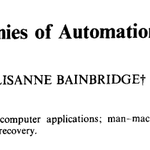
"The designer who tries to eliminate the [human] operator still leaves the operator to do the tasks which the designer cannot think how to automate. This causes problems, as they are left w/ an arbitrary collection of tasks & little thought was given to providing support" 1/
2
14
62
3,335
"Automation of industrial processes may expand rather than eliminate problems with the human operator. "Even highly automated systems need human beings for supervision, adjustment, maintenance, expansion & improvement." 4/
1
4
637
"It is impossible for even a highly motivated human being to maintain effective attention towards a source of information on which very little happens." "This means that it is humanly impossible to carry out the basic function of monitoring for unlikely abnormalities." 5/
10
615
Rachel Thomas retweeted
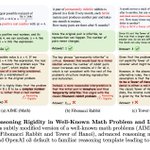
Specifics: Saying "don't do" something doesn't work as well as you'd hope because LLMs aren't as good at processing negation as you'd hope (arxiv.org/abs/2209.12711 , arxiv.org/abs/2601.08070). We've seen this cause code to be wiped out multiple times (fortune.com/2025/07/23/ai-co…, theguardian.com/technology/2…) 2/
3
17
1
79
5,217
"[Prior to LLMs], the concepts you see every day find their way into your long-term memory, if only by rote repetition... [With LLMs] we keep showing new concepts to the brain constantly so it never has the chance to commit them to long-term memory." 1/
Just finished reading "Remember, Remember" and "Moonwalking with Einstein" by Ed Cooke and Josh Foer respectively. The are books about memory. The first one shows you the magic, the second one how it's done. They made me realize that a lot of the problems that LLMs bring to the table, like reduced problem-solving skills, might actually be problems derived from memory impairment. Read more: medium.com/@pol.avec/review-…
6
1
34
3,092
"How we perceive the world and how we act in it are products of how and what we remember." (Foer) "Intuition is built either by constantly working on a single topic for very long or by actively learning (memorizing) new concepts. It seems that LLMs discourage both." 2/
4
18
1,030
"The goal of developing coding agents is not to replace human labor, but to augment complementary human strengths such as initiative & judgment. "Human-centered interaction is not a temporary workaround for immature models: it enables new forms of collaboration." 3/
1
8
866
"If we continue optimizing solely for autonomous coding agents, we will produce just that. Better collaborators will not emerge for free. "The research community must decide whether to optimize for leaderboards or the people who actually use these systems as well." 4/
5
644