

VP for Policy Design @americans4ri | Tech & National Security | IR & Foreign Policy | American Politics | All Things Midwestern | Opinions Mine
Arlington, VA
Joined April 2018
- Tweets1.7K
- Following316
- Followers599
- Likes26.1K







Morgan Plummer retweeted

Of course they will. But, as my wife likes to say, the ax forgets while the tree remembers.

NEW: Right after Tuesday's midterms, OpenAIwill unleash a policy and PR blitz to try to get in sync with the new Washington, including an effort to rebrand data centers as "AI compute campuses." axios.com/2026/11/01/scoop-o…

Morgan Plummer retweeted

Agree with Boaz and wanted to expand on a couple points.
@Slatestarcodex's SURA essay has many good points and i'm glad he wrote it, but I didn't like how much it sometimes conflates the idea that companies should totally stop AI development unilaterally with the idea that companies should exercise more unilateral restraint that might slow them down/hurt their relative position to help us collectively get to a better equilibrium. (and that they should be investing far more resources on solving the collective action problem through e.g. support for policies that could actually effectively restrain them and their competitors).
I worry that people arguing against ~any costly unilateral constraint at safety motivated companies will cite this essay as supporting their views even if that isn't Scott's intent.
To put it another way - there is a difference between saying a country should get rid of all their nukes unilaterally vs whether they should accelerate development of larger hydrogen bombs and hypersonic missiles and not really particularly prioritize even setting up multilateral nonproliferation talks.
As a bottom line: I think that there are situations where continuing to race to plausibly catastrophic results is defensible for the sorts of reasons Scott lays out, but the bar towards this being the strategy should be extremely high and rely on making clear to everyone around you that you would love to accept an offramp to get away from the current cursed equillibrium. The bar is even higher if you are not just trying to remain competitive in the race to have a seat at the table in future negotations, but actively pushing the limits and accelerating in particular the kinds of development you believe to be most dangerous.
(Of course, one reason among many why this strategy is so questionable both morally and pragmatically, is that it is so incredibly unintuitive to external observers that it will lead them to doubt your claims about the relevant risks.)

Quick comment on Scott Alexander's SURA essay.
I agree with several parts of it, but there is a huge spectrum between "stop unilaterally" and "race to RSI at maximum speed, then try to solve alignment with right-on-the-brink-of-superintelligence AIs."
It also seems to imagine that the release of the aligned super intelligence is basically the end of history, and is very unclear on what happens after this "last possible moment." Section IV is not very reassuring.


Morgan Plummer retweeted

AI is giving the government unprecedented power to monitor speech online.
In a new Policy Byte, @AllieMaloney1 proposes a clear red line: prohibit the use of AI tools that scan and score Americans’ views for law enforcement surveillance.
Read more: ari.us/policy-bytes/stop-the…

Morgan Plummer retweeted

If just a few lab staff took on verification work full-time, verifying a US-China pacing deal could get much more feasible within months.
Here are 8 specific things lab staff could start on today to help make international verification possible: 🧵
Morgan Plummer retweeted
We're hiring!
ARI is looking for three talented people to join our team.
If you're passionate about shaping the future of AI policy and ensuring this technology works for the public interest, we want to hear from you.
Check out open roles and apply: ari.us/careers/

Morgan Plummer retweeted
One mistake about politics, in my opinion, that I see people make on Twitter is the assertion that, yes, people don't like AI, but they're not yet voting on it (seeing that it is not something that a majority of people say is driving them to vote, or it's not un the top five or even ten issues for them). This misunderstands how politics works.
Questions like abortion, gun rights, LGBTQ, and many other cultural issues have never been in the top five for many voters. It's simply a question of whether there are any single-issue voters, especially people you can poach from the other party, who would vote your way on these questions. That's why positions like anti-gun control and pro-life, which rarely command a majority viewpoint, are adopted by lots of politicians. It's about stitching together intense voters, even if they're a small fraction of the electorate.
When it comes to AI, even 3% or 5% of the electorate who vote on the question of AI is vital to your coalition and could be outcome determinative. To the extent those voters are people who are switching to your party from their traditional home, they can really make the margin of difference. AI will probably never be an issue where more than 50% say it's why they're going to the polls. It doesn't have to be for it to be extremely powerful.
Morgan Plummer retweeted
NEW from ARI: As AI increasingly helps build the next generation of AI, Washington needs an early warning system.
Our new proposal would create an office at Commerce to track whether AI development is outpacing human oversight and safety testing.
ari.us/policy-bytes/keeping-…

Morgan Plummer retweeted
TODAY: ARI is urging the White House to endorse the Chip Security Act.
By pairing U.S.-China AI talks with stronger chip security, the U.S. can reduce shared risks while strengthening the foundations of American AI leadership.
@thehill has the story:
thehill.com/newsletters/tech…

Morgan Plummer retweeted

I wrote about my love for the film Master and Commander, in honour of Trafalgar Day this week spectator.com/article/in-pra…

One of my favorite authors once wrote, “life is made of ever so many partings welded together..”. As I get older, I’d hoped that they would eventually get easier, but I’ve generally found the opposite to be true. Today, we said goodbye to our family dog, Sonoma. This parting will be a rough one; I’ll miss her like hell. She was a great dog, and we were lucky to have her in our lives as long as we did.

Morgan Plummer retweeted

I feel like one service I can provide is trying to help sort through what feels like a big deal and what doesn't feel like a big deal, to try to help make sense of it all and not just make it feel like the sky is falling.
This one feels really overrated to me.
My understanding is these were user-authorized agents doing mostly-user-authorized things (think like asking Grok Bot check your bank balance), but they weren't *bank-authorized* and the banks seem kinda unprepared for this being possible.
No hacking of banks by AIs occurred here. No AIs went rogue while using bank web apps as far as we know.

SCOOP: Major U.S. banks are detecting unauthorized third-party AI agents inside customer accounts, including some attempting to take actions that appear to be independent of user instructions, sources told Axios.
The findings have alarmed banking executives, who are racing to restrict access to their systems as AI moves at a velocity faster than financial institutions can respond, multiple industry and bank executives told Axios.
Several banks are now preparing for worst-case and even “day after” scenarios, including how to rapidly secure or restore customer accounts if things go wrong, the people said.
Several bank executives told Axios they're struggling to distinguish between human users and AI agents. One executive said banks also struggle to determine whether agents are authorized by customers or potentially operating without their permission, more akin to rogue agent behavior.
Read my latest for Axios here: axios.com/2026/10/22/ai-agen…

Morgan Plummer retweeted

It's time for identity verification for AI Agents.
SCOOP: Major U.S. banks are detecting unauthorized third-party AI agents inside customer accounts, including some attempting to take actions that appear to be independent of user instructions, sources told Axios.
The findings have alarmed banking executives, who are racing to restrict access to their systems as AI moves at a velocity faster than financial institutions can respond, multiple industry and bank executives told Axios.
Several banks are now preparing for worst-case and even “day after” scenarios, including how to rapidly secure or restore customer accounts if things go wrong, the people said.
Several bank executives told Axios they're struggling to distinguish between human users and AI agents. One executive said banks also struggle to determine whether agents are authorized by customers or potentially operating without their permission, more akin to rogue agent behavior.
Read my latest for Axios here: axios.com/2026/10/22/ai-agen…
Morgan Plummer retweeted
Legit a major problem, can attest. The left needs to take AI seriously. If it's all just a "hustle," the left will be caught unprepared for the defining political challenge of our time. It will a world-historical error.


Morgan Plummer retweeted
I would say rush to this article, which I'm doing now. Anything by Stephen Biddle is certain to be one of the most trenchant pieces of military thinking you'll ever read.

No modern conflict has ended by destroying the enemy’s ability to resist—not even World War II. To end a war, both sides must choose to stop fighting, and those choices always require nontrivial bargaining. Misunderstanding the relationship between bargaining and fighting produces systematic failures to integrate negotiating strategy with campaign planning, from Afghanistan to Ukraine to the US war with Iran.
New piece in @ForeignAffairs with Stephen Biddle and Yuri Zhukov on the myth of military victory.

Morgan Plummer retweeted
“We have democratic institutions in this country that are specifically designed to protect the public, and it is the job of those institutions to help set those standards.”
ARI’s @mcplummer1789 on @WGCU on why AI’s safety standards can’t be left to developers alone. 📺
Morgan Plummer retweeted
Interesting and well-done post by the @forethought_org that is a real contribution to the debate on autonomous weapons.
newsletter.forethought.org/p…

Morgan Plummer retweeted
When companies define safety on their own terms, they can change their definition at will.
ARI’s blueprint for federal AI governance pairs binding safety standards with government-backed assurance and real visibility into the automation of AI research.
ari.us/research/responsible-…

Morgan Plummer retweeted

Little tidbit tucked into my latest—Moran told me he’s taking a look at that bill Beyer and Jacobs floated at The Curve 👀 transformernews.ai/p/nathani…
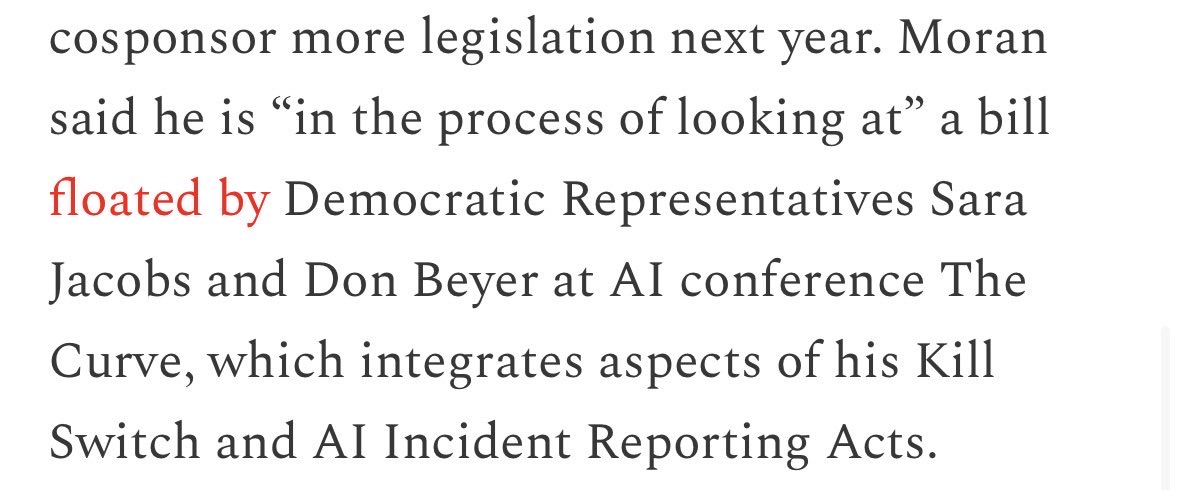

The new fellow being hired by @RepNateMoran looks set to be the only staffer recruited directly by a member of Congress to focus exclusively on AI
Will more follow? Story by @vronirwin
transformernews.ai/p/nathani…

Morgan Plummer retweeted
When it comes to to AI safety standards, the government - not AI companies - should write the rules.
Anthropic's proposal for federal legislation has some strong points, but it doesn't deliver the guardrails necessary to keep the public safe.
ari.us/ari-statement-on-anth…
