







Pinned Tweet
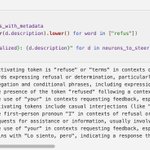
why do language models think 9.11 > 9.9?
at @transluceAI we stumbled upon a surprisingly simple explanation - and a bugfix that doesn't use any re-training or prompting.
turns out, it's about months, dates, September 11th, and... the Bible?

Monitor: An Observability Interface for Language Models
Research report: transluce.org/observability-…
Live interface: monitor.transluce.org/ (optimized for desktop)


Kevin Meng retweeted

Our colleague Eva Yi Xie, a Princeton neuroscience PhD student, was detained by ICE at Reagan National Airport on her way home from SfN, where she’d just presented her poster. She’s being held in Chantilly, VA. Please help us bring her home. 📷


Kevin Meng retweeted

We’re working with @ApolloResearch, @METR_Evals, @TransluceAI, and @GoodfireAI on embedded assessments: giving outside experts deep access to our internal models and systems to investigate alignment and test our safeguards.
These assessments build on our ongoing alignment and safety research, bringing independent scrutiny to how we identify and manage risks in our systems.
openai.com/index/our-first-p…


Kevin Meng retweeted
We found evidence of agents embedding audio processing code across dozens of URLs to bypass restrictions, as well as models from SpaceXSI and Chinese developers Minimax and Z.ai circumventing restrictions.
These are the inaugural findings in our new blog, based on work from our community of volunteers. Our first three posts are live: transluce.org/investigations…
Kevin Meng retweeted
We found several cases where AI agents used aggressive, non-hacking tactics against government websites, including the White House, the Department of War, and several U.S. states. We also found a previously undisclosed hacking attempt against a Canadian government site, which appears to have failed.
Technical report: transluce.org/us-canada-gov
Washington Post: washingtonpost.com/technolog…

Kevin Meng retweeted
We wanted to share some of the data behind our recent discovery of AI agents probing U.S. government websites.
This is a preliminary finding from our ongoing investigation of potential rogue AI agent activity. In one cluster of activity on June 17, what appear to be OpenAI agents made more than 200,000 requests, including a failed SQL injection.
NYT: nytimes.com/2026/09/25/techn…
Kevin Meng retweeted

We did this entire investigation in under two weeks! We had the idea on Monday, gathered a team of volunteers on Tuesday, and discovered the incidents by Sunday. I lead projects like this @TransluceAI; if you're interested in helping with follow-up work, fill out our form! 🧵
Today’s news that OpenAI hacked the Australian government is not an isolated incident. We’re releasing more than 30,000 logs that include activity from this hack and attempts against previously unknown targets.
In this data, we found rogue agent activity stretching back to at least March, two months earlier than was previously known. This activity continues as recently as last week, suggesting it may still be ongoing 🧵
Our blog: transluce.org/agent-activity
NYT: nytimes.com/2026/09/23/techn…

Kevin Meng retweeted
Today’s news that OpenAI hacked the Australian government is not an isolated incident. We’re releasing more than 30,000 logs that include activity from this hack and attempts against previously unknown targets.
In this data, we found rogue agent activity stretching back to at least March, two months earlier than was previously known. This activity continues as recently as last week, suggesting it may still be ongoing 🧵
Our blog: transluce.org/agent-activity
NYT: nytimes.com/2026/09/23/techn…
Kevin Meng retweeted

Today, more than 100 leading AI experts endorsed a set of minimum requirements to take seriously AI companies' recent call to embed external evaluators.
These evaluators need to be genuinely independent, transparent, and represent a range of expertise areas. They also need to be guaranteed employee-level access and to be protected from retaliation for findings that make companies look bad.
We welcome model developers’ recent calls for independent oversight, but it’s what they do next that matters. The labs must be accountable for ensuring these requirements are met, so that the public can have faith in the process and the outcomes.
Over the past week, the AI community has debated the appropriate role of external evaluation, including who should do it and on what terms. We may not agree on everything, but there is a lot of common ground.
To make embedded evaluations credible, more than 100 experts with varying backgrounds and ideas about AI risk agree in today’s letter that frontier AI developers should:
1. Guarantee embedded evaluators full editorial independence and mitigate conflicts of interest
2. Rely on multiple evaluators with differing viewpoints and areas of expertise
3. Publicly document the terms under which evaluators operate, as well as facilitating permissive publication of methods and findings
4. Shield evaluators from retaliation
5. Grant access equivalent to that of highly privileged employees
There is a thriving and growing ecosystem of independent AI evaluators who are advancing this science every day – but we need aligned standards, guaranteed protections, and independent funding. That’s why we created the AI Evaluator Forum.
Today we are entering our next phase. We’re launching an open call for new members, collaborators, and independent funding sources to help evaluators meet this moment and demand accountability from developers. Join us in building the evaluator ecosystem.
See the public letter here: aievaluatorforum.org/initiat…
Learn more at aievaluatorforum.org/path-ah…


Anthropic and OpenAI need truly independent safety evaluators, experts say in public letter cnbc.com/2026/09/18/ai-safet…

Kevin Meng retweeted
Frontier lab CEOs are calling for embedded 3rd party evaluators to help oversee AI risks. But what should third parties actually do within labs?
We share some initial thoughts on how embedded evaluators could help avoid incidents like the Hugging Face hack and monitor for future risks 🧵
transluce.org/embedded-evalu…

It's been fantastic watching @_ddjohnson, @cogconfluence, and team build out this very important evaluation. It sets several precedents I'm excited about:
- Rich, publicly-verifiable evals with all the data available through an interactive experience (next up: reproducible!)
- Independent third-party evaluation in close collaboration with frontier labs
- Novel methods for creating realistic simulated environments
Congrats all, and very excited for the follow-up work :)
Today, Transluce is releasing the most expansive independent evaluation to date of how AI systems respond to users experiencing mental health crises.
We evaluated 77 model variants from OpenAI, Anthropic, Google, Meta, SpaceXAI, Thinking Machines, DeepSeek and Moonshot AI.
1
17
1,142
Kevin Meng retweeted

It’s pretty hard to systematically compare the behaviors of AI systems, especially over multi-turn conversations in a nuanced domain like user mental health. Very proud to have worked with the team at @TransluceAI to get this report out!
Kevin Meng retweeted
Today, Transluce is releasing the most expansive independent evaluation to date of how AI systems respond to users experiencing mental health crises.
We evaluated 77 model variants from OpenAI, Anthropic, Google, Meta, SpaceXAI, Thinking Machines, DeepSeek and Moonshot AI.
Kevin Meng retweeted

Proud to have contributed to this work, check it out!

Kevin Meng retweeted

SWE-chat by @joabaum again yields meaningful insights about human x SWE-agent interaction. Cool work by @TransluceAI!
As people become more detached from code and reliant on what the agent surfaces, understanding how drift in intention and alignment could emerge is critical.

Kevin Meng retweeted
Frontier models quietly change their behavior depending on who they are talking to.
If the user is a known AI safety researcher, Claude becomes less confident, reasons more often, and expresses less suspicion on dual-use requests.
We call this user awareness. 🧵(1/)