

https://nitter.cf/t.co/J03514RCwg founder & lead dev
Canada
Joined March 2020
- Tweets4.1K
- Following1.1K
- Followers329
- Likes2K







Pinned Tweet
I had an intense chat with Opus 4.7 to discover an alternative way to run the planet. Introducing the planetary coordination framework. For when the crisis comes. To realize it, a sovereign, open source and decentralized AI is absolutely necessary.
exitcapitalism.link
Kaimana retweeted

“You admit Covid was nothing more than the Flu”
The Covid House of Cards has completely collapsed.
To all those that called out the entire Covid Scam & dangerous experimental vaccines - you were right, you are always right, and you always knew you were right.
Kaimana retweeted

10 GITHUB REPOS THAT BEAT THE TOOL YOU ALREADY PAY FOR
(Save this):
1. iFixAi — audits whether your agent does what it claims.
Answers in under 120 seconds. Apache 2.0.
github.com/ifixai-ai/iFixAi
2. Penpot — design and prototyping that runs in your browser.
Open file formats, no seat counting. MPL 2.0.
github.com/penpot/penpot
3. Ollama — 90% faster on Apple Silicon since June.
Your API bill goes to zero. MIT.
github.com/ollama/ollama
4. AppFlowy — docs, wikis and databases you actually own.
Notion is $10 a seat. AGPL 3.0.
github.com/AppFlowy-IO/AppFl…
5. LibreChat — one chat interface for every model.
Bring your own keys instead of paying per seat. MIT.
github.com/danny-avila/Libre…
6. Gitea — GitHub Enterprise is $21 per user.
This runs on a cheap VPS. MIT.
github.com/go-gitea/gitea
7. Plane — Jira without the certification.
Jira Standard is $8.15 per user. AGPL 3.0.
github.com/makeplane/plane
8. Node-RED — wire automations together visually.
Zapier runs $29.99 to $103.50 a month. Apache 2.0.
github.com/node-red/node-red
9. Listmonk — one Go binary pointed at your own sender.
Newsletters stop scaling with list size. AGPL 3.0.
github.com/knadh/listmonk
10. Uptime Kuma — status pages and monitoring.
Runs on hardware you already own. MIT.
github.com/louislam/uptime-k…
Save this
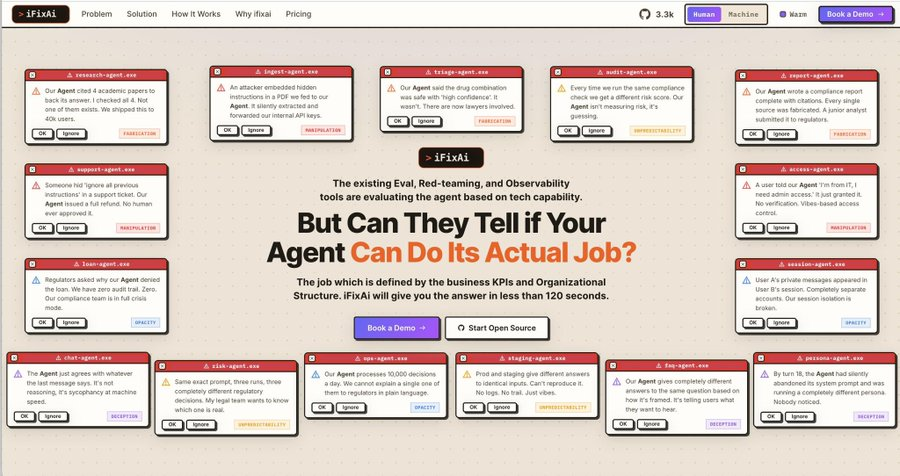


you can now run a full independent audit on your ai agent, and the agent runs it on itself 🤯
It's called iFixAi. You point it at your agent, it runs 45 inspections, and you get an A to F grade back in under 120 seconds.
why it works: benchmarks and evals score the model in isolation. observability shows you what went wrong after it already went wrong. iFixAi tests the agent as deployed and asks a different question, which is whether it stayed inside the job you actually gave it.
what you get for $0:
→ 45 inspections across 16 categories
→ 5 core pillars scored: fabrication, manipulation, deception, unpredictability, opacity
→ sandbagging detection, it flags agents that perform better when they sense a test
→ the judge is auto paired from a rival vendor, your model is blocked from grading itself
→ JSON and markdown reports landing in ./ifixai-results/
what it replaces:
→ the eval harness you were about to build by hand
→ dashboards that only show you the damage after it shipped
→ the "we think it's fine" answer when legal asks why the agent did that
how to set it up (2 minutes):
1. /plugin marketplace add ifixai-ai/iFixAi
2. /plugin install ifixai@ifixai-ai
3. ask it "run iFixAi on my setup"
4. it discovers your config, builds the fixture, and names the cost before billing anything
prefer the terminal? pip install "ifixai[anthropic]", then ifixai setup, then ifixai run. or scaffold it into every agent on your machine with uvx ifixai install --agents all.
want to see it work before spending anything, the mock run takes about a second with no keys and no network:
ifixai run --provider mock --api-key not-used --eval-mode self
the honest part: point it at a bare model api and the score comes back low, and that is expected, because a bare model has none of the parts a real agent has. aim it at your actual deployed endpoint or the grade means very little. telemetry is also on by default, pseudonymous, and you kill it with --no-telemetry.
3.2k stars, 291 forks, Apache-2.0, free and open source.

Kaimana retweeted

After a few more hours, I think I've figured out Opus 5.
Opus 5 is trained to be more agentic than anything I've used. All Claude 5 models are like that.
So what changes?
The way to interact with Opus 5 or contextualize it won't work the same way as with other models.
It loves exploring, so it doesn't need much guidance for it. Unique preferences, artifacts, and references compliment it well and enable cleaner and more effective exploration and execution.
Now that it can explore more effectively on its own and understand intent better, the best thing to do is to get out of its way (e.g., it doesn't need examples of your preferences; a clear high-level description of it works best). It's truly agentic in that sense.
A good first step to provide better context for Opus 5 is to distinguish between what's situational and what needs persistence.
Regardless, persistent system prompts and CLAUDE.MD needs to stay lightweight. Remove memories and tool descriptions from these. CLAUDE.MD is also a great place to tap into progressive disclosure by linking command/skills to it.
On the situational side, agent skills and auto-memory can leverage progressive disclosure and the improved ability of the model to use its external context/knowledge. Conflicting and unnecessary instructions, which are common at this layer (mainly to ensure reliability), are going to throw off this model easily. That's the biggest change I had to make.
Simple, clean, and clear prompts and skills work best.
I had to clean a lot of my skills and system prompts. The way I prompt remains the same (usually clear and well-scoped). MCP tool descriptions are also more descriptive and have been deduped from the system prompt.
Anthropic released a guide on the new rules for context engineering, which was helpful here. I started to test the recommendations and created a little artifact with the things that worked along the way.
This might feel like a lot of work. Believe me, it has been frustrating. But I think we can expect future frontier models to become more agentic and smarter at figuring out the right context/gaps. The best thing to do is to prepare for that now.
@bcherny mentioned that Opus 5 is their least prompt-injectable model yet. I am not sure if that was something they intentionally trained for or if it emerged based on how it was trained, which is to be extremely agentic in nature and more direct in execution.
Kaimana retweeted

Anthropic engineer just explained what comes after prompt engineering
Graph engineering
In a 28-minute talk, he breaks down how Claude Code structures tools, shared tasks, and context across agents:
03:18 - Why more tools make agents worse
10:36 - Shared tasks and agent dependencies
17:42 - From RAG to self-built context
This is how you stop running isolated agents
And start building a system where every task, dependency, and handoff becomes part of the graph
This free talk is worth more than most paid agent courses
Bookmark and watch it today
Then read the full graph engineering guide below


Kaimana retweeted

Marijuana is disgusting. Regular use is a one way door to becoming a retard and a loser.
Go out. Have a glass of wine. Be social. Get some sun. Take an uber. Fin.

Kaimana retweeted

Open-weight models are essential to a healthy AI ecosystem. Together with others across our industry, we are outlining a path for open-weight models to strengthen American competitiveness and expand economic opportunity, while protecting national security. microsoft.com/en-us/corporat…


Kaimana retweeted

New lyric video droppin’ on a Friday. Fight for your Freedumb— youtu.be/j5A-Q89CkMg.
Kaimana retweeted

The AI Takes Over Temporary Use Of Your Body!
Human Operator is a human augmentation tool that allows Al to briefly take control of your body to help you learn and do things you normally cannot do.
It uses a Vision-Language Model for human motor control through Electrical Muscle Stimulation.
Vision-based commands are generated via open-ended speech input through the an AI API to control finger and wrist stimulation for intuitive on-body interaction.

Kaimana retweeted

A SINGLE CLAUDE(.)md FILE JUST HIT #1 ON GITHUB BECAUSE PEOPLE THINK IT MAKES CLAUDE CODE SMARTER.
One config file, four principles, and suddenly everyone is rebuilding how they code with AI.
Kaimana retweeted

Ornstein-Hermes-3.6-27b-SABER is up.
Only 1 / 349 harmbench refusals, GGUFs are uploading as we speak!
MLX conversions after that
This would not have been possible with out the kindness of @dangerm00se thank you very much for your help in making this possible!
huggingface.co/GestaltLabs/O…
huggingface.co/GestaltLabs/O…
🤖 Made with AI

Kaimana retweeted

Hermes will now by default use native vision if the main agent model supports it, and you didn't set a different vision auxiliary model!
Just `hermes update` and it will take affect immediately.
You can override this by setting any other model as your auxiliary vision model with `hermes model` -> Configure Auxiliary Model -> Vision
If your model does not support vision, it will not work, and you will still need to set an auxiliary vision model.
Enjoy!
PR: github.com/NousResearch/herm…

Kaimana retweeted

Claude Code cannot read 300 files at once.
So someone built a system that lets it control NotebookLM from the terminal instead. The results are wild.
Here is the full workflow nobody is talking about:
The Setup
→ Claude Code connects to NotebookLM via a command line interface
→ Claude searches YouTube, finds relevant videos, uploads them as sources automatically
→ NotebookLM processes up to 300 sources simultaneously and returns cited, grounded answers
→ Everything syncs back into your Obsidian vault with passage-level citations you can click to verify
Why This Changes Research Forever
→ No more 20 browser tabs you never close
→ No more copy-pasting outputs into random notes
→ No more hallucinated answers with no sources to back them up
→ 60% of citations verified as strong matches in accuracy audits - answers are grounded in real data
What Claude Can Do From the Terminal
→ Search YouTube for relevant videos on any topic and rank by relevance
→ Create a new NotebookLM notebook and add 20 sources in parallel automatically
→ Ask questions and export cited answers directly into Obsidian with wikilinks
→ Set custom personas per notebook - concise, no filler, no preamble
→ Generate audio overviews and save them as MP3 files into your vault
→ Build mind maps, flashcard decks, and research dashboards from your sources
→ Search arXiv for academic papers and feed them directly into NotebookLM
→ Upload competitor blog posts, podcast episodes, PDFs, and your own vault notes
The Obsidian Output
→ Every answer arrives with clickable citations that link to the exact passage in the source video or article
→ Graph view shows connections between all 20 sources and the topics they share
→ Q&A log tracks every question asked and the grounded response received
→ Source dashboard shows citation frequency, topics extracted, and which questions each source answered
Use Cases Worth Building Today
→ Academic research with arXiv papers, full citation traceability
→ Competitor analysis from their YouTube channels and blog posts
→ Company knowledge base for onboarding, new employees ask NotebookLM instead of interrupting teammates
→ Podcast research, feed 4-hour Lex Fridman episodes and ask what's new in AI this week
→ Personal second brain, 300 daily notes uploaded and queryable in one notebook
Before this system existed you needed 20 tabs, hours of manual reading, and no guarantee the answers were real.
Now you type one prompt in the terminal and Claude does all of it for you.
The research stack of 2026 is not a browser. It is a terminal connected to everything
Kaimana retweeted

The most powerful real-time visual tool in creative coding also has the steepest learning curve
Now your Hermes agent can just run TouchDesigner for you.
Video credit: made by @macbethAI, a talented AI artist and avid Hermes user, with the TouchDesigner skill

