

Alumnus of @ManMetUni || National Publicity Secretary, City Boy Movement | Political Communicator | Youth Mobilisation | Public Affairs | Renewed Hope Advocate
Nigeria
Joined December 2010
- Tweets4K
- Following173
- Followers963
- Likes424







Pinned Tweet
There is no calamity greater than lavish desires. There is no greater guilt than discontent. And there is no greater disaster than greed.
- Lau Tzu
15
Your first tweet was a reaction to him flying with other CBM executive to attend a rally, saying they spent 20k an hour "on the purse of government." A claim you made without proof, even though you are a media guy who should work with fact.


In my opinion the ministry of youth should be scrapped.
Cos I havent seen anything meaningful this minister has done or achieved in 4years.
57
You have raised a valid point about the importance of community impact, and it is a perspective we appreciate.
Interestingly, the City Boy Movement is already doing quite a lot in this regard. Our mandate rests on three pillars: Inform, Engage and EMPOWER.

Just imagine; this so called City Boy movement was built to revive a major monument or solve a major problem in every state. This is their only duty. canvassing for vote will be their least priority. Just to fix major issues in every state. Imagine the city boy movement revives the National Zoo, National Museum, National parks, every national monument, canvases and champions causes like state police, strengthening the Army etc. imagine It was built to fix one major problem in every state. They will be closer to the hearts of the people by 40% .. Imagine they have an imprint everywhere for fixing major problems. You are closer to the funds; you are closer to the power to carry it out, you can be independent of the govt if you want to. it will help cushion the pressure. They are even closer to building a sustainable future in politics. Trust me; they won’t need a difficult approach to convince people. It will come naturally. You can’t win hearts if you don’t “FIX NIGERIA”
2
67
So, politics is not a career, but you fought so hard for your uncle to retain his seat. Does that mean Senator Ademola has no career outside politics?

6
190
NYSC Reform: Beyond Nostalgia, Towards Relevance and the Future of Nigerian Youth
Dr Reuben Abati’s recent intervention on the proposed reform of the National Youth Service Corps (NYSC) raises important questions about the direction of one of Nigeria’s most enduring national institutions. His concerns are understandable, particularly given the emotional connection many Nigerians have with the scheme and the memories it has created over the past five decades. The NYSC has produced lifelong friendships, inter-ethnic marriages, and a deeper understanding of Nigeria’s diversity for millions of young Nigerians.
However, while defending the historical significance of the NYSC is important, it is equally important that public commentary on a reform of this magnitude is guided by facts, context, and a proper understanding of the proposals being considered. Nostalgia cannot be the only basis for determining the future of an institution that was created over 50 years ago to address the realities of a different Nigeria.
Dr Abati’s assertion that “nobody was consulted” before the proposed reform was announced is inaccurate. Public commentators must exercise caution and ensure that they do not unintentionally mislead citizens with claims that are not supported by facts. The reform process was not conceived in isolation or imposed without consultation. A multi-stakeholder committee worked for several months to develop the reform framework. Following the work of that committee, a stakeholders’ consultative forum was convened on 8 December 2025, bringing together relevant voices and perspectives to examine the proposed direction of the scheme.
The question, therefore, is not whether consultation happened. The more important question is whether Nigeria is prepared to continuously review its institutions to ensure that they remain relevant to present realities.
Dr Abati correctly highlighted that the emphasis of NYSC has always been on service. However, he also recommended that the community development component of the scheme should be discontinued. This position appears to overlook the historical foundation of the NYSC idea.
The inspiration behind the creation of the NYSC was not merely about deploying graduates across states. The concept was influenced by the Peace Corps initiated by United States President John F. Kennedy in 1961, an initiative that enabled American volunteers to serve in developing countries by contributing to healthcare, education, agriculture, and other community development interventions.
This historical context explains why the reform committee deliberately retained the Community Development Service component. The committee understood that removing that aspect would fundamentally alter the philosophy of the NYSC. Indeed, a former Minister of Youth Development expressed concern that tampering with the community development element could unintentionally transform the NYSC from a national service platform into merely a self-development programme.
The purpose of NYSC has always been bigger than individual advancement. It is about national contribution, social responsibility, and participation in community transformation. Any reform that ignores this foundation risks losing the very essence of the scheme.
Another issue raised by Dr Abati is the proposal that prospective corps members may be posted to their states of origin in situations where security concerns exist. He argued that this would defeat the central objective of NYSC, which was designed to encourage integration by exposing young Nigerians to communities different from their own.
Again, while the argument for national integration is valid, the reality of today’s Nigeria cannot be ignored. Even under current NYSC structure, prospective corps members are sometimes posted to neighbouring states when security challenges make deployment to certain locations unsafe. The principle has always been that while national unity is important, no life is expendable.

Meanwhile, it is also important to note that this is not the first attempt to reform NYSC.
In his memoir, The Loyalist, former Minister of Youth Development, Bolaji Abdullahi recounted his own effort to reform the scheme during his tenure. On page 112, he recalled presenting his ideas to President Goodluck Jonathan:
“Sir, apart from General Gowon, who created the NYSC, I want you to be the President that reforms it to address current challenges,” he told the President.
He explained that while the original purpose of NYSC was to strengthen national unity, changing realities required giving young Nigerians additional reasons to participate beyond patriotism alone.
He proposed ending postings to private companies unless those companies could guarantee employment. He proposed entrepreneurship training, incubation opportunities, and credit support for corps members. He suggested creating a teacher supply pipeline by allowing interested corps members to spend an additional year teaching before pursuing other careers. He also advocated restricting postings to critical sectors such as health, education, agriculture, and infrastructure.
After listening, President Jonathan responded:
“Your ideas sound very interesting. They are good ideas. But will they let you do it?” That question remains relevant today.
Abdullahi also noted that NYSC reform would naturally attract resistance, particularly because the military had, over time, come to view the scheme almost as its own territory. He observed that even other military institutions, including the Air Force and Navy, appeared to accept that the NYSC Director-General position belonged to the Army.
Yet, other institutions created by the military, such as the Federal Road Safety Corps and the Federal Character Commission, are today not headed by military officers. The question therefore remains: why the fixation on NYSC?
Reforming NYSC does not mean destroying it. It means protecting its relevance. Institutions survive not because they remain unchanged, but because they evolve with society.
The Nigeria of 1973 is not the Nigeria of 2026. The challenges facing young Nigerians today are different. The labour market is different. Security realities are different. Identity challenges are different. A responsible government must therefore ask how a 53-year-old institution can better serve a new generation.
The debate around NYSC reform should therefore not be about defending the past against the future. It should be about ensuring that the future honours the best parts of the past while correcting its weaknesses.
The question President Jonathan asked many years ago remains the most important question confronting this reform effort today: “Will they let you do it?”
The “they” President Jonathan referred to are the same forces that have historically resisted attempts to modernise NYSC — those who prefer familiarity over reform, those who mistake preservation for progress, those who benefit from the status quo, and those who continue to frustrate every serious attempt to reform the scheme.
* Abdullahi is Chief of Staff to the Minister of Youth Development
1
74
A major misunderstanding also exists around the proposed six-week orientation programme. Many people commenting on this issue do not appear to understand the justification behind it.
A report once highlighted a troubling reality: only about 25 percent of Nigerian youths identified primarily as Nigerians first, while more than 70 percent identified mainly through ethnic or religious identities. Nigeria, according to the report, had become a fourth-level identity for many young people.
The proposed first two weeks of orientation are therefore designed to address this challenge by focusing on civic responsibility, patriotism, leadership, and national consciousness. This is not an arbitrary extension of camp duration. It is a response to a national challenge.
Week 3 to 4 are dedicated to soft skills development, which is also based on global realities. The World Economic Forum’s Future of Jobs Report 2026 highlights that many of the skills required for success in the coming years are not necessarily those acquired through university degrees alone. Skills such as negotiation, relationship management, emotional intelligence, financial literacy, and adaptability are becoming increasingly important in the future workplace.These are precisely the kinds of competencies the proposed reform seeks to provide.
The final two weeks are designed to prepare corps members for specific career pathways, ensuring that the service year produces young Nigerians who are better prepared for the future.
1
20
The proposed reforms are designed around many of the issues Dr Abati identified.
He called for increased monthly allowances for corps members. The reform conversation recognises the need to improve the welfare of young Nigerians serving the nation. He called for improved feeding at orientation camps. The reform proposal includes the upgrade and modernisation of orientation facilities. He called for stronger security around camps to prevent attacks by bandits and terrorists. The proposed reforms take this concern seriously. He called for corps members to be deployed to places of primary assignment relevant to their fields of study. This is also part of the reform direction.
On the question of replacing the passing-out parade with a graduation ceremony, there appears to be a misunderstanding. Corps members will not be wearing academic gowns, and the idea is not to transform NYSC into a university programme. They will continue to wear their uniforms. However, the argument is that “passing out parade” traditionally has a military connotation, and since corps members are not enrolled in the Nigerian Defence Academy, a graduation ceremony may better represent the completion of a national service programme.
Will the proposed reforms modernise NYSC? Yes. That is precisely the objective. Will they improve employability? Yes. Corps members will acquire market-relevant skills during their service year, increasing their chances of meaningful engagement after graduation.
1
18
Dr. Abati also argued that universities, rather than NYSC, should be responsible for preparing graduates for employment by reviewing curricula and integrating entrepreneurship into academic disciplines. While this argument has merit, it overlooks the fact that Nigeria is not the only country with transition programmes designed to bridge the gap between education and employment.
Several countries operate structured programmes between graduation and full participation in the workforce. Singapore’s SkillsFuture equips graduates with industry-relevant skills and career support. South Korea’s K-Move programme prepares young people for employment through specialised training and work placement. Germany’s dual vocational transition system combines practical workplace experience with structured learning.
These countries understand a simple reality: obtaining a university degree alone does not automatically guarantee employability. They also teach entrepreneurship within their educational systems, yet they still maintain transition programmes that help young people adapt to the demands of the labour market.
This is precisely the thinking behind the proposed NYSC reform. It is not a replacement for university education. It is an additional bridge between academic learning and workplace realities.
Interestingly, Dr Abati himself stated that “what the federal government needs to do is to make the NYSC experience richer and more exciting for those who participate in it.” That statement is essentially the reason the reform conversation began in the first place.
1
34
On the issue of uniform, the conversation has perhaps received more attention than it deserves. The proposal is not simply about changing fabric. The objective is to develop a uniform that maintains the identity of the NYSC, reflects professionalism, projects national pride, and gives corps members a stronger sense of belonging.
Many Nigerians who grew up in earlier decades remember the respect attached to the NYSC uniform. I recall when my brother participated in the scheme around 1994; people in our community gathered in our compound because they believed a “soldier” had arrived in the family. That perception reflected the dignity and symbolism attached to national service at the time.
The intention today is to preserve that symbolism while modernising the outlook. As the current Minister of Youth Development, Ayodele Olawande, himself has stated, the discussion around uniform is among the least important aspects of the reform. The focus should remain on the substance of the transformation.
1
20
For instance, a young Nigerian from Borno posted to Yobe may have a better understanding of the environment, culture, and terrain, and may be better positioned to navigate challenges in an emergency situation, compared to someone from another part of the country who has no familiarity with the area. This is not an argument against integration; it is an argument for responsible deployment.
Security situations are also not permanent. A temporary adjustment in deployment policy because of insecurity should not be interpreted as abandoning the original objective of NYSC. It is simply an adaptation to current realities.
Interestingly, whenever corps members have unfortunately lost their lives due to insecurity or election-related violence, commentators, including Dr Abati, have understandably expressed anger and concern. Such reactions are justified. But when government responds to those concerns by introducing reforms aimed at reducing those risks, the argument should not suddenly shift to accusing the same reforms of undermining NYSC’s purpose.
1
1
40
APC KWARA YOUTH UNITY DIALOGUE
The recently concluded APC primary has once again demonstrated the passion, commitment and energy that young people bring to our great party. While every democratic contest naturally produces different opinions and emotions, our greatest responsibility is what happens after the contest.
It is in this spirit that I am convening the APC Kwara Youth Unity Dialogue.
Let me state clearly from the outset that this initiative is not intended to debate or relitigate the outcome of the primary election. The primary has come and gone. The focus of this dialogue is to promote unity, reconciliation, mutual understanding and constructive engagement among young members of our party, while exploring the role of youth in strengthening the APC and advancing the progress of Kwara State.
At the first instance, the dialogue will be held virtually, providing an opportunity for youth representatives from across the different aspirants' support groups to engage openly, respectfully and in the spirit of one progressive family.
Before announcing the date and time, I am currently reaching out individually to major youth stakeholders and representatives across the various camps to ensure that the process is inclusive, balanced and reflective of our shared commitment to party unity.
My expectation is that this dialogue will reduce tension, rebuild confidence, foster mutual respect, open new channels of communication among youth leaders, and produce practical ideas for sustaining harmony within our party. More importantly, I hope it will send a strong message that, although we may have supported different aspirants during the primary, we remain united by a common vision for the APC and for the future of Kwara State.
In moments like this, leadership demands dialogue, not division; understanding, not hostility; and reconciliation, not resentment. I believe our young people are capable of setting that example.
Further details, including the date, time and participation arrangements, will be communicated after the ongoing consultations.

Mohammed Funsho Abdullahi (MFA) retweeted

DG SHOGA TOURS CITY BOY MOVEMENT'S CALL CENTER
Yesterday, the Director General of the City Boy Movement, Hon. Francis Oluwatosin Shoga alongside Deputy Director General (Coordination), Hon. Favour Abayomi and other high profile members of the Movement visited the newly set-up call centre office ahead of its planned relocation in the coming days. The visit was aimed at assessing the readiness of the facility and ensuring it provides a conducive environment for effective operations.
During the inspection, the Director General toured the office, reviewed the available facilities, and expressed satisfaction with the progress made in preparing the new location. The Director General emphasized the importance of maintaining high standards of service delivery and ensuring a smooth transition.
The relocation to the new office is expected to enhance the efficiency of the call centre by providing improved workspace, better infrastructure, and a more comfortable environment for staff. The move marks another step in the Movement's commitment to strengthening its operations and delivering quality service to its stakeholders and supporters, home and in the diaspora.
#CityBoyMovement
#RenewedHope
#APC
cc: @STinubu
@ayowisdom_
@shoga_francis
@kokomatic
Earlier today, I represented the Honourable Minister for Youth Development, His Excellency Olawande Emmanuel Ayodele at the Citizen Engagement Rally organised by the Relax, Tinubu is Fixing Nigeria movement in the Federal Capital Territory.
The engagement, which attracted a large number of participants from different communities, was designed to deepen citizens' understanding of the policies and programmes of the administration of President Bola Ahmed Tinubu and to encourage constructive dialogue between the government and the people. The rally was particularly significant because it provided an opportunity to counter misinformation and reinforce the need for continuous public engagement at a time when many government reforms are beginning to yield positive outcomes.
The programme commenced with a peaceful procession through major parts of Abuja, during which participants interacted with residents and distributed messages highlighting the achievements and reform agenda of the Federal Government. The procession culminated at Kuje Area Council, where a large crowd gathered for the main engagement.
Speaking on behalf of the Honourable Minister for Youth Development and in my capacity as Director of Intergovernmental Affairs of the Movement, I reaffirmed the Federal Government's commitment to building a more prosperous, inclusive and sustainable Nigeria. I assured the people that every major policy of the President Bola Ahmed Tinubu administration is driven by the long-term interest of the nation and the welfare of Nigerians.
I urged citizens not to be distracted by opposition narratives intended to undermine public confidence in ongoing reforms. Rather, I encouraged them to assess government policies based on their objectives and emerging results, while remaining active partners in nation-building through constructive participation and civic responsibility.
During my address, I highlighted some of the key reforms being implemented by the administration. I explained that the removal of fuel subsidy, though difficult in the short term, was a necessary step to halt an unsustainable fiscal burden, redirect scarce public resources to critical sectors, and lay the foundation for long-term economic stability and growth.
I also drew attention to the Student Loan Scheme, which is expanding access to higher education by ensuring that financial constraints no longer prevent qualified young Nigerians from pursuing their academic aspirations. The initiative, I noted, reflects the administration's commitment to investing in the nation's human capital.
Furthermore, I briefed the gathering on the ongoing reforms of the National Youth Service Corps (NYSC), explaining that the reforms are aimed at making the scheme more responsive to the realities of the 21st century. I stated that the proposed changes seek to strengthen skills acquisition, entrepreneurship, employability, digital innovation, and national productivity, thereby enabling young graduates to transition more successfully from education to meaningful careers and enterprise.
The engagement was interactive, with participants expressing appreciation for the opportunity to receive first-hand explanations of government policies. The rally also reinforced the importance of sustained grassroots engagement as a vital tool for promoting public trust, correcting misconceptions, and strengthening the relationship between government and citizens.
Overall, the event was successful in advancing the objectives of citizen engagement, promoting national unity, and reinforcing confidence in the reform agenda of the President Bola Ahmed Tinubu administration. It further underscored the need for continuous public enlightenment to ensure that Nigerians remain well-informed and actively involved in the country's development journey.


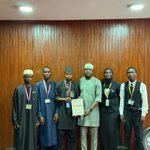
Today, I had the pleasure of receiving the Executive Council of the Ilorin Emirate Students' Union (I.E.S.U.), University of Abuja Chapter, led by its President, Mallam Abdulhameed Robiu Ghatta, on a courtesy visit to my office.
The visit was both nostalgic and inspiring. It reminded me of my own days of active student leadership as the Public Relations Officer of the University of Ilorin chapter of the Union. It was heartwarming to interact with a new generation of leaders who are committed to preserving our values and promoting academic excellence.
I was particularly honoured by their request that I host this year's I.E.S.U. Musabaqah (Qur'an Competition), a noble initiative that promotes the teachings of the Holy Qur'an and strengthens our moral values. I gladly accepted the request and commended the Union for sustaining this important tradition.
I sincerely appreciated their prayers and goodwill, as well as their expressed support. I, however, made it clear that I have no political aspiration at this time. Rather, I encouraged them to support the candidates of our great party, the APC, particularly our governorship candidate in Kwara State, Rt. Hon. Saliu Yakubu Danladi, and our President, Asiwaju Bola Ahmed Tinubu, GCFR.
I urged them to mobilise eligible voters across Kwara State to support the APC, reminding them that true brotherhood is not merely about shared ancestry but about supporting leaders who will genuinely protect and advance the interests of our people.
I am deeply grateful for their thoughtful letter of appreciation after the visit and for their kind words. May Allah continue to guide these young leaders, grant them success in their academic pursuits, and raise them to become worthy ambassadors of Ilorin Emirate and Nigeria.
#YouthLeadership #IlorinEmirate #StudentLeadership #APC #Kwara #Musabaqah


Mohammed Funsho Abdullahi (MFA) retweeted

Through my moin-moin business here in Ilorin, I have been able to build a house, buy a car, pay my employees, and sponsor all my children through university. — Iya Ibeji Oni Moinmoin, speaking during an interview with BBC Yoruba.
Every morning before going to primary school, I helped my late mother hawk akara. She was a farmer. She processed and sold fufu. Like millions of Nigerian women of her generation, she did whatever honest work she could to keep food on the table and ensure her children had a future.
She never waited for anyone to rescue her. She never believed that selling akara, roasted corn (agbado), fufu or any other local food was beneath her. There was honour in labour, and she wore that honour with pride.
That is why I struggle to understand the outrage over the First Lady's remarks.
Nothing is wrong with selling akara. Nothing is wrong with roasting corn. Nothing is wrong with selling fufu. These are not signs of failure. They are symbols of enterprise, resilience and self-respect.
I believe the point she was making has been misunderstood. Her message was that with even the smallest support (access to finance, skills, markets and an enabling environment), small-scale traders can build sustainable businesses, earn decent incomes and live dignified lives.
My late mother never had such support from any government. Yet, through sheer determination, she raised her family. Imagine what women like her could have achieved if they had received the kind of opportunities many are advocating today.
Our forebears taught us that no honest work is shameful. They preferred to sweat than to beg. They built families, communities and even educated children through businesses many people now dismiss.
Let us celebrate honest labour, not ridicule it.
I will always remain proud of where I come from. I am, and will always be, a proud son of an Akara Seller.

One of the biggest issues with many Nigerians today is the habit of merely reading social media headlines without investigating the full story. For instance, how many people actually know that the Office of the First Lady, through the Renewed Hope Initiative, has been distributing ₦50,000 cash grants to thousands of women nationwide to recapitalize their businesses? People rushed to criticize her remarks about small scale trades, but since when did frying Akara or selling street snacks become a crime or a business reserved only for the poor? Honest work is honest work, and providing capital to boost these grassroots traders should be commended, not mocked.
CITY BOY MOVEMENT CONGRATULATES @officialABAT ON HIS RESOUNDING VICTORY AT THE APC PRESIDENTIAL PRIMARIES
@CityBoyMedia
@STinubu
@ayowisdom_
@shoga_francis
@BashirAhmaad


2
2
45
CITY BOY MOVEMENT
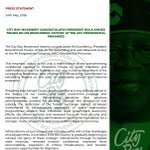
PRESS RELEASE
FOR IMMEDIATE RELEASE
24 May 2026
ADEPOJU BABATUNDE SALAKO IS NOT A MEMBER, OFFICER OR COORDINATOR OF THE CITY BOY MOVEMENT
The attention of the leadership of the City Boy Movement has been drawn to a series of online publications and social media reports attempting to falsely associate one Mr. Adepoju Babatunde Salako with the City Boy Movement in relation to criminal proceedings and conviction reportedly arising from alleged fraud-related offences in the United States of America.
The Movement considers it necessary to categorically, clearly and unequivocally state as follows:
1. Mr. Adepoju Babatunde Salako is not a member of the City Boy Movement and has never held any office, appointment or official position whatsoever within the structure of the Movement at the national, zonal, state, diaspora or international level.
2. The said Mr. Adepoju Babatunde Salako was never appointed, recognised, authorised or designated by the City Boy Movement as a coordinator, representative, campaign official, spokesperson or mobilization officer in the United States of America or anywhere else in the world.
3. The City Boy Movement therefore completely dissociates itself from the said individual and from every publication, insinuation or narrative attempting to create a false relationship between him and the Movement.
4. It is important to note that several earlier media reports concerning the said criminal allegations and conviction did not in any way associate the individual with the City Boy Movement. The sudden attempt by certain mischievous elements to drag the name of the Movement into the matter clearly suggests a deliberate agenda aimed at discrediting prominent mobilization platforms and support structures associated with President Bola Ahmed Tinubu and the broader progressive movement.
We find it curious that the same individual has also been identified in separate reports as a Philadelphia Coordinator of another pro-Tinubu support platform known as “Relax, Tinubu Is Fixing Nigeria.” This clearly underscores the reckless and indiscriminate manner with which certain actors are now attempting to attach politically convenient labels and affiliations to the individual in order to manufacture sensational narratives.
For the avoidance of doubt, this clarification has absolutely nothing to do with the personal legal circumstances, travails or judicial proceedings involving the said individual. Every citizen is entitled to constitutional rights and due process under the law. However, the City Boy Movement cannot and will not accept false attribution, reputational manipulation or deliberate attempts to create artificial relationships where none exists.
The CBM remains a lawful, disciplined and responsible sociopolitical movement committed to constructive engagement, youth mobilisation, democratic participation and national development in line with the ideals and progressive vision of President Bola Ahmed Tinubu.
Members of the public and the media are therefore advised to disregard all publications, insinuations and social media claims linking Mr. Adepoju Babatunde Salako with the City Boy Movement in any capacity whatsoever.
Signed:
MOHAMMED ABDULLAHI
National Publicity Secretary
City Boy Movement
@CityBoyMedia

2
101