










Mindflex retweeted
A community sale with something extra beyond the allocation.
One detail worth paying attention to with Zoth is the 7% cashback in zMAG7 when you participate through a referral link or hold zMAG7.
That's one onchain token representing the Magnificent Seven: Apple, Microsoft, Alphabet, Amazon, Meta, NVIDIA and Tesla.
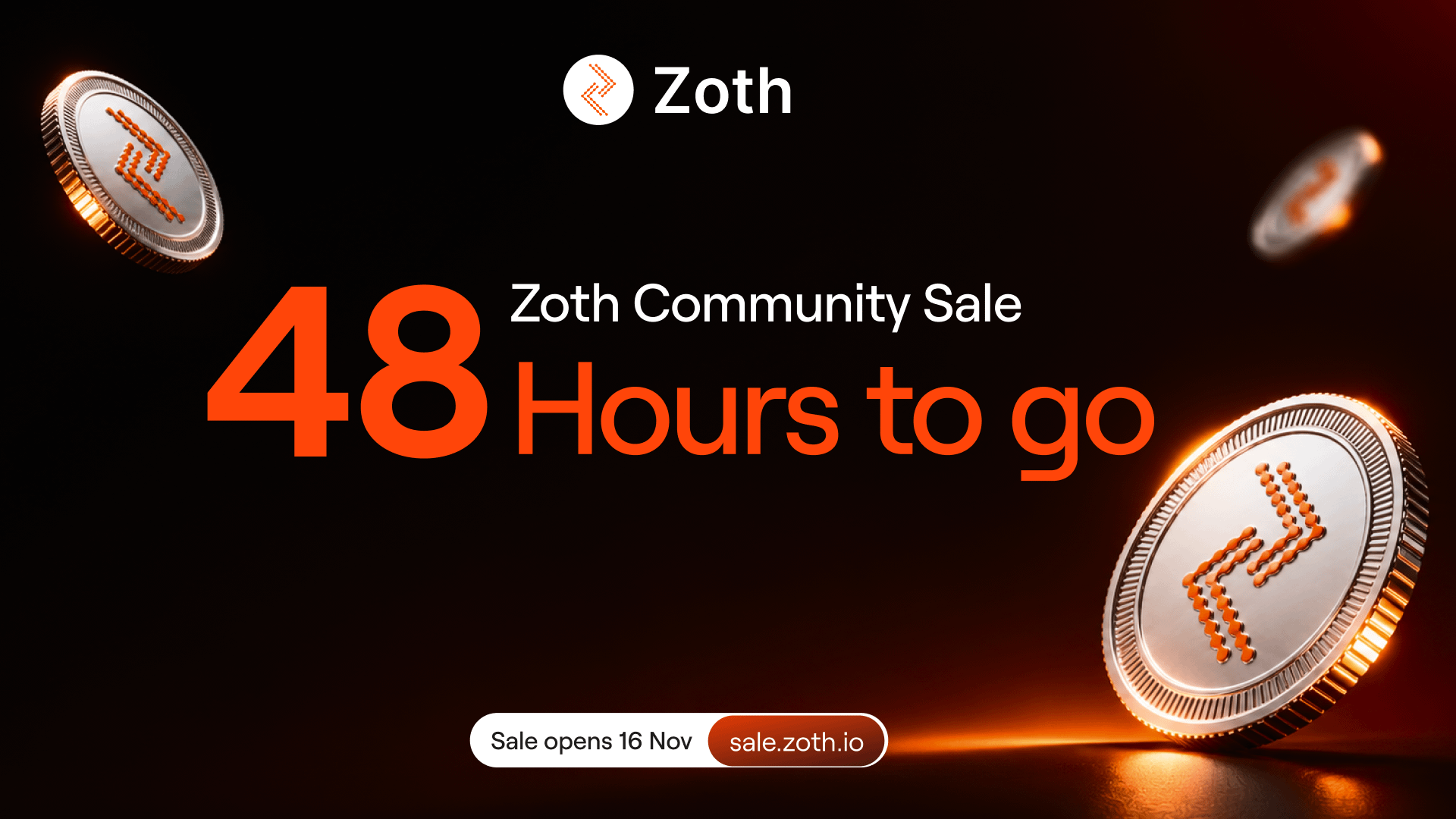
The Zoth Community Sale opens on Sonar tomorrow, November 16, with a $500K cap.
Worth understanding before the sale opens.
@zothdotio
Join here 👇 sale.zoth.io/?ref=MINDOAI


48 hours.
The Zoth Community Sale opens on Sonar on 16 Nov.
Before the doors open:
✅ Finish your KYC on SONAR
✅ Fund your wallet with USDC or USDT on Ethereum
✅ Get cashback - use a referral link or hold zMAG7.
The round is capped at $500K. Be ready at the open.
Whitelist → sale.zoth.io

Mindflex retweeted
Imagine having crypto in your wallet but feeling stuck when someone asks you how to buy or sell it using local currency.
That's a gap many people overlook when learning about crypto.
We spend so much time discussing market trends, new tokens, and investment opportunities that the practical side of crypto sometimes gets ignored.
How do you find a suitable offer? What payment method works for you? What should you check before confirming a transaction?
These are important questions, especially for people getting started with P2P trading.
CoinCola gives users a platform to explore buying and selling crypto with other people. But understanding how the process works is just as important as having access to the platform.
Don't just learn how to enter the crypto market. Learn how to navigate it properly.
#CoinColaP2P #CoinColaGiftcard

Mindflex retweeted
Good night ct
A blockchain becomes more interesting when different applications can build around the same financial infrastructure.
That's one thing I find interesting about what @strato_net is building.
STRATO isn't positioning HardFi around just one product.
Look at the different parts of its ecosystem:
↳ STRATO App brings onchain finance together, allowing users to buy tokenized metals, mint USDST, trade and earn.
↳ STRATO Odds introduces prediction markets backed by USDST.
↳ STRATO Play brings onchain settlement to games and head-to-head matches.
↳ STRATOSCAN gives users a way to explore activity and applications on the network.
What connects these products is the underlying STRATO infrastructure.
Tokenized assets, stablecoin liquidity and financial applications are being brought together within one Layer 1 ecosystem.
I think this is an important part of the HardFi vision.
The opportunity isn't simply to launch another blockchain or introduce another token.
It's to build an environment where different applications can use the same underlying financial infrastructure.
And that's the bigger picture I'm watching with STRATO.
How much can this ecosystem grow as more applications, assets and users come together?

Mindflex retweeted
Rarity becomes more interesting when there's something specific behind it.
That's what caught my attention about the Genesis guardians in @Voide1998.
VOIDÉ has six rarity levels, but Genesis sits at the top with a 0.4% probability.
These guardians are distinguished by special traits such as Cosmic Aura, Void Flame Foil, Seraph Wings and Star Eyes.
What I find interesting is that rarity here isn't only about how difficult a collectible is to obtain. The combination of traits also gives each guardian its own visual identity.
For collectors, that makes discovering what each guardian holds part of the experience.
And with 2,499 guardians in the collection, Genesis is certainly one of the rarities worth watching.

Mindflex retweeted
Some teams entered blockchain when it became popular.
Others were building the infrastructure before most people understood what Ethereum could become.
The team behind @strato_net belongs to the second category.
Their Ethereum journey dates back to 2014, when STRATO's founders began developing an Ethereum client written in Haskell.
By July 2015, that client was among the six mainnet-compatible clients at Ethereum's Frontier launch.
Then came another milestone.
In November 2015, the team brought Ethereum infrastructure to Microsoft Azure through an early Blockchain-as-a-Service offering.
That's a decade of experience working around blockchain infrastructure.
But what makes this history interesting to me isn't simply the number of years.
It's the transition.
The team that helped build early Ethereum infrastructure is now applying that experience to a different challenge: making tokenized real-world assets useful through borrowing, trading, savings and other financial applications.
That's the thinking behind STRATO's HardFi vision.
Building a blockchain is one challenge.
Building useful financial infrastructure on top of it is another.
And STRATO is bringing those two ambitions together.


What happens after a real-world asset becomes a token?
That's where things get interesting.
Tokenizing gold or silver gives it an onchain representation. But the bigger opportunity is connecting those assets to financial applications where they can actually be used.
This is the direction @strato_net is taking with HardFi.
Through GOLDST and SILVST, STRATO brings tokenized precious metals into an ecosystem that connects collateral, borrowing, trading and savings.
For example, users can borrow USDST against supported collateral without having to sell their underlying assets, although borrowing fees and liquidation risks still apply.
I think this is an important distinction.
STRATO isn't approaching real-world asset tokenization as an isolated product. It's building financial infrastructure around those assets on its own Layer 1 network.
And the traction is worth examining.
In the campaign's supplied DefiLlama snapshot, STRATO ranks #3 among Gold & Commodities platforms by DeFi Active TVL.
The same snapshot reports $13.2M used in DeFi and $27.66M in tracked metals Active AUM.
These metrics measure different things, but they show two sides of the ecosystem: assets being tracked and assets being put to work.
For me, the bigger question for the RWA sector isn't simply how much value can be brought onchain.
It's what financial opportunities become possible once that value arrives.
That's the HardFi direction STRATO is pursuing.

Mindflex retweeted
Imagine holding tokenized gold but needing liquidity without selling the gold itself.
That's one problem @strato_net is building around.
STRATO allows users to lock supported assets in collateral vaults and mint USDST against them.
This is how its collateralized borrowing system works.
But there's an important distinction here.
The user isn't simply receiving a loan from another person. USDST is created against the collateral deposited into the vault.
The position carries a stability fee, and if the collateral's value falls too far relative to the debt, the vault can be liquidated.
So there's real risk involved.
What interests me is how this connects to STRATO's broader HardFi vision.
Tokenized assets become more than digital representations of physical assets. They can serve as collateral within an onchain financial system.
There's already measurable activity.
DefiLlama reported approximately $4.69M in active loans for STRATO as of November 7, 2026.
To me, this is an important part of the RWA conversation.
Bringing real-world assets onchain is one milestone.
Building financial infrastructure that allows people to use those assets is another.
That's the distinction STRATO is trying to establish.

Mindflex retweeted
A token's supply tells you how many tokens exist.
But its utility tells you what role it is supposed to play in an ecosystem.
That's what makes the $STRATO tokenomics worth examining.
@strato_net has a fixed maximum supply of 100 million $STRATO tokens, with 55.2% allocated to the community.
But the interesting part is how the token connects to the infrastructure STRATO is building.
Its published design gives $STRATO three important roles:
↳ Staking: Validators stake $STRATO to participate in securing the network, while other holders can delegate their tokens.
↳ Gas: $STRATO is designed to become the network's gas token, although transactions currently pay fees in USDST.
↳ Governance: Tokenholders are intended to participate in decisions affecting network parameters and ecosystem development.
There's an important distinction here: staking is implemented on-chain and active on testnet, while mainnet consensus activation is scheduled for a future network fork. Gas utility and full tokenholder governance are also part of the planned design.
What I find interesting is the connection between the token and the network's broader purpose.
STRATO isn't building around a token alone. It's developing an ecosystem involving tokenized gold, silver, USDST, borrowing, trading and savings.
The question is how activity across these applications will translate into demand for the network's native functions as adoption grows.
For me, that's a much more interesting way to examine $STRATO than looking at supply numbers alone.

Mindflex retweeted
Gmgm fam
TVL can show how much capital is sitting in a protocol.
But I also pay attention to whether that activity is generating revenue.
That's another interesting part of @strato_net
STRATO's borrowing system allows users to mint USDST against supported collateral. As borrowers use the system, stability fees generate protocol revenue.
And there's already measurable activity.
According to DefiLlama, STRATO recorded $16,257 in protocol revenue over the last 30 days, bringing its cumulative protocol revenue to $59,458 as of November 10.
What's interesting is where that revenue comes from.
DefiLlama identifies CDP borrowing stability fees as a revenue source, with those fees flowing to protocol-owned reserves and the treasury.
This is important because protocol revenue shouldn't automatically be confused with money distributed to tokenholders.
I think this is a useful way to examine STRATO's HardFi vision.
The idea is to connect real-world assets, collateralized borrowing and other financial applications into one ecosystem where financial activity can generate measurable revenue.
For me, the interesting question is how that economic activity develops as more applications and users join the network.
That's worth watching beyond the usual TVL conversation.


Mindflex retweeted
Big step for @Voide1998 Excited to see what’s coming with the mint. Looking forward to what’s next!

VOIDÉ x OpenSea – Official Collection is Live!
Our official collection is now on @opensea . The mint is coming soon! Stay tuned for more updates.
🔗 Collection: opensea.io/collection/voide
#NFTs #MINT

Mindflex retweeted
VOIDÉ NFT – 600 WHITELIST SPOTS OPEN
Want to secure your spot? Complete these simple steps:
☑ Follow @VOIDÉ
❤️ Like this post
🔁 Repost this post
💬 Drop your EVM wallet address in the comments.
Complete all tasks for a chance to join the VOIDÉ community!
Good luck!
#VOIDÉ #NFT #Whitelist

Mindflex retweeted
600 WL to grab here
Drop your addy fast
VOIDÉ NFT – 600 WHITELIST SPOTS OPEN
Want to secure your spot? Complete these simple steps:
☑ Follow @VOIDÉ
❤️ Like this post
🔁 Repost this post
💬 Drop your EVM wallet address in the comments.
Complete all tasks for a chance to join the VOIDÉ community!
Good luck!
#VOIDÉ #NFT #Whitelist


Mindflex retweeted
Most NFT collections give you something to display. @Voide1998 wants to give you something to play.
What makes this interesting is how each guardian comes with its own battle card.
These aren't just decorative details. Each card carries attributes like HP, attack, elements, weaknesses and retreat costs.
That gives every guardian a different identity beyond its visual appearance.
The bigger idea is the planned Arena, where these battle cards are expected to become part of an interactive gameplay experience.
Imagine collecting a guardian not just because of its rarity or appearance, but because of how it fits into the game.
That's an interesting direction for NFT ownership.
And it's one of the things I'm watching closely with @Voide1998

Most NFT collections give you something to display. @Voide1998 wants to give you something to play.
With a collection of 2,499 unique guardians, VOIDÉ is building around more than artwork and rarity.
Each guardian comes with its own battle card, featuring HP, attack, elements, weaknesses and retreat costs.
This is where things get interesting.
The planned Arena will bring these guardians into an interactive experience where their battle cards become part of the gameplay.
There's also a scratch mechanic that adds another layer to the experience.
I like the idea of connecting NFT collecting with actual gameplay instead of making ownership the final destination.
That's what makes @Voide1998 worth watching.
Mindflex retweeted

Gaming, community, and crypto are coming together!
The $FUNGO Airdrop campaign by @FungoLabs is giving the community an opportunity to get involved and support the growing ecosystem.
It's exciting to see more projects creating opportunities for community participation through token campaigns.
If you're interested in exploring the $FUNGO campaign, this is a good time to check it out.
Let's see what FungoLabs has in store!
Join the campaign
fungolabs.org/launchpad/c/cf…
#FungoLabs #FUNGO #Airdrop #Web3 $INSO
