

Director @FinDevLab, ex-OECD, Ex-World Bank with many random interests. MPAID-Kennedy Sch Alum
Paris, France
Joined March 2012
- Tweets5.6K
- Following3.6K
- Followers2K
- Likes8.8K



Pinned Tweet
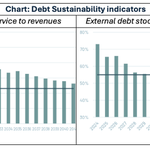
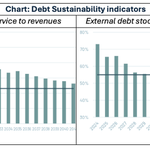
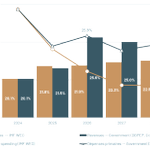
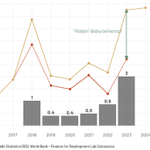
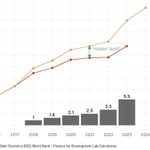
The debt crisis in Senegal started by the discovery of a massive "hidden debt" by the new govt. This week, with the publication of the new IDS report, we get a bit more clarity on the external part of the debt.
First, *how much*? A lot: external public debt reached $25 bn in 2024

Martin Kessler retweeted

What is the link between tax collection and development?
We hand-collected new data on the cost of tax collection across 100 countries, historically, and across subnational states.
💡There is a strong positive correlation between efficiency of tax collection and development 1/

Martin Kessler retweeted

Africa's new credit rating agency, AfCRA, launched this month. Can it change how sovereign risk is assessed?
Wider coverage, new data and a rethink of rating drivers could bring greater differentiation between African sovereigns. Read our new blog post by Tatiana Lysenko 👇


Martin Kessler retweeted
Happening now: geopolitics shocks and development with @doro_rouzet @SongweVera @ishacdiwan @Martin_M_Guzman @mamomihre

Martin Kessler retweeted
🚨New Paper🚨The World Bank Guarantee Platform hit its 2030 target 4 years early. But 2/3 of guarantees went to upper-middle and high-income countries. How can the Platform reach the countries that need it most? Our new Policy Note sets out 6 proposals. Link👇
Martin Kessler retweeted
📣 Event Alert! How can development progress in a fractured world? 🌍 Join the 2026 FDL/IPD Annual Seminar public session with Mamo Mihretu, Dorothée Rouzet, Martin Guzman & Ishac Diwan, moderated by Vera Songwe.
🗓️ Thu 22 Oct, 17:00–18:30 CEST
Register now! Link in comment 👇

Martin Kessler retweeted
“Dette du Sénégal: Acoster le Navire Une Bonne Fois Pour Toutes”
Une nouvelle note Finance for Development Lab de Martin Kessler et Abdoulaye Ndiaye


Martin Kessler retweeted

Pakistan just pulled off one of the fastest grassroots energy transitions anywhere:
>Solar: 3% of power in 2020 to 20% to 25% today >Generation: 7.7 to 36.6 TWh (2022–25), up nearly 5 times
>$12B in fossil fuel imports avoided
>34% of rural Balochistan homes rely on solar for light
No grand plan was needed or required: Cheap Chinese panels + TikTok tutorials did what decades of policy couldn't, deliver power where the grid never reached, and keep dollars at home
Hormuz shut? Pakistan's rooftops kept humming
Wires chewing pipelines
bloomberg.com/news/features/…

Martin Kessler retweeted

This a.m., I walked my two youngest kids (ages 7 and 4) to school. I held their little hands as we crossed streets, and gave my youngest a giant hug at his PreK4 classroom door.
Then, after walking a block towards home, I opened this app to a terrifying stream of tweets.
Of course, I have heard about "alignment" and "AI safety" and "x risk" concerns for years. I took these concerns at face value, especially when I heard them directly from folks at the labs working closest with the technology. And I was grateful so many smart people are working on them. And that's about it. (My work focuses on AI's impact on jobs.)
But something has shifted, dramatically, for me in the last few weeks. Between the Hugging Face incident, the damning independent @METR_Evals reports that followed, and the alarming chorus of calls (pleas? shouts? SOS signals?) from inside the labs that we are careening toward potential catastrophe, all of this has made me feel, viscerally, how truly dangerous this moment is.
Clearly I am not alone in this light bulb moment. It is one thing for someone in a tropical climate to try and conceptualize snow. It is another thing entirely to be knee deep in it, frozen down to your toes. Somehow hearing the details of the HF incident felt to me more like trudging through snow than theorizing about a possible blizzard; it really hit home.
Which is why, standing a block from my children's elementary school in Capitol Hill this morning, I felt sick to my stomach reading my phone.
I kept going back to @EvanHub's > 0.1 risk of AI killing us all. TEN PERCENT. *Greater* than ten percent. (To be fair to him, he was clear his worry isn't today's models, but what comes next.)
As a parent, it is extraordinary the lengths I will go to keep my children safe against lethal risks with infinitesimal chances of happening.
Bike to school? My children *must* wear a helmet. A national study found 2 bicycle-related deaths per million children <16 in states with helmet laws, vs 2.5 per million in states without. So: 0.000002. More than half the states passed a law over that.
When I was pregnant, I religiously avoided soft cheese, hyper aware of the risks of listeria, even as @ProfEmilyOster's fabulous books walked me through the actual math. The joint FDA/FSIS risk assessment puts the odds of listeriosis at roughly one in 5 million per serving of soft cheese. 0.0000002.
This morning, as I microwaved oatmeal for my kids' breakfast, I made sure I avoided a plastic bowl, to avoid some future cancer risks or something else we'll discover plastic causes.
As a parent, I will go to extraordinary lengths to keep my kids' safe. Because that is literally my number one job as a parent.
And yet, here I am, outside my kids' school this morning, scrolling through tweet after tweet about the AI arms race, the blistering pace of technological progress, the bee-line for trillion dollar IPOs, and our professed (confessed?) inability to make sure this exceedingly capable technology we are racing to create and unleash into the world won't escape our control and destroy us. Or, more bluntly, kill our children.
To be sure, we are tied in knots trying to resolve the game theory dynamics with China, and there are all sorts of competitive pressures and unresolved tensions. But OBVIOUSLY, we need a proactive plan, with real coordination, effective regulation, and an ability to do what my 11-year-old bluntly stated as the clear solution if we are at risk of serious harm: just turn it off.
We also need to figure out better ways of talking about this with the American public, outside of the AI-pilled Twitterverse.
I just polled my college roommates, sisters, book club, mom friends, none of whom are anywhere close to the AI conversation. Suffice to say, this AI safety conversation has *not* entered the mainstream. Most people I pinged are not following it closely, beyond several listening to @kevinroose on the Daily a few days ago. The newspaper headlines don't speak to them, and they aren't clicking. It seems like a niche AI issue. Others said it all sounded hyperbolic, Y2K all over again.
One friend said bluntly, "people get data centers and jobs. They like to get paid and have water."
Even those who tuned it to the Daily episode found the issue hard to understand, and overwhelming to wrap their heads around. Terms like "superintelligence" and "alignment" are getting lost on people. Several people told me the paper clip example used everyday language people can actually understand. Another friend said she has never seen a clear explanation of *how* AI could kill us all.
Here's my two cents. I think these issues are *exceedingly* important and hugely consequential to literally every person in this country. We need an actual plan, and we need policymakers to step up, asap. Right now, I hear only crickets in DC, where I live.
For that to happen, this needs to be a kitchen table conversation, not just an x debate among AI insiders who speak in technical terms that leave normal people behind. This moment demands brilliant communicators -- journalists, experts, activists, concerned citizens, writers, researchers, filmmakers, creatives-- who can relate this to people in ways they can wrap their heads around, who can connect this to what matters in their lives (ahem, keeping their kids alive!), and who can lay out practical steps that policymakers can do to safeguard humanity.
In other words, this can't just be talked about on @dwarkesh_sp, it needs to be everywhere, from the View to People Magazine.
And it needs to be tackled here, in my town, in Washington, DC. One of the streets I crossed this morning with my kids on the way to school was East Capital. I told my kids to look left, and see if they could spot the capital building.
There were too many trees this morning blocking the view.

Martin Kessler retweeted

I’m excited to share that I have joined the @FinDevLab in Paris as China Program Manager.
At FDL, I’ll be leading work on China’s role in development finance, with a particular focus on sovereign debt restructuring and China’s evolving engagement with developing economies and the international financial architecture.
Grateful to everyone who has supported me along the way, and excited for what’s ahead with @mkessler_DC, @ishacdiwan, and other amazing colleagues at FDL.
Martin Kessler retweeted

Great new review article from Pascaline Dupas, with a new take on the Jeff Sachs vs AJR debate:
20+ years of rigorous, empirical evidence point to a strong role for geography in shaping econ development outcomes

Martin Kessler retweeted

1/2
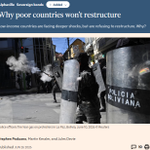
Excellent writing by Stephen Paduano and Julian Watrous in @phenomenalworld on the recent experiences of Debt restructuring in African countries. They argued that the Brady Plan succeeded because of reducing the debt stress by restructuring, rather than refinancing and extend borrowings to an already indebted borrowers which could have channeled capital from productivity to higher debt interest payments and make liquidity crisis into a solvency crisis. The authors also that Multilateral lenders and advanced countries worked towards closely to stem debt crisis spilling out to advanced economies, and to maintain the geopolitical leverage during cold war, the United States and others supported debt restructuring. This has changed now. Defaults by poorer nations wouldn't create financial crisis in advanced economies, and Geopolitically, providing Foreign aid to poorer nations, or spending money on overseas Developement is Materialistically not in the table. Therefore, there is much less political pressure on rich countries to create a large, coordinated solution to the debt problems of poorer countries.

Martin Kessler retweeted
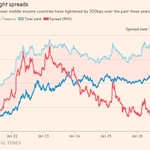
Frontier markets are facing nasty rates, but not due to wider spreads. More featured on today's Chartbook Top Links in the comment below.

This week was the annuel Paris Forum, and this year was special because it celebrated the 70 years anniversary of the Paris Club 🎂🎂🎂. In a piece at @FTAlphaville, @StephenPaduano , Jules Devie and I (a @FinDevLab team) ask an old question: why don't countries restructure?

Though its members are not major bilateral creditors anymore, the Paris Club Club maintains the legitimacy and deep expertise to drive progress. It now needs to continue to do the patient, difficult diplomacy of integrating China into the global debt architecture.
Pehaps of interest: @arvindsubraman @Brad_Setser @adam_tooze @TheStalwart @upanizza @LaynaMosley @AGelpern (and others)