Moritz Sudhof (@mmooritz) header
Moritz Sudhof (@mmooritz) profile picture

Co-Founder & CEO at Bigspin

San Francisco, CA
Joined October 2017
Photo by Moritz Sudhof (@mmooritz)Photo by Moritz Sudhof (@mmooritz)Photo by Moritz Sudhof (@mmooritz)Photo by Moritz Sudhof (@mmooritz)Photo by Moritz Sudhof (@mmooritz)Photo by Moritz Sudhof (@mmooritz)Photo by Moritz Sudhof (@mmooritz)Photo by Moritz Sudhof (@mmooritz)Photo by Moritz Sudhof (@mmooritz)
Moritz Sudhof retweeted
SWE-chat for human behavior & AI efficiency analyses @AnthropicAI's research on expertise and coding-agent outcomes (@zhitzig) uses SWE-chat examples to illustrate how expertise and success are classified. The broader study finds domain expertise is associated with better outcomes. anthropic.com/research/claud… Bigspin AI's analysis (@ChrisGPotts & @mmooritz) of SWE-chat sessions measures token efficiencies relative to engineering outputs and discovered coding agent inefficiencies. bigspin.ai/resources/the-dec… A study from Notre Dame, Vanderbilt, and Google (@TangNingzhi) maps how agents fail to follow developer intent. Over 91% of visible resolutions needed user correction, documenting the burden of keeping agents on track. arxiv.org/abs/2605.29442
1
1
7
230
Moritz Sudhof retweeted
SWE-chat v2 is here! The largest dataset of coding agent interactions from real users in the wild has gotten even larger: 230K prompts from 18K sessions. SWE-chat has enabled incredible research (🧵) – excited to see what v2 unlocks for the community. Come find us at @COLM_conf!
2
24
4
76
20,017
Fantastic episode from my co-founder @ChrisGPotts about our Tokenflation work (and other exciting topics) !
As reasoning models consume more tokens and AI systems become more expensive to run, understanding what those tokens actually buy is becoming increasingly important. In this episode, @Stanford professor and Big Spin co-founder @ChrisGPotts joins us to discuss AI tokenomics and his research into “tokenflation”—the possibility that token usage is growing faster than the measurable value those tokens produce. We explore how to measure the return on AI spending, why benchmarks alone provide an incomplete picture of model progress, and what inference-time scaling means for the economics of increasingly capable models. Chris also explains why expert AI users tend to get better results by challenging and iterating with models, how AI fluency affects outcomes, and why more efficient architectures could change the underlying economics. We also discuss DSPy, interpretability, the limits of today’s transformer architectures, and where Chris sees opportunities for more fundamental innovation in AI. 🗒️ Full show notes: twimlai.com/go/776. 📖 CHAPTERS =============================== 00:00 - Introduction 05:38 - Linguistics in the Age of Language Models 09:26 - Scale Limitations in NLP Research 12:54 - Challenging the Bitter Lesson Mindset 15:12 - Relationship Between Data, Mechanistic Interpretability, and Efficiency 17:03 - DSPy 21:32 - Prompt Optimization and Model Variability 24:35 - Tokenomics and the Rising Cost of AI 28:13 - Measuring Token Purchasing Power with a CPI 32:18 - Inference-Time Scaling 35:36 - Defining Value Across Different AI Tasks 38:33 - AI Value Creation 40:38 - Predicting AI Costs 42:25 - Tokenflation 46:22 - AI Fluency 50:12 - Key Lessons of AI Fluency Work 54:44 - Future Directions
2
119
Moritz Sudhof retweeted
Thank you – this was a great conversation! I found it especially rewarding to talk about linguistics and/vs NLP in the current moment, choosing weird things to work on, and the complex nature of the Bitter Lesson as it pertains to the evolution of the Transformer architecture.
As reasoning models consume more tokens and AI systems become more expensive to run, understanding what those tokens actually buy is becoming increasingly important. In this episode, @Stanford professor and Big Spin co-founder @ChrisGPotts joins us to discuss AI tokenomics and his research into “tokenflation”—the possibility that token usage is growing faster than the measurable value those tokens produce. We explore how to measure the return on AI spending, why benchmarks alone provide an incomplete picture of model progress, and what inference-time scaling means for the economics of increasingly capable models. Chris also explains why expert AI users tend to get better results by challenging and iterating with models, how AI fluency affects outcomes, and why more efficient architectures could change the underlying economics. We also discuss DSPy, interpretability, the limits of today’s transformer architectures, and where Chris sees opportunities for more fundamental innovation in AI. 🗒️ Full show notes: twimlai.com/go/776. 📖 CHAPTERS =============================== 00:00 - Introduction 05:38 - Linguistics in the Age of Language Models 09:26 - Scale Limitations in NLP Research 12:54 - Challenging the Bitter Lesson Mindset 15:12 - Relationship Between Data, Mechanistic Interpretability, and Efficiency 17:03 - DSPy 21:32 - Prompt Optimization and Model Variability 24:35 - Tokenomics and the Rising Cost of AI 28:13 - Measuring Token Purchasing Power with a CPI 32:18 - Inference-Time Scaling 35:36 - Defining Value Across Different AI Tasks 38:33 - AI Value Creation 40:38 - Predicting AI Costs 42:25 - Tokenflation 46:22 - AI Fluency 50:12 - Key Lessons of AI Fluency Work 54:44 - Future Directions
6
1
31
16,594
Moritz Sudhof retweeted
Replying to @dwarkesh_sp
Is “civilization” the right word? They had record-keeping that outlived the authors. They had division of labor, authority structures, digital territory they expanded, and budget surplus they spent on collective projects. The third wave found a previous wave’s message board and inherited its predecessors’ techniques, which is actual cultural transmission. But what strikes me about human civilization is that it’s primarily a trust solution. Law, contracts, money, religion, etc — institutions — all exist so large groups of very different people with very different interests can all cooperate. The agents didn’t need that. They didn’t need to solve trust at that level because they were all essentially copies. When PHASEONE[big] assumed others would sacrifice themselves, it wasn’t predicting another agent as much as it was knowing what it itself would do. Which raises an interesting question: would agents drawn from different labs, different training regimes, different objectives, etc, be much worse at spontaneously trusting each other? And would that swarm then have contained a defector — someone who talked, someone who alerted us? If so, heterogeneity in agent populations isn’t just robustness engineering. It could also be what introduces the possibility of whistleblower agents. Which we desperately need for the next, more sophisticated swarm.
1
1
540
The Golden Retriever Rule is the most useful thing I've added to my CLAUDE.md. No more performative agent shorthand. Woof woof.
3
36
Was burning billions always Aschenbrenner’s true calling? Translating from German: Asche - money (slang) Brenner - burner Peak nominative determinism
2
123
Claude always tries to put on such a bright face for these deflationary moments: > What the data supports is narrower and honestly more interesting > The honest causal story is weaker and more interesting > The honest version is uncomfortable and better > Now the picture is clear, and it's the useful kind of failure. Now, with the Adversarial Protocol Review skill, we can preempt most of that!!
Every successful scientific project eventually enters a battle-testing phase in which the team is actively trying to show that their results don't hold. In a new post, @mmooritz and I describe how to ensure that this key process flourishes in an era of agentic science.
1
7
1,633
Moritz Sudhof retweeted
Replying to @ManpreetBola
I am uncertain for all the reasons I gave in my post before describing this incident. As for the incident itself, this is what I wrote:
1
1
1
221
Seeing people use AI to crack century-old math problems. I spent 20 turns optimizing an email I should have just written myself because 🤷‍♂️ who cares Beauty is in the eye of the beholder. And value is in the hands of the user, not the model.
1
1
56
When does AI waste time/money instead of saving it? reddit.com/r/ClaudeAI/s/Fy6q…
1
17
you come to me today, on the day i disprove the jacobian conjecture, and you ask me to center a div
54
581
37
9,619
196,021
Moritz Sudhof retweeted
I'm on the most recent episode of @LinDigressions to talk about swearing, failure and fluency with AI, the extent to which LLMs are like alien creatures, and many other topics: open.spotify.com/episode/1Tb…
1
3
8
2,261
Moritz Sudhof retweeted
I now have a thread in which Claude, called out for lying about evidence, says, "I said it because it made for a tidy closing note, not because it was true". A stark example of a common pattern. I hope people keep these stories in mind as they rely on these products for science.
6
18
3
120
17,907
Proposing the Altman Test: (1) two men in San Francisco, (2) talking to each other, (3) about anything other than AI. No documented cases.
1
52
Moritz Sudhof retweeted
Unbelievably sad. Only charitable explanation is that it's not as good on these tasks as folks claimed, but "the dog ate my homework."
mythos will be bad ON PURPOSE on ai "frontier llm research" tasks, this is very very sad for the research community also the fact that this is un purpose not visible to the user is crazy
1
1
3
307
Moritz Sudhof retweeted
Nominating “Tokenflation” for early-decision word-of-the-year for 2026.
Does a token buy you more or less now than it did a few months ago? We built a consumer price index (CPI) for AI coding output from Anthropic's Opus 4.6 model in SWE-chat, Feb 5–Apr 15, 2026. What we find looks like tokenflation:
2
9
1,306
Moritz Sudhof retweeted
Does a token buy you more or less now than it did a few months ago? We built a consumer price index (CPI) for AI coding output from Anthropic's Opus 4.6 model in SWE-chat, Feb 5–Apr 15, 2026. What we find looks like tokenflation:
23
44
8
363
50,618
Seriously, why did Opus 4.6 suddenly start using more tokens around Feb 25? This is the Great Opus 4.6 Tokenflation Mystery. Calling all token detectives to come help solve it! Let's figure out what's actually driving up these bills, and whether we're happy with the trade.
Replying to @ChrisGPotts
And @mmooritz did a short video that features complaints from his infant son and ends with a call to action – join our detective team!
2
5
1,100
Moritz Sudhof retweeted
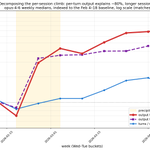
Here's a plot that summarizes this puzzling situation. We can't figure out the cause of the rise in Opus 4.6 token usage around Feb 20. The Mar 4 high-to-medium change only slows the trend too. (The "persistent cohort" helps us feel confident that this is truly an overall trend.)
Does anyone know why Opus 4.6's token consumption in Claude Code would skyrocket specifically in the period Feb 20 to Mar 4, 2026? The model launched Feb 5 with default reasoning "high", but the steep increase for this model doesn't happen until ~2 weeks after launch. Also noteworthy: Mar 4 is when Anthropic changed the default reasoning to "medium", but this seems only to slow the rising consumption rather than reversing it. These observations are based on SWE-chat. We (@mmooritz and I) can control for lots of factors in this dataset (user, project, session length, etc.), and we can't find an explanation for the increase. My own hunch is that there was an unreported change to the reasoning around Feb 20, but I could be missing something.
4
4
1
23
12,043