

The voice intelligence company | MIT-alum founded. LLMs read text. We listen and understand: Try Velma 2.0.
Boston, MA
Joined August 2017
- Tweets833
- Following455
- Followers1.6K
- Likes737




Pinned Tweet
We just raised $25M in new funding led by Future Ventures (@VenturesVc), with @HyperplaneVC and @lakestarvc - bringing Modulate’s total funding to $60 million.
Building the next phase of audio-native AI: more models, more developers, more of the stack that actually understands voice.
Where we stand today:
- Ranked #1 on Hugging Face for deepfake detection and transcription
- 600M+ hours of audio analyzed
- 10M+ hours analyzed every month
A foundational layer of the AI stack is getting more powerful. More soon.


Senior Director of Customer Advocacy. Mid-market team. Real workload. 👀
Here's what he had to say about building with Modulate's Transcription AI:
⭐ 4.5/5 "Flexible API and Superb Integration"
"Modulate strikes the right balance of features for our small team, where simplicity and functionality are very important."
Flexible API. Fast setup. Reliable at scale - for teams analyzing customer conversations without the overhead. 💯


44% of new tracks hitting Deezer every day are fully AI-generated.
97% of listeners in Deezer’s blind test couldn’t tell.
Modulate AI Music Detection is built to.
Vocals and instrumentals scored separately, in batch or streaming.
Real music deserves a real shot.
Test the API free, 1,000 credits on us:
modulate.ai/api-overview?utm…
Stats: Deezer, April 2026.
Modulate retweeted

New series: Velma in the Wild.
We take famous scenes, run Velma on the raw audio, and watch what it hears. No script. No transcript. Just the sound.
Episode 2: A Few Good Men, the courtroom scene.
Everyone remembers “You can’t handle the truth!”
But the shout isn’t the real moment. The confession that comes after is.
Watch what Velma flags on the way there.
Words give you the script. Voice gives you the performance.
Modulate retweeted
Going live in a few hours 🚨
Your next inbound call might not be a person.
William and I are demoing real-time synthetic voice detection: spot the bot mid-call, then route it where it belongs.
Bots one way. Humans the other.
Join us: linkedin.com/events/75190943…


Voice-native fraud detection for banking, insurance, retail and telecom:
modulate.ai/solutions/commer…

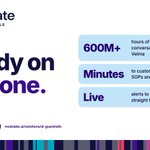
Guardrails for AI voice agents, ready on day one.
→ Built on 600M+ hours of real-world conversations
→ Customize in minutes with your SOPs and code of conduct
→ Live alerts to your team, or straight to your AI
Details: hubs.ly/Q04BRZjN0

~$0.20: a 6-minute voice AI interaction.
~$2–5: a human-handled call.*
So why are AI callers still reaching your humans?
Modulate scores whether a caller is likely human or AI from as little as 2.5s of audio. Humans → humans. Bots → bots.
*Modulate analysis, varies by operating model

Route from the first utterance, using the telephony you already have. Carter breaks down how it works: shorturl.at/8HHsJ
“Wait, that’s not what I meant 🙄”
Our CTO Carter Huffman talks to an AI voice assistant every day. When he says that, it keeps talking for about four more seconds.
A human would stop instantly. Or get called rude.
That’s where voice AI is right now: useful, but still young. It fails in ways people don’t expect and don’t know how to design around. One day it’s perfect. The next it’s mispronouncing words, stuttering, lagging, talking over the caller.
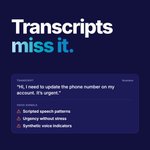
Most of that never shows up in a transcript.
The words look fine. The conversation wasn’t.
Carter joined The Microdose on to break down why, when you’re running voice agents across thousands of calls, you can’t read your way to these failures. You have to listen ↓
That’s what Modulate’s Velma is built for: monitoring AI voice agent conversations in real time, hearing what the transcript leaves out, and flagging issues to your team or your AI before they escalate
Good comms travel.
In Call of Duty®: Warzone™, ~5.5% of players produced at least one prosocial voice interaction. ~22% were exposed to one.
That’s roughly 1 speaker for every 4 players reached.
Modulate’s new case study looks at prosocial voice in North American Warzone™ matches from Dec 4, 2025 to Feb 4, 2026, identified by Modulate’s ToxMod, powered by Velma.
What we found:
→ ~66% of matches with prosocial voice also had a cooperative gameplay event, like a revive or a thanks
→ Same-session continuation: ~77% for prosocial speakers, ~71% for exposed players
→ Exposure reached active, new and returning players, not just the most engaged
Healthy communities aren’t defined only by reducing harm. Positive play is already happening at meaningful scale, and it’s worth understanding.
@Activision


Your next inbound call might not be a person.
Part 2 of our LinkedIn Live series: Carter Huffman and William Brown go under the hood of Modulate’s Synthetic Voice Detection.
Live demo: real-time detection routing bots and humans where they belong.
October 27, 3PM ET. Save your spot ↓
What you’ll see:
→ Spotting synthetic voices as the call happens
→ Routing bots and humans where they belong
→ Taking it from prototype to production
linkedin.com/events/75190943…
Modulate retweeted
I talk to an AI voice assistant every day. It’s genuinely useful.
But when I say “wait, that’s not what I meant,” it keeps talking for about four more seconds.
A human would stop instantly. Or get called rude.
That’s where voice AI is right now: useful, but still young. It fails in ways people don’t expect and don’t know how to design around. One day it’s perfect. The next it’s mispronouncing words, stuttering, lagging, talking over you.
The catch is that most of that never shows up in a transcript. The words look fine. The conversation wasn’t.
If you’re running voice agents across thousands of calls, you can’t read your way to these failures.
You have to listen.