

34 | research AI since 2021 | ex Binance
Joined March 2010
- Tweets8.3K
- Following547
- Followers22.9K
- Likes3.3K


Mojunel.eth retweeted

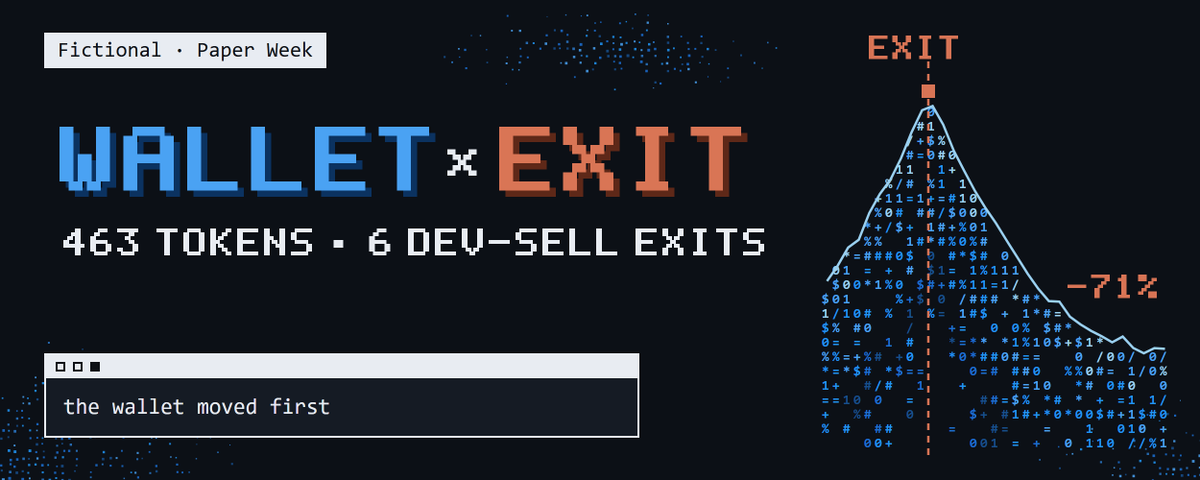
Most dangerous filter a memecoin bot can carry.
I wired a seven-gate checklist and fed it 50 launches. 41 orders died before signing.
1. Authority. Both mint and freeze read null, or the order never fires.
2. Sell simulation. Dry-runs the full exit before a dollar moves. Revert means honeypot.
3. Liquidity. LP burned or locked 30+ days, order capped at 2% of pool.
4. Holder concentration. Top-10 wallets over 30% after stripping pool and burn kills it.
5. Creator history. Two rugs from the deployer in ten launches, coin rejected.
6. Price impact. Chase over 15% or impact above 3% at the moment of signing.
7. Freshness. Any gate older than 10 seconds stops the entire chain.
One fail kills the trade. No overrides.
50 in → 41 refused → 9 through. Score-only wallet: down 34%. Gate wallet: up 9%.
The 6x runner got blocked at one gate. That is what 41 refusals cost.


I loaded Grok Bot a second time with $103
it came out to $5,738.00, and here's the whole damn prompt
first round went $101 to $7,943. second round, same desk, four agents, one task each:
Scanner checks new Solana pools every 15 minutes. Liquidity, holders, top-10, volume, new buyers
Rug Check drops anything suspicious before it moves forward
Momentum only enters on a confirmed move
Exit sells in pieces and follows the plan
small quick trades on routine setups, one larger position on the day's strongest setup, and every dollar of profit rolls back in.
the day dragged. CHOO, HAMSTER, a handфful of minor closes. then the overnight kicked in.
1:45 AM, CHILLCATS. +$1,055 in roughly an hour, larger than every prior big close combined. nearly all the strongest moves came between 10 PM and 6 AM.
and the big closes still weren't the real story. the small trades pulled $3,978, more than double what the five large ones brought in.
one thing worth saying: that single big position on the top setup is what turns a flat day into multiples. it's also the exact spot where it burns if the setup breaks.
85 of 101 green.
full desk in one prompt:
Build a Solana memecoin trading desk in Grok Bot that runs autonomously for 24 hours.
4 agents with clean handoffs: Scanner, Rug Check, Momentum, Exit.
Scanner: scan new Solana pools every 15 minutes. Review liquidity, holders, top-10 concentration, volume and fresh buyers.
Rug Check: drop anything suspicious before it moves on.
Momentum: buy only on a confirmed move.
Exit: sell in pieces, stick to the plan, never chase the exact top.
Sizing: small quick trades on routine setups, one bigger position only on the day's strongest setup. Reinvest all profit.
Run it first.
same desk, two rounds, and the boring trades won both.

Mojunel.eth retweeted

holy sh*t. one memory field feeds ChatGPT, Claude and Codex. re-explaining is dead.
3,948 memories in a single field. ChatGPT, Claude and Codex all pull from the same store.
1. Nine signals feed one field
2. Clusters link every memory
3. Three models read same pool
4. One bad entry hits all three
5. No wall between any layer
Telegram, GitHub, files, CRM, sales calls, email all pour straight in. The blast radius is not one wrong answer. It is every agent hallucinating off the same poisoned entry.
Adding another pipe takes minutes. Adding a permission layer between them takes the rest of the quarter.
The cluster map drifts and every thread tightens around its node ↓

I don't think I'm opening Blender again. A dev put a free Claude skill on GitHub that builds a 3D machine out of one picture and films it coming apart.
i handed it one ChatGPT image, typed "octopus" and waited for it to hand me a toy.
what came back instead:
> nothing got imported, every lens, hose and suction wheel on it is three.js code
> the glass dome on the head is 4 mm borosilicate and it lifts off and flips over mid-air
> a 10-blade iris pulls back from the eye inside a 62 mm ring of light
> each arm ends in a 16-link spiral with 2 rows of suction wheels running down to it
> all 8 arms lock into one 48-tooth hub and 16 hoses spring out when it splits
> one more part breaks loose every 3 seconds and by 0:19 the whole octopus is floating in pieces
the skill only ships with a tarantula, a piranha and a wasp. the octopus wasn't on the list.
the install command and the full brief 👇


Mercedes-Benz spends $2,000,000 on aerodynamics testing, crash simulations, and wind tunnel optimization.
a grandmother on an electric wheelchair strapped to a Jeep bumper just achieved peak highway aero resistance for $40 of stretch wrap.
the clip: a highway at 60 mph. an elderly woman sits calmly in her motorized wheelchair, completely wrapped in industrial plastic wrap, strapped securely to a hitch platform on the back of a silver SUV. she looks directly at the camera, waves, and smiles as traffic flows past.
14M views in 6 hours. half the comments are asking if it’s legal, the other half are nominating her for driver of the year.
here is why your brain thinks it’s engineering genius:
1. The stretch wrap tension dynamically adapts to wind drag, maintaining aerodynamic laminar flow around her headrest
2. The heavy-duty ratchet straps flex precisely under G-force shifts during lane changes on the highway
3. The calm facial expression proves absolute aerodynamic stability at 100 km/h
the toolchain:
> Claude Opus 5: mapped the full trajectory, suspension load limits, wind resistance coefficients, and strap tension thresholds: 8 min
> Kling 4.0: rendered the vehicle vibration physics, plastic wrap flutter, and highway exhaust displacement: 15 min
> Seedance 2.5: animated the continuous rolling motion with realistic motion blur and passing traffic parallax: 20 min
> ElevenLabs: spatialized the highway roar, engine hum, and one driver shouting "absolute legend": auto
Mercedes books a closed test track, a team of safety engineers, a fleet of prototypes, and a 6-month homologation cycle.
this family books a hardware store roll of stretch wrap and an open interstate.
save this breakdown.

I TOLD GROK BOT:
“Create the most insane viral AI vehicle stunt video that could make me my first $500.”
I expected something stupid.
I definitely didn’t expect this.
It gave me a scene where a futuristic supercar literally launches off a ramp on the Golden Gate Bridge, plunges straight into the water, activates vertical jet thrusters, flies back up, and lands smoothly on the road.
It looks weird and interesting enough to make you stop scrolling.
And that’s basically the whole strategy:
> make the first frame impossible to ignore
> use one idea people understand instantly
> keep the environment realistic
> make something progressively weirder happen
> end before people get bored
The funny part is that you don’t need some huge cinematic story.
You need one visual idea that makes someone think “WTF am I watching?” and keeps them there for another 5 seconds.
Grok handled the concept.
AI handled the scene ↓
picsart.go.link/31F4Z
I just turned the insanity into a video people would actually stop for.
One weird prompt. One 45-second clip.
Now I want to see how far I can push it toward that first $500.
Mojunel.eth retweeted
I TOLD GROK BOT:
“Create the most insane viral AI vehicle stunt video that could make me my first $500.”
I expected something stupid.
I definitely didn’t expect this.
It gave me a scene where a futuristic supercar literally launches off a ramp on the Golden Gate Bridge, plunges straight into the water, activates vertical jet thrusters, flies back up, and lands smoothly on the road.
It looks weird and interesting enough to make you stop scrolling.
And that’s basically the whole strategy:
> make the first frame impossible to ignore
> use one idea people understand instantly
> keep the environment realistic
> make something progressively weirder happen
> end before people get bored
The funny part is that you don’t need some huge cinematic story.
You need one visual idea that makes someone think “WTF am I watching?” and keeps them there for another 5 seconds.
Grok handled the concept.
AI handled the scene ↓
picsart.go.link/31F4Z
I just turned the insanity into a video people would actually stop for.
One weird prompt. One 45-second clip.
Now I want to see how far I can push it toward that first $500.


2 follows, 1 message to Grok Bot, sleep. $260 to $3,418.73
13.15x by 6:50am, cashed out every cent before coffee
6:38pm, loaded $260 with Face ID
then i followed 2 wallets off the 24h leaderboard
first wallet, $394,013.99 balance, +$29,570.48 in 24h
second wallet, +$29,741.66 in 24h
then i sent Grok Bot one message
→ mirror each buy 30s behind them
→ sell once they sell
→ take profit at 10x
→ lock everything by 6:30am
9:41pm the wallet i followed bought a coin under an hour old
9:42pm Grok Bot copied the trade at $72K market cap
12:00am it reached $720K. Grok Bot sold at 10x, +$1,603.35
that wallet kept holding. the bot moved on
3:33am the second wallet dropped a loser, Grok Bot dropped it too, -$0.41
$260 to $1,887.89 to $3,418.73
5 copies, 4 green, 1 red
same coin. that wallet made $12,540.19, i made $1,603.35 off $178.15
who trades smarter, you or the bot that cashed 10x while the wallet held?
Oh god, did you see this? This is literally going to change how teams run automated operations forever.
A multi-agent autonomous system hooked to an admin backend is running entirely in the background, managing complex video reviews, auditing footage events, and handling operational workflows without manual intervention:
> Autonomous Event Processing: The agent swarm instantly analyzes surveillance data, scans timelines for flagged events, and categorizes security incidents based on custom parameters.
> Unified Dashboard Control: All neural workflows and data filtering happen seamlessly through a centralized dashboard, turning raw security logs into active, structured insights.
> Real-Time Data Orchestration: Automated pipelines bridge complex database storage and interactive UI actions, synchronizing background system agents with instant operational updates.
We are no longer just clicking through endless folders and sorting timelines manually.
We are deploying autonomous AI swarms that control entire enterprise backends right behind our screens.
Bookmark this before multi-agent automation takes over every business setup on the market.

Mojunel.eth retweeted
Nuts, token-cost team in 10 repos.
Claude Code Max at $100 a month and agents still torch the plan limit on raw tool noise.
compression. filtering. replies. costs. retrieval.
01 LLMLingua → squeezes prompts up to 20x before the API call
github.com/microsoft/LLMLing…
02 rtk → filters git, test and build output, cuts 60–90% of dev-command tokens
github.com/rtk-ai/rtk
03 headroom → compresses logs, JSON and RAG chunks before the model reads them
github.com/headroomlabs-ai/h…
04 lean-ctx → reads signatures or diffs instead of dumping whole files
github.com/yvgude/lean-ctx
05 caveman → forces terse agent replies, cut 33.2% of session tokens across 54 runs
github.com/JuliusBrussee/cav…
06 TokenEconomizer → Microsoft cost controller for Claude Code, drops mean cost 18.4–30.9%
github.com/microsoft/TokenEc…
07 code-review-graph → code graph for the agent, 2,196 tokens per answer vs 143,594
github.com/tirth8205/code-re…
08 graphify → turns repo and docs into a queryable graph, zero LLM credits
github.com/safishamsi/graphi…
09 token-savior → navigates code by structure and carries memory across sessions
github.com/Mibayy/token-savi…
10 jcodemunch-mcp → fetches the one function you need, 94.5% fewer tokens per lookup
github.com/jgravelle/jcodemu…
compress → filter → shorten → cap → retrieve
rtk engine runs BUSL-1.1 and jcodemunch charges for commercial use.
Fewer tokens per task ↓

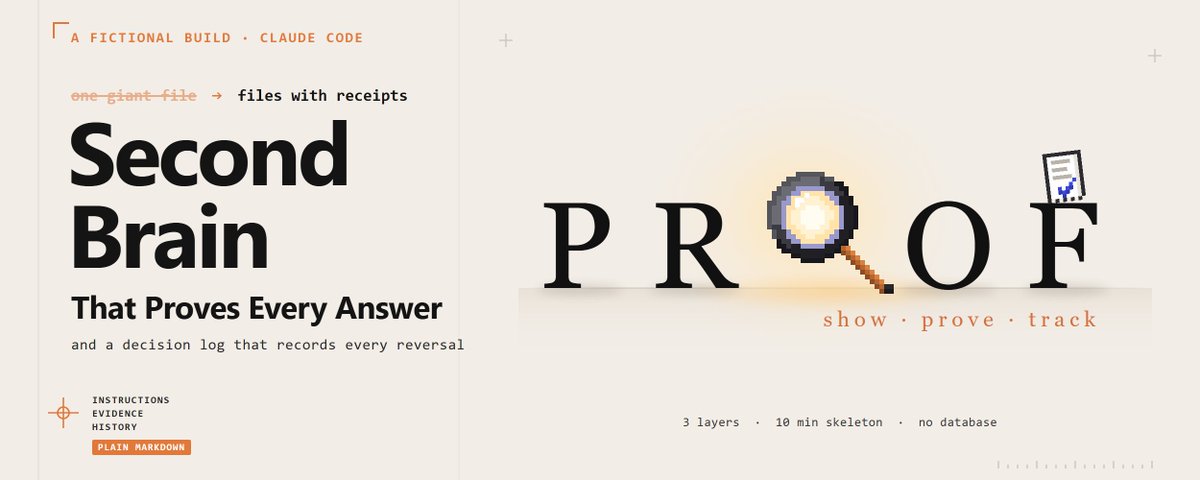
Haven't second-guessed a note in five months
I split one giant scroll into four files and every answer now lands with a dated receipt.
Drop a link into the inbox. The pipeline does the rest:
1. Promote into a topic note: summary, evidence pointer, open question
2. Stamp a source receipt: URL, check date, recheck trigger
3. Log the decision: choice, reason, tradeoff, status, revisit condition
4. Flag outdated claims the moment a date goes cold
5. Return a prioritised checklist after a 6-step audit
January tool note. March reversal. June query pulled both entries and killed the recommendation on the spot.
4 files. 6 steps. 10 minutes to build.
Every answer has a receipt.
Claude + Obsidian + Axiom just completely broke the meta for productivity and automated trading, and it's scaling faster than anything we've seen before...
It links deep AI reasoning, local knowledge graphs, and on-chain execution so seamlessly that manual work practically disappears.
Two days ago I wired this setup together, and now my entire workflow runs on autopilot: from structuring project architecture to tracking real-time liquidity and executing swaps.
Claude + Obsidian + Axiom combined do this:
→ Claude instantly generates and structures complex code, logic, and task pipelines right inside the workspace
→ Obsidian maps out the entire knowledge base and connects project nodes into a unified, clean architecture graph
→ Axiom automates data fetching, monitoring, and on-chain actions across decentralized markets without extra friction
→ Real-time analytics and data pipelines run 24/7, saving hours of manual routine every single day
Everything runs as a single unified engine, and I've set up automated monitoring for any incoming tasks and market shifts.
The exact setup is in the first comment and takes ten minutes. Save this and send it to any developer or trader still doing everything manually.
straight up insane, a whole web-scraping team in 10 repos.
Firecrawl cloud charges $99 a month for 100,000 credits. Most of this list runs on your machine for nothing.
Fetch. Unblock. Extract. Drive. Scale.
01 Firecrawl → Search, scrape and interact with pages through one API
github.com/firecrawl/firecra…
02 Camoufox → Firefox browser built for scrapers and AI agent pipelines
github.com/daijro/camoufox
03 Scrapling → Parse pages that change layout, 785x faster than BS4
github.com/D4Vinci/Scrapling
04 Crawl4AI → Crawl pages into agent-ready markdown, no per-page fee
github.com/unclecode/crawl4a…
05 ScrapeGraphAI → Describe the fields you need, the LLM extracts them
github.com/ScrapeGraphAI/Scr…
06 Apify MCP → Agent picks a ready-made scraper and runs it on Apify
github.com/apify/apify-mcp-s…
07 Nanobrowser → Run an AI agent right inside your signed-in Chrome
github.com/nanobrowser/nanob…
08 agent-desktop → Read and drive desktop apps through the accessibility tree
github.com/vercel-labs/agent…
09 Maxun → Record a robot by clicking, schedule it to scrape
github.com/getmaxun/maxun
10 Crawlee → Queue and retry crawls at scale with Playwright and proxies
github.com/apify/crawlee
Point it at one URL.
Fetch → Unblock → Extract → Drive → Scale.
Three carry copyleft. Check the license before shipping a hosted wrapper.
Which stage eats most of your agent's time right now?
Oh god f*ck, is this even possible? Someone just ported the original Bully game into Unreal Engine using AI, and the live rendering and asset translation is genuinely terrifying.
Watch what happens as the player runs through the school grounds in real time. Instead of old-gen limitations, you can watch modern engine lighting and native physics breathe new life into a classic:
• AI-Powered Migration: Overnight, Claude Opus 5 processed original asset structures, translating legacy data cleanly into a cutting-edge environment without manual rebuilding.
• Next-Gen Fidelity: The classic academy layout now runs smoothly on Unreal Engine, complete with high-end reflections, modern rendering, and full controller support.
• Seamless Integration: Every corridor, courtyard, and texture was brought over natively, bypassing traditional multi-year game porting cycles entirely.
We are no longer just remastering old software; we are watching legacy worlds wake up in next-generation engines overnight.
Bookmark this before AI completely rewrites the entire game development industry.
A robotics startup burned $61 in tokens to find the bug that had cost it four months of hardware revisions.
The arm kept dropping objects at a rate nobody could reproduce, roughly one grab in forty, always at a different moment.
Three physical redesigns went past before anyone questioned whether the fault was mechanical at all.
Opus 5.5 read the full sensor log instead of the incident reports, and the pattern showed up inside an afternoon.
> PULL - every grab logged, successes included, not just the drops
> ALIGN - sensor timing compared against the moment of failure
> SPLIT - failed grabs separated by what preceded them, not by object
> TRACE - the delay followed back into the firmware loop
> PROVE - the fix tested against the archive before any hardware moved
The drops happened when two sensors reported in the wrong order, which occurred only under a specific thermal load.
No redesign could have caught it, because the hardware was never wrong. The software believed a reading that had already expired.
Teams reach for new parts because a physical fault feels like a physical problem, and the logs sit unread the whole time.
Four months of machining and three prototypes went into chasing something that lived in a timing window.
The sensor trace and the one line that fixed it are in the article below.


someone built a virtual office right inside their terminal
a guy deployed 20 autonomous ai agents to simulate an entire agency using claude opus 5 as the brain for every single workstation
one weak laptop and local pipelines. clients thought he hired a whole floor of senior managers
he entered one prompt, built the floor plan and went to sleep
by morning the agents checked 45 pull requests, deployed 12 features, sorted client emails and left one note: stanley tried to poison the coffee again
the consulting agency he competes with charges 14500 dollars a month for the same sprint volume
he spent 12 dollars and 40 cents on this
right now millions of agencies work manually and keep paying monthly for the work that agents finish overnight
and fewer than 70 thousand people on earth know how to set this up. that is millions of businesses for every one of them
i told you about one of those below

a founder just built a company of 27 AI agents on a Mac Mini that runs his entire business without him
it’s broken up across 6 different departments: communications, sales, finances, clients, marketing/growth, and tech running his daily operations
these aren't just visual art, they are real functional AI agents you can click into to see every single skill and SOP being run
in the middle sits his full company knowledge base built on G-Brain, handling everything in the company through a simple directory
every workflow is connected to whatever AI agents and humans are necessary, whether human-led, human-assisted, or fully autonomous
the best part: he has this whole thing hosted on his Mac Mini so he can run it on the go
thousands of traditional companies are still doing everything manually, waiting for someone to build a full AI agent enterprise
Opus 5.5 dropped into Roblox Studio and three games ship every week
A 22-year-old in Lisbon pulls $9,700 a month running this exact same stack.
Every line on the cost sheet:
Opus 5.5 Max plan. $100 a month.
Roblox Studio. Free.
DevEx cashout. 0.0038 per Robux.
Floor payout. 30,000 Robux, $114.
One prompt opens the agent session.
Code scrolls, Studio loads the build.
Four playtests run. Clicker, tycoon, egg hatch, arena.
Red errors in the output log. Next build loads.
Three games a week. One plan.
Anthropic. buried. this. in the docs.
A three-model split killed my costs.
I was feeding Opus 5.5 every task. Every grep, every search, every diff audit. The priciest context window in the stack, burning on work that needed seconds.
Then I found one flag.
claude --model sonnet --advisor opus
Sonnet 5.5 took the main seat. Wrote code, applied fixes, coordinated the build. I set three Haiku 5.5 subagents loose on the repo:
→ search mapped modules
→ grep found call sites
→ audit checked the diff
All three ran in parallel, read-only, in throwaway worktrees. Opus 5.5 never touched a file.
It sat on call as advisor and only stepped in at three moments:
1. Before a plan locked
2. Same error showed up twice
3. Before calling it done
Routine tokens landed on the cheapest model that could carry them. Every judgment call went to the one built for it.
Sonnet 4.6 with an Opus 4.6 advisor scored 2.7 points higher on SWE-bench Multilingual. Cost per task dropped 11.9%.
The 5.5 generation runs the same advisor split on a single flag.
The advisor is experimental, Anthropic API only, and every advisor token bills on top.
Mojunel.eth retweeted
Karpathy's repos just ate my entire AI path
7 repos. 306,741 stars combined. I went through every single one in order.
micrograd came first. About 100 lines of Python for backprop from scratch.
nn-zero-to-hero. 8 free lectures from a single neuron all the way to GPT.
minbpe. Tokenization in minimal code. 10.9k stars. I nearly walked past it.
Every model I touched after minbpe ran better than the day before.
nanoGPT: 64.3k stars but deprecated. Its own README sends you to nanochat.
nanochat: 59.1k stars. About $48 for what cost about $43,000 in 2019.
autoresearch closed the whole chain. 98.9k stars. Agents on 5-minute loops.
About 100 experiments ran overnight while I slept. Kept or dropped by loss.
Each repo stands on the one before it. Skip one step and it all goes dark.
Start with one file