Molíkův vesmír retweeted
It's been 60 years in the making and it's all thanks to you the fans! Happy Birthday @StarTrek! My best, Bill
Molíkův vesmír retweeted
The Pelican Nebula is slowly being transformed. IC 5070 (an official designation) is divided from the larger North America Nebula by a molecular cloud filled with dark dust. The deep featured picture from Utah, USA incorporates 25 hours of exposure and brings out great details of this filamentary dust. The Pelican Nebula receives much study because it is a particularly active mix of star formation and evolving gas clouds. The light from young energetic stars is slowly transforming the cold gas to hot gas, with the advancing boundary between the two, known as an ionization front, visible in bright orange on the upper right. Particularly dense tentacles of cold gas remain. Millions of years from now, the Pelican Nebula, bounded by dark nebula LDN 935, might no longer be known as the Pelican, as the balance and placement of stars and gas will surely leave something that appears completely different.
Image Credit & Copyright: Mark Killion
Co by měl Aleš Svoboda vzít sebou do vesmíru?
ceskacestadovesmiru.cz/co-vz…
Pozvánka na akci: Pozorování částečného zatmění Slunce v Ostravě. Planetárium a hvězdárna Ostrava si připravilo speciální večerní program plný pozorování, přednášek a projekcí ve sférickém kině, včetně online přenosu ze Španělska. 12. 8. 2026, od 15:15 kudyznudy.cz/akce/pozorovani…
Pozvánka na srpnové akce Ždánické hvězdárny, včetně mimořádného pozorování částečného zatmění Slunce a Perseid
Molíkův vesmír retweeted
🌠 Look up! The Perseid Meteor Shower reaches its peak August 12-13, offering one of the year's best celestial shows. You may spot dozens of meteors streaking across the sky each hour! Grab a blanket, find a clear view of the night sky, and enjoy this spectacular cosmic event. ✨
Pozvánka na akci: Zatmění Slunce a Perseidy v Beskydech. Pozorování částečného zatmění Slunce, Perseid i planet, hledání meteoritů, expozice Muzea Meteoritů, dětská zóna, letní kino s Paxi. Středa 12. srpna 2026, Restaurace a pivovar Kohutka. Vstup zdarma. muzeum-meteoritu.cz/ke-cteni…
Molíkův vesmír retweeted
Turn around bright eyes ☀️🌑🌍
On Wednesday, Aug. 12, a total solar eclipse will cross Greenland, Iceland & Spain, with a partial eclipse visible as far as parts of North America & western Africa.
Not in the path? Watch with us, starting at 1:15 pm ET!
nasa.gov/live
Molíkův vesmír retweeted
🌑🌠🪐 FLASH || Le 12 août 2026, quatre événements célestes majeurs coïncident : une éclipse solaire totale, le pic des Perséides, une nouvelle lune et un rare alignement de six planètes (Jupiter, Mercure, Mars, Uranus, Saturne, Neptune), entièrement visible uniquement au télescope.
Molíkův vesmír retweeted
The Stunning Andromeda Galaxy captured above a mountain peak, glowing clearly in the night sky. This rare shot reveals our nearest major galaxy shining 2.5 million light-years away, perfectly aligned above the landscape — a breathtaking blend of Earth and the cosmos.
Molíkův vesmír retweeted
I made an astronomical clock for smartwatches (Wear OS only)
Once you learn how to read it, you can tell what time it is everywhere on Earth at once, and find all celestial objects in the sky. It goes counterclockwise because that's how the Earth spins when viewed from north
Jak by vypadalo Vaše jméno z vesmíru?
science.nasa.gov/specials/yo…
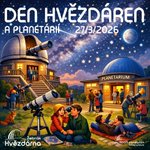
Tip na akci: V pátek 27. března 2026 proběhne po celé ČR Den hvězdáren a planetárií – skvělá příležitost vyrazit za pozorováním hvězd s dětmi, s přáteli nebo jen tak sami a objevit hvězdárnu ve vašem okolí. Více zde: astro.cz/clanky/ostatni/den-…
For the first time, astronomers captured a clear image of a young 'Sun' blowing bubbles in the galaxy using NASA's Chandra X-ray Observatory. This discovery reveals clues to how our Sun behaved in its earliest stages.
Learn more: go.nasa.gov/3PsHDpK
LIVE: Northrop Grumman's uncrewed Cygnus XL spacecraft is departing from the @Space_Station. Release is scheduled for 7am ET (1100 UTC). nitter.cf/i/broadcasts/1YxNrZRLW…
For 20 years, our Mars Reconnaissance Orbiter has searched the planet for signs of long-ago water. It has sent back photos that are not only stunning, but useful – they'll help us when future astronauts land on Mars to explore it. Which is your favorite?