

Enabling open access to fair financial markets on neutral ground || account by Monad Foundation || https://nitter.cf/t.co/oM9xT93LGf
Joined December 2020
- Tweets3.4K
- Following252
- Followers1.1M
- Likes11.3K





Monad retweeted

The winning blockchain will offer:
- MEV-resistance
- scalability
- Quantum resistance
- privacy
These properties are rooted in basic user expectation. They are hard to deliver in full combination on a decentralized, censorship-resistant, open ecosystem. North Star


Monad retweeted

Credit is the multiplier for the economy and starting to take root even further for onchain markets.
We’re hosting a private event in SF on Tuesday (11/17) with @raincards and will have a short panel with co-founder of Morpho @MerlinEgalite there in person to discuss the future of credit.
Checkout the link to register - luma.com/future-of-credit

Monad retweeted

Nobody really just wants money.
Money is just a means to an end: security, opportunity, freedom, even status.
Those ends haven’t changed.
What's changing is the technology underneath the decades old financial system.
Introducing Money Machines, a podcast about how finance is becoming 24/7, programmable and agent-driven.
Join hosts @chuk_xyz and @rparekh as they speak with operators working on stablecoins, tokenized assets and artificial intelligence.
The conversations examine how emerging financial systems work, what it takes to build them and what these shifts mean for businesses and investors.
The first episode drops tomorrow. Links in the first reply.
Powered by @raincards
🤖 Made with AI
Monad retweeted
Privacy is eroded in a variety of places. Here is an important one: currently, third-party RPC providers can see what accounts you are reading, and what transactions you are simulating before you send them.
Perhaps most significantly, if your browser wallet has multiple accounts, the provider can group them together by seeing which accounts are queried from the same IP address at the same time.
@category_xyz researchers have addressed this with WP-ORAM (write-public ORAM), a new means of making servers oblivious to what data is being read, while keeping writes (and the actual state) public. The paper includes both a proposal and a real, pragmatic implementation that can keep up with Monad.
Practical innovation to solve real privacy problems. Great job @AnanyaAppan James Austgen @KushalBabel @sourav1547 !


Monad retweeted
Quantum Cadence is a step forward for consensus, delivering the properties that we think blockchains really need: quantum-security, extreme pipelining, and censorship-resistance.
We've published a primer, starting with the fundamentals:
monad.xyz/blog/quantum-caden…

Monad retweeted
In this age of AI-empowered attackers, the only way forward for our industry is to continue hardening. Security should be every team's top focus.
The Monad Foundation invests heavily in security and is sharing the following resources to the community:
Everyone:
- The Crypto OpSec Bible: monad.xyz/blog/crypto-opsec-…
Smart contract developers:
- Importance of not relying on EOAs for admin roles: monad.xyz/blog/say-no-way-to…
- Importance of only signing admin functions on a dedicated laptop: monad.xyz/blog/monad-foundat…
Hardening code with Ultrafuzz, our open source tool for agentic fuzzing and threat hunting:
- Codebase: github.com/monad-developers/…
- Overview: monad.xyz/blog/ultrafuzz
- monad.xyz/blog/open-sourcing…
Learnings from the field on threat hunting with LLMs:
- monad.xyz/blog/writing-secur…
- monad.xyz/blog/evaluating-my…
Learnings from securing code with Formal Verification:
- category.xyz/blogs/finding-b…
- category-labs.github.io/cate…

Monad retweeted
Quantum-Resistance is hard because PQ signatures are much larger (25x larger) and quorum certificates on PQ signatures are much much larger (2500x larger)
So, @category_xyz solved this problem with Quantum Cadence, a new version of Cadence that eliminates quorum certificates altogether. The new protocol actually scales better with more proposers.
Incredibly exciting developments in the Monad world. Monad will simply run faster as quantum takes center stage
Today we are releasing Quantum Cadence, a post-quantum version of Cadence, our consensus protocol with multiple concurrent proposers. Quantum Cadence uses no quorum certificates, and its safety and liveness do not depend on signatures.
Most modern consensus protocols, Cadence included, rely heavily on signatures and quorum certificates, which a large-scale quantum computer could forge. Simply replacing today's signatures with post-quantum ones would make certificates too large for every validator to send around in a high-performance blockchain. Quantum Cadence instead draws on Forget-IT, a recent signature-free consensus protocol co-developed by researchers at Category Labs.
Quantum Cadence still keeps the overall architecture and core guarantees of Cadence, so our Cadence prototype was easy to carry over: an AI was able to adapt it to Quantum Cadence in a few hours, and an early prototype now runs on an internal test network.
We designed Quantum Cadence to be practical for a high-performance blockchain. In our simulations, its latency is similar to Cadence's, and it scales better with the number of proposers.
Interactive explainer: category.xyz/quantum-cadence.
Full paper: arxiv.org/abs/2610.32803.
Joint work by @MohammadMJalal1, @TobiasKlenze, and @komasito55
Monad retweeted
I am a technology optimist. I believe:
1. decentralization and censorship-resistance (real versions of these properties, not larps) matter to human freedom in the coming age of AI
2. self-sovereign money, implemented by code and maintained through decentralized consensus, is the final form of money. But it needs to be truly decentralized -- cut out every possible weakness, trust assumption, keeper, etc. Of course there will be connectors to the real world - harden those maximally
3. AI will write most smart contract code. Spec-driven development with Formal Verification will be how new contracts are written rigorously. FV will also be crucial to securing all the infra including the blockchain itself
4. AI will harden our surfaces, with some unfortunate hacks in the process, but ultimately the crypto and financial industries will come out stronger
5. properly-constructed and properly-indexed data lakes will enable agents to build software far more productively
6. governments will move to restrict AI usage in the future, causing true decentralization and CR to matter in dramatic fashion
7. quantum security will be a must for any ledger where people trust their assets. And specifically, blockchains will need to deliver quantum-resistance while retaining programmability and performance. Again, no larping
8. ZK will be an important part of the puzzle too, as it'll be increasingly important to prove off-chain computation and utilize the result on chain. But again, performance and effortlessness for users will be the differentiator
9. pragmatic and composable privacy will be the missing piece for real adoption. People will use apps that stack together stablecoins, DeFi, blockchain settlement, passkey or MPC authentication, and friction-free onramps, but the part that gets fintechs over the line is knowing that user balances will remain private while still being able to tap into shared liquidity
10. blockchain will serve as the global, universal marketplace, for anyone anywhere to get the best opportunities. For that we will need guarantees of fair execution, protection from frontrunning, and a convergence of all of the best assets
At @category_xyz and the @monad Foundation, we are assembling all of these missing pieces in parallel with extreme urgency, and I hope this is clear from our actions. See you in the future
Monad retweeted
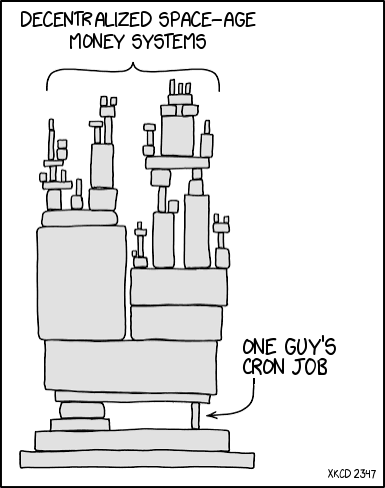
Yesterday's Railway issues, and an increasing stream of cloud provider incidents, highlight a major issue: decentralized apps have no way of scheduling or automating smart contract calls. Someone needs to run that cron on a server, which are becoming increasingly unreliable in the age of AI.
The point of decentralized systems is that we shouldn't need to rely on a single server to maintain an invariant that protects the correctness and solvency of self-sovereign money protocols. Automation needs to move to the blockchain, where a network of distributed nodes brings fault-tolerance and checks-and-balances.
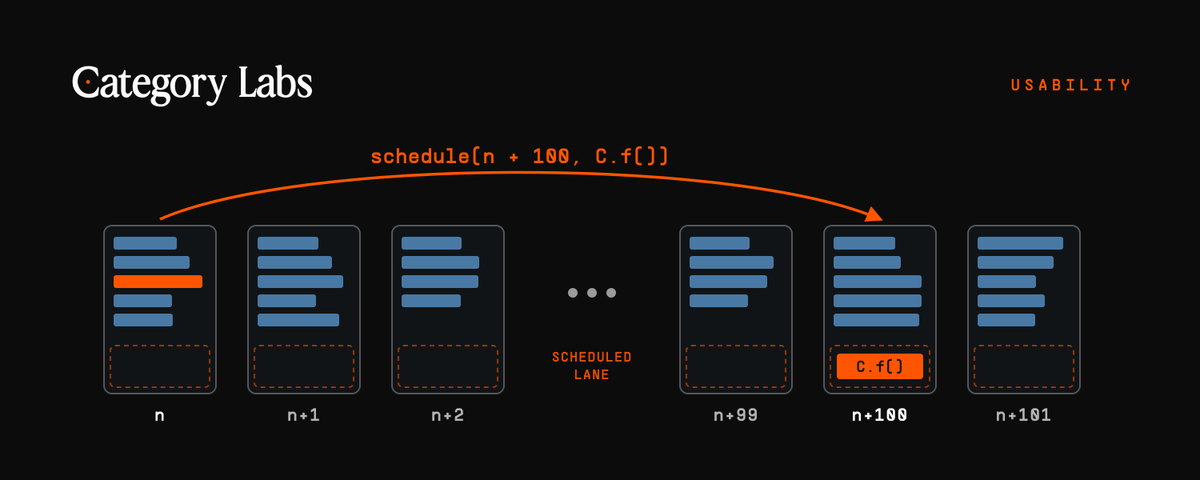
Scheduled Transactions are how we accomplish that.
Scheduled Transactions are far more than a replacement for keepers. They let users and applications alike set up interactions that recur on a cadence, happen once at a chosen moment, or follow from something that happened earlier.
Check out the details below, as well as a few examples of what you can build with Scheduled Transactions, such as on-chain keepers, recurring payments, long-running (asynchronous) computations, automatic refunds in atomic swaps, and order-book cleanup.

Monad retweeted
More info about the Formal Verification effort on Monad: category.xyz/blogs/finding-b…


Monad retweeted

We're excited to welcome @monad as a sponsor of UBC 2026! 💜
Monad is a high-performance, EVM-compatible blockchain built to enable highly performant apps.
With a strong focus on developer adoption, Monad Foundation regularly hosts hackathons and is looking to work with university blockchain communities around the world.
If you're a student interested in learning more about Monad, make sure to meet the team at UBC 2026!


Monad retweeted

Metropolis submissions end tomorrow
Submit your projects here:
hackathon.monad.xyz

Monad retweeted

FULL CONVERSATION: The Monad Institutional & Onchain Trading Barbell Thesis Is In Full Swing
@keoneHD @keoneHD @robbieklages
Timestamps:
00:00 Intro
01:30 Monad Needs Both Sides Of The Barbell
03:45 Keone Refused To Cut Corners From Day One
05:23 Privacy And Composability Cannot Coexist Yet
06:07 Speed Is Everything Lesson From Mainnet
Monad retweeted
Monad’s focus:
- MEV-resistance
- Multiple concurrent proposers
- Quantum security
- Private domains integrated into public liquidity
while continuing the march toward the endgame architecture of decentralized systems


