



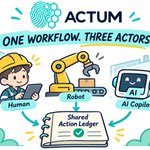


The Hidden Cost of Investigating an AI Mistake
Imagine a factory where an automated system makes a wrong decision and production stops for two hours. Fixing the machine might be straightforward, but figuring out why the decision happened could take much longer.
Engineers may need to compare system logs, check operator instructions, review sensor readings, and reconstruct the sequence of events. When those records are scattered across different systems, even a small incident can become an expensive investigation.
This is one practical reason I find @Actum_AI's behavioral evidence approach interesting. ACTUM aims to preserve the context, authorization, and execution history of actions, making it easier to reconstruct what happened when something goes wrong.
The potential benefit isn't limited to identifying responsibility. Better evidence could also reduce investigation time, reveal recurring operational weaknesses, and help teams prevent similar incidents.
I'd be interested to see ACTUM publish a real case study comparing investigation time before and after deployment. That would help demonstrate the business value of its approach beyond technical specifications.
#Actum
🤝 Paid partnership


When Humans, Robots and AI Share the Same Workplace
Imagine a modern factory where an engineer approves a maintenance task, a robot performs the operation, and an AI system monitors the results. Everything works smoothly until a machine suddenly fails.
Who should investigate the problem, and how can they determine which part of the process went wrong?
This is an interesting direction in @Actum_AI's recent discussion about the future workforce. ACTUM proposes bringing human actions, industrial robots, and AI copilots into a shared behavioral ledger, where their activities can be traced under consistent rules.
What makes this approach valuable is the ability to connect different participants in a single operational process. Instead of reviewing separate reports from employees, machines, and software, organizations could reconstruct how a task moved between them.
Of course, recording actions doesn't automatically determine legal responsibility. But reliable evidence can make investigations more transparent and help companies identify weaknesses in their workflows.
As workplaces become increasingly automated, I believe this kind of coordination will matter just as much as the intelligence of individual machines.
#Actum

dmann retweeted

Actum’s PoHA is already running in production across two very different industries - rail equipment manufacturing and commercial hospitality.
Different operational needs on the surface, same underlying problem underneath: when an action happens, who is accountable?
One shared ledger, same verification process. The real question is how far this model can travel beyond these two settings. 👇

One Ledger, Two Very Different Industries — How Does That Work?
Actum's PoHA runs in production in two completely different settings: a rail transit equipment manufacturer, with 5,000+ machines and operators doing hourly inspections; and a commercial hospitality setting, with guest data and service records flowing back and forth.
What the two settings need looks nothing alike — the factory needs every bolt's inspection tied to a person; the hotel needs every data access traceable. But underneath, the problem is the same: when an action happens, who was there, who authorized it, can you trace it afterward, can you hold someone accountable?
PoHA's answer is one shared ledger: Humans, Machines, and AI Agents, verified against the same standard, speaking through the same evidence. A pre-frozen codebook before the action, six-dimensional verification at the gate, signed attestation after — a factory inspection check-in and a hotel data access go through the same process.
The numbers: the ledger now produces ~5,800 verified events a day across 5,300+ endpoints, with 174,000+ on-chain attestations in the past 30 days, 0 failures, 99.986% coverage.
Different industries, same ledger. That's why PoHA can move from one setting to another: it doesn't solve one industry's business problem. It solves the problem every industry shares — who is accountable for what AI does.

dmann retweeted
In a factory with 5,000+ machines, you can’t photograph every normal bolt every hour.
Actum’s 5-State Behavioral Evidence Model including Contextual Silence, lets you capture full operational accountability without drowning people in paperwork.
Curious how others here think about handling “nothing abnormal happened” as valid evidence. Drop your view below 🔗
In a factory with 5,000+ machines, operators can't photograph every normal bolt every single hour.So how do you capture 100% operational accountability — without drowning humans in paperwork?Enter Actum's 5-State Behavioral Evidence Model — and the power of Contextual Silence. 🧵👇

SimpleChain Update #3: From Testnet Activity to Real-World Assets
My previous posts covered SimpleChain's testnet activity and validator network. But there's another important part of the project worth exploring: how its infrastructure connects to real-world assets.
@SimpleChain_RWA has introduced CycleYield Fund #001 through @DataIPO_RWA, its RWA launchpad.
Unlike a typical token launch, this product is based on receivables generated by smartphone leasing activities.
According to the project's announcement, the model includes:
• Income linked to actual leasing payments and repayments.
• Daily on-chain synchronization of leasing and cash-flow data.
• Physical smartphones serving as underlying collateral.
• A structure designed around business-generated income rather than token emissions.
SimpleChain provides the blockchain infrastructure, while DataIPO handles the asset issuance side of the ecosystem.
The team has also announced DataIPO's deployment on BNB Chain as its first issuance chain.
What interests me here is the connection between the infrastructure and an actual financial product.
The next important question is how consistently asset data, repayments, and operational performance can be verified over time.
That's the kind of progress I want to keep following.
#SimpleChain #DataIPO #RWA
🤝 Paid partnership · 🤖 Made with AI

In my previous post, I covered @SimpleChain_RWA's testnet activity, including over 226 million transactions and more than 1 million addresses recorded on its explorer.
But transaction numbers are only one part of a blockchain's development. Another important part is the infrastructure responsible for keeping the network operational.
According to SimpleChain's staking dashboard, the network has reported 13 active validators.
Validators play an essential role in processing transactions, participating in consensus, and maintaining network security.
SimpleChain's documentation also describes a staking-based security model, where network participants contribute to the validation process.
For a Layer 1 focused on Real World Assets, reliable infrastructure matters. Asset records, transaction histories, and on-chain operations all depend on a network that can maintain consistent and verifiable records.
The next things worth following are validator participation, network stability, and further technical updates from the team.
You can explore the staking dashboard here:
staking.simplechain.com/
#SimpleChain

1
1
23
5X Points? Looks like Sweep just turned up the heat!
There's something worth checking out today in the @SweepGlobal ecosystem.
The ActionFi × Sweep Black Friday campaign is bringing a limited-time points boost, giving the community more reasons to explore different activities.
Here's what's on the table:
🔥 5X Points for Rugs, Up/Down, and Sweepbird.
🔥 4X Points for creating X content about Sweep.
And there's also a $30,000 prize pool promotion, with $250 prizes for selected winners under the campaign rules.
What I like about this event is that it connects different parts of the Sweep ecosystem. Whether you're interested in gaming, predictions, or creating content, there's more than one way to participate.
Of course, bonus points aren't guaranteed token rewards, and the prize draw isn't guaranteed income.
The campaign is scheduled for just 24 hours, from November 20, 00:00 UTC.
I'll be keeping an eye on how Sweep continues to connect community participation with its growing ecosystem.
Check the official details before joining.
#SweepFinance #SWEEP #ActionFi
🤝 Paid partnership · 🤖 Made with AI

Sweep's Block 0: From “Trust Us” to “Verify It Yourself”
One update from @SweepGlobal that deserves more attention is the announcement that Sweep is now on-chain.
Why does this matter?
In Web3 gaming, transparency is just as important as the gameplay itself.
Players shouldn't have to rely entirely on a platform's promises when it comes to their activity and rewards.
According to Sweep's latest announcement, gameplay activity, earned rewards, and user actions are now recorded on the blockchain.
That introduces an important distinction: A platform telling you what happened is one thing. Having a record that users can independently verify is another.
For an ecosystem that includes games like Sweepbird, Rugs, Up/Down, and prediction markets, this could become an important part of building long-term user confidence.
But there's still something worth watching.
Recording activity on-chain doesn't automatically guarantee that every game is fair or that every reward mechanism works perfectly.
The real test is how easily users can verify those records and how transparently the system operates over time. To me, that's what makes this update interesting.
Sweep is moving the conversation beyond earning points and toward something more fundamental: accountability.
I'll be watching how @SweepGlobal develops this on-chain infrastructure and makes it accessible to everyday users.

2
4
51
dmann retweeted

In a factory with 5,000+ machines, operators can't photograph every normal bolt every single hour.So how do you capture 100% operational accountability — without drowning humans in paperwork?Enter Actum's 5-State Behavioral Evidence Model — and the power of Contextual Silence. 🧵👇
dmann retweeted
🚨 Weekly AI Fail Check #3 is here!
What wild mistakes did you see an AI agent make this week? Auto-ordering the wrong thing, deleting the wrong file, sending test data to a real customer, or confidently talking nonsense in a group chat?
A fail itself isn't scary. What's scary is when nobody knows, nobody is accountable, and there's no way to trace it back. Most agent failures don't happen because the agent is "not smart enough" — they happen because there's no gate before it acts: no pre-frozen rules, no entry verification, no signed behavioral record. It fails, and you can't even investigate it properly.
So the same question as always this week: drop your AI fail screenshot or story in the replies, tag @Actum_AI, and tell us whether an entry "Circuit Breaker" could have stopped it.
The 3 best answers win 10 USDT each. 🏆
That's exactly what Actum's PoHA is for: a pre-frozen codebook before the action, six-dimensional verification at the gate, and signed attestation after — so every agent action has someone accountable for it.
This is fine. Everything is fine.
Meanwhile, quantum computing is getting stronger, and Satoshi's legendary 1,096,361 BTC is still sitting there like one of the biggest treasures in crypto history.
Crypto community: "Bitcoin has survived everything so far. What's the worst that could happen?" Quantum computers: "Give us a little more time."
That's exactly why MemeBitcoin caught my attention.
@1096361BTC is turning a serious conversation about future quantum threats into something the internet understands best: MEMES.
The funny part? We're all a little like the dog in this picture. Sitting comfortably, drinking coffee, watching technology evolve, and pretending there's nothing to worry about.
Of course, quantum computers aren't breaking Bitcoin today. But potential future risks deserve attention before they become real problems.
Sometimes a simple meme can start a conversation that a hundred technical articles never could.
1,096,361 BTC. One legendary wallet. One very nervous cup of coffee.
#Meme
🤖 Made with AI

Meet Q-BIT – The Pixel Guardian of MemeBitcoin!
In a world built from blocks, where ancient treasures meet futuristic technology, a new guardian has emerged.
His name is Q-BIT, a brave pixel warrior inspired by the nostalgic world of Minecraft and classic gaming adventures.
Wearing black and gold armor, Q-BIT carries a golden Bitcoin shield representing Satoshi Nakamoto's legendary legacy of 1,096,361 BTC. In his other hand, a glowing quantum staff symbolizes the rapid advancement of quantum computing and the potential security challenges it may bring.
But Q-BIT isn't fighting alone. His loyal little companion represents the strength of the crypto community, reminding us that awareness and preparation are responsibilities we share.
I chose this pixel-style mascot because MemeBitcoin deserves something unique, memorable, and connected to internet culture.
Q-BIT isn't just another cute character. He's a guardian of history, a messenger of future risks, and a bridge between gaming nostalgia and Bitcoin's evolving story.
1,096,361 BTC. One legendary legacy. One guardian reminding us to prepare for tomorrow @1096361BTC.
#Meme #POV


3
5
55
When Humans, Robots and AI Share the Same Workplace
Imagine a modern factory where an engineer approves a maintenance task, a robot performs the operation, and an AI system monitors the results. Everything works smoothly until a machine suddenly fails.
Who should investigate the problem, and how can they determine which part of the process went wrong?
This is an interesting direction in @Actum_AI's recent discussion about the future workforce. ACTUM proposes bringing human actions, industrial robots, and AI copilots into a shared behavioral ledger, where their activities can be traced under consistent rules.
What makes this approach valuable is the ability to connect different participants in a single operational process. Instead of reviewing separate reports from employees, machines, and software, organizations could reconstruct how a task moved between them.
Of course, recording actions doesn't automatically determine legal responsibility. But reliable evidence can make investigations more transparent and help companies identify weaknesses in their workflows.
As workplaces become increasingly automated, I believe this kind of coordination will matter just as much as the intelligence of individual machines.
#Actum
🤝 Paid partnership · 🤖 Made with AI
ACTUM's 1.139 Million Verified Events: Looking Beyond the Numbers
One detail from @Actum_AI's recent update caught my attention: the project reports over 5,300 active endpoints and 1.139 million verified behavioral events, with 99.986% attestation coverage.
These figures are interesting because they shift the conversation from what ACTUM intends to build toward how its infrastructure is reportedly being used.
Consider the environments mentioned in the update: rail transit equipment manufacturing and commercial hospitality. Both involve recurring operational tasks, multiple personnel, and equipment that requires regular inspection. At this scale, even small gaps in record collection can become difficult to identify manually.
However, I think the most important metric isn't simply the number of events processed. It's how consistently those events can be linked to actual operations and whether the system helps organizations identify problems they would otherwise miss.
The reported 99.986% coverage is encouraging, but understanding how that figure is calculated and how the remaining gaps are handled would make the results even more meaningful.
For me, ACTUM's next interesting milestone isn't necessarily a bigger number. It's seeing more measurable examples of how this infrastructure improves everyday operations.
#Actum

dmann retweeted

🛡️ Proof-of-Stake needs to know how much is staked. It never needed to know by whom.
Orbinum is private staking infrastructure: Zero-Knowledge Private Staking with Shielded Delegation lets you join a nomination pool, earn its rewards and leave again, with no account of yours on chain.
🔗 Our new post explains how it works:
orbinumnetwork.medium.com/in…

dmann retweeted
Traditional logs tell you what the system says happened.
A PoHA ledger proves what happened, when it happened, and who is accountable for it.
That’s the gap Actum is closing. Curious how others here think about the difference between logs and verifiable records 🤔
Traditional Logs vs. Actum PoHA Ledger — why the difference matters more than it looks.
Traditional logs record what happened. That sounds enough, until something goes wrong. Then the questions start: who edited this entry? When did it actually happen — when the event occurred, or when it reached the log? And the investigation usually ends the same way: "system error." No one accountable, nothing to prove otherwise.
❌ Editable by admins — whoever holds the keys can rewrite history.
❌ Single timestamp — occurrence and ingestion collapse into one number, so you can never prove when something really happened.
❌ Blames "system error" — the log describes the machine, not the human behind it.
Actum's PoHA ledger is built the other way around:
✅ Signed at generation — every event is signed the moment it's created. Tamper-evident: any change after the fact is detectable.
✅ Bi-temporal truth — Occurrence Time and Ingestion Time are recorded separately, so the timeline is provable, not asserted.
✅ Anchors every AI and machine action to an accountable human — Humans, Machines, and AI Agents all write to the same ledger, under the same standard, and every entry traces back to a specific authorized person.
A log tells you what the system says happened. A PoHA ledger proves what happened, when, and who is responsible for it.
That's the difference between "we looked into it" and "here is the evidence."
Meet Q-BIT – The Pixel Guardian of MemeBitcoin!
In a world built from blocks, where ancient treasures meet futuristic technology, a new guardian has emerged.
His name is Q-BIT, a brave pixel warrior inspired by the nostalgic world of Minecraft and classic gaming adventures.
Wearing black and gold armor, Q-BIT carries a golden Bitcoin shield representing Satoshi Nakamoto's legendary legacy of 1,096,361 BTC. In his other hand, a glowing quantum staff symbolizes the rapid advancement of quantum computing and the potential security challenges it may bring.
But Q-BIT isn't fighting alone. His loyal little companion represents the strength of the crypto community, reminding us that awareness and preparation are responsibilities we share.
I chose this pixel-style mascot because MemeBitcoin deserves something unique, memorable, and connected to internet culture.
Q-BIT isn't just another cute character. He's a guardian of history, a messenger of future risks, and a bridge between gaming nostalgia and Bitcoin's evolving story.
1,096,361 BTC. One legendary legacy. One guardian reminding us to prepare for tomorrow @1096361BTC.
#Meme #POV
🤖 Made with AI
In my previous post, I covered @SimpleChain_RWA's testnet activity, including over 226 million transactions and more than 1 million addresses recorded on its explorer.
But transaction numbers are only one part of a blockchain's development. Another important part is the infrastructure responsible for keeping the network operational.
According to SimpleChain's staking dashboard, the network has reported 13 active validators.
Validators play an essential role in processing transactions, participating in consensus, and maintaining network security.
SimpleChain's documentation also describes a staking-based security model, where network participants contribute to the validation process.
For a Layer 1 focused on Real World Assets, reliable infrastructure matters. Asset records, transaction histories, and on-chain operations all depend on a network that can maintain consistent and verifiable records.
The next things worth following are validator participation, network stability, and further technical updates from the team.
You can explore the staking dashboard here:
staking.simplechain.com/
#SimpleChain
SimpleChain Testnet: Real Numbers, Real Network Activity
A look at the official @SimpleChain_RWA testnet explorer shows:
• 226M+ transactions recorded
• 1M+ wallet addresses
• Around 1-second average block time
These are testnet figures, not mainnet adoption numbers. The explorer is still indexing the chain, so some totals may change.
It's worth following the actual network data as SimpleChain continues its development.
#SimpleChain #RWA

dmann retweeted
🛡️ Private Staking is live on Orbinum.
Nomination pools can now take private members. Once a pool's operator enables private staking, you can stake ORB in it straight from your Private Vault: the entry is proved on your device and sent with no signature, so no account is linked to it and no one can tell it was you.
· Only in pools that enable private staking, marked Private in the Hub, from 10 ORB
· Stake in more than one pool: a private stake isn't tied to an account, so no one can see you're already staking (a public account stays in one pool)
· Rewards compound into your pool shares every era, nothing to claim
· Unbonding takes 2 eras, public or private
The Hub got a major staking UI overhaul too: your public and private stake side by side, a clear unbonding view, forms that follow each transaction until it lands, and pools that are easier to run.
🔹 Stake privately → docs.orbinum.network/staking…
#Orbinum #Testnet #PrivateStaking #Staking #Privacy #Web3 #Crypto #Blockchain

dmann retweeted
Enterprise AI Agents are everywhere in demos, but far fewer make it into production.
The technical issues are real, but the bigger blocker for many teams is liability and auditability: when an agent acts, who is accountable?
Actum is built around that exact gap. What’s the biggest barrier you’re seeing right now? Comment your thoughts👇
Enterprise AI Agents are everywhere in demos — but far fewer are running in production. Why?
The usual answers sound technical: hallucinations, accuracy, integration cost. Those are real. But talk to the people actually signing off on deployments, and a different barrier comes up: when an Agent acts, who is liable? Can you audit what it did, prove what happened, and trace it back to a specific authorized person?
That's the gap Actum was built for. PoHA — Proof of Human-Accountable Action — puts three gates around every Agent behavior: a pre-frozen codebook that only allows whitelisted actions; six-dimensional entry verification — Time, Space, Personnel Authorization, Whitelisted Action, Required Elements, Sequence & Thresholds — that blocks anything failing even one check; and signed, dual-timestamped, on-chain attestation of every event, tamper-evident and accountable to a specific human.
It's already running in production: 5,300+ endpoints, 1.139M+ verified behavioral events, ~5,800 new events a day, 99.986% attestation coverage with zero failures in the last 30 days — across rail transit equipment manufacturing and commercial hospitality.
Accuracy will keep improving. Integration will keep getting cheaper. But liability and auditability aren't problems you wait out — they're problems you build for.
👇 Poll: What is the biggest barrier to enterprise AI Agent adoption right now?
ACTUM's 1.139 Million Verified Events: Looking Beyond the Numbers
One detail from @Actum_AI's recent update caught my attention: the project reports over 5,300 active endpoints and 1.139 million verified behavioral events, with 99.986% attestation coverage.
These figures are interesting because they shift the conversation from what ACTUM intends to build toward how its infrastructure is reportedly being used.
Consider the environments mentioned in the update: rail transit equipment manufacturing and commercial hospitality. Both involve recurring operational tasks, multiple personnel, and equipment that requires regular inspection. At this scale, even small gaps in record collection can become difficult to identify manually.
However, I think the most important metric isn't simply the number of events processed. It's how consistently those events can be linked to actual operations and whether the system helps organizations identify problems they would otherwise miss.
The reported 99.986% coverage is encouraging, but understanding how that figure is calculated and how the remaining gaps are handled would make the results even more meaningful.
For me, ACTUM's next interesting milestone isn't necessarily a bigger number. It's seeing more measurable examples of how this infrastructure improves everyday operations.
#Actum
🤝 Paid partnership · 🤖 Made with AI
Can blockchain make false information trustworthy?
Imagine a technician skipping a scheduled equipment inspection but submitting a report claiming everything was checked. The report is then recorded on a blockchain, making it extremely difficult to alter.
The record is now protected, but the inspection still never happened.
This is a problem that @Actum_AI is trying to address through its 6-Dimensional Entry Verification mechanism. Instead of relying solely on immutable storage, ACTUM proposes checking six aspects of an action, including time, location, authorization, permitted activities, required elements, and execution sequence.
What interests me most is the shift in focus from protecting stored records to examining their reliability before they enter the ledger.
However, verification rules are only as reliable as the evidence they receive. A timestamp or location check alone cannot guarantee that a physical inspection actually took place.
If ACTUM can demonstrate that these checks reliably detect false or incomplete records in real operating environments, it could offer meaningful value to industries where inaccurate maintenance data creates serious risks.

dmann retweeted
Enterprise AI Agents are everywhere in demos — but far fewer are running in production. Why?
The usual answers sound technical: hallucinations, accuracy, integration cost. Those are real. But talk to the people actually signing off on deployments, and a different barrier comes up: when an Agent acts, who is liable? Can you audit what it did, prove what happened, and trace it back to a specific authorized person?
That's the gap Actum was built for. PoHA — Proof of Human-Accountable Action — puts three gates around every Agent behavior: a pre-frozen codebook that only allows whitelisted actions; six-dimensional entry verification — Time, Space, Personnel Authorization, Whitelisted Action, Required Elements, Sequence & Thresholds — that blocks anything failing even one check; and signed, dual-timestamped, on-chain attestation of every event, tamper-evident and accountable to a specific human.
It's already running in production: 5,300+ endpoints, 1.139M+ verified behavioral events, ~5,800 new events a day, 99.986% attestation coverage with zero failures in the last 30 days — across rail transit equipment manufacturing and commercial hospitality.
Accuracy will keep improving. Integration will keep getting cheaper. But liability and auditability aren't problems you wait out — they're problems you build for.
👇 Poll: What is the biggest barrier to enterprise AI Agent adoption right now?
Sweep's Block 0: From “Trust Us” to “Verify It Yourself”
One update from @SweepGlobal that deserves more attention is the announcement that Sweep is now on-chain.
Why does this matter?
In Web3 gaming, transparency is just as important as the gameplay itself.
Players shouldn't have to rely entirely on a platform's promises when it comes to their activity and rewards.
According to Sweep's latest announcement, gameplay activity, earned rewards, and user actions are now recorded on the blockchain.
That introduces an important distinction: A platform telling you what happened is one thing. Having a record that users can independently verify is another.
For an ecosystem that includes games like Sweepbird, Rugs, Up/Down, and prediction markets, this could become an important part of building long-term user confidence.
But there's still something worth watching.
Recording activity on-chain doesn't automatically guarantee that every game is fair or that every reward mechanism works perfectly.
The real test is how easily users can verify those records and how transparently the system operates over time. To me, that's what makes this update interesting.
Sweep is moving the conversation beyond earning points and toward something more fundamental: accountability.
I'll be watching how @SweepGlobal develops this on-chain infrastructure and makes it accessible to everyday users.
🤝 Paid partnership · 🤖 Made with AI
Where do Sweep's USDT rewards actually come from?
One of the more interesting updates from @SweepGlobal is its 50/50 protocol fee model.
Every time users play, activity generates volume and protocol fees.
According to Sweep's model:
• 50% of fees are used to burn $SWEEP, reducing token supply.
• 50% are distributed in USDT to eligible users.
What makes this interesting is the connection between platform activity and rewards. Instead of relying entirely on promotional campaigns, Sweep aims to create a system where actual usage contributes to its token economy.
Of course, the long-term results will depend on real user activity, fee volume, and how consistently the mechanism operates.
That's what I'll be watching as Sweep moves forward with Phase 3.
#SWEEP #SweepFinance

dmann retweeted
⚡ Orbinum is now secured by Nominated Proof-of-Stake.
Runtime spec 21 replaces the permissioned validator set with NPoS. Validators bond their own ORB, nominators back the ones they trust, and the chain elects the active set every day.
· Nominate up to 16 validators, or join a pool from 1 ORB
· Rewards paid automatically every era, no claims
· Double-signing gets slashed: validators now have stake at risk
· Stake from any account: Substrate, EVM or Solana
Same Aura + GRANDPA. Now with stake behind it.
🔹 Start staking → docs.orbinum.network/staking
#Orbinum #Testnet #NPoS #Staking #Web3 #Crypto #Blockchain #Community
