

dropped college for whitepapers, no ragrets 🥄 · worked with 50+ protocols · yield / LSTs / L2s / RWA · truth & TL;DR maxi
probably in your feed 🥄
Joined May 2021
- Tweets17.4K
- Following3.7K
- Followers12.5K
- Likes59.7K







Pinned Tweet
What would you do if you were to "make it" financially? (this is subject to every individual)
Would you keep working, or would you go the "hedonistic" route and just try to "enjoy life" as much as possible?
Also, what is a "I made it financially" scenario for you?
To me, it's this:
- being debt-free
- being healthy again
- having ~$50k to $100k in savings
- having a home/flat, and being surrounded with family and friends
- having time to do what I believe is best - use my God-given talents the adequate way
What would I do if I was in that position?
I'd probably spend a good amount of my time drawing (I draw hyperrealism in pencil and charcoal), and doing work on different, more humanitarian-oriented, Christ-centered fields.
Below are some of my drawings, if you'd like to have a look into them.
M 🤝
Your timeline is already filled with reports on what happened yesterday so no need to write about it. I'll just say that it triggered a cascade of liquidations as BTC and ETH dropped. I hope you didn't get affected by neither of the events.
If you trade ETH or BTC with leverage, look at @protocol_fx . When a position gets close to danger, the protocol trims back to 88% LTV rather than liquidating your position right away. You get up to 7x long or 6x short, and pay no funding in normal conditions.
If you're not trading, fxSAVE pays 8.9% APY on stables, funded by trading fees and staking yield, not emissions, You can keep it simple and USDC into the fxSAVE market on @Morpho , which pays 20.79% APY right now: 11.83% in interest plus 8.98% in ethereum:0x365accfca291e7d3914637abf1f7635db165bb09 .
Obviously, it isn't risk-free. Smart contract risk applies and a fast or big enough crash can push past the brake. However, it beats parking leverage on a CEX.
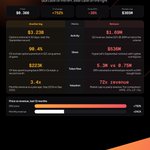
There's way more to f(x), but I'll keep it at this short post (and image) for now. Btw, do check the image if you're curious about the protocol's numbers (spoiler: they're on fire).


Alrighty, some charts are actually wild. ethereum:0xb1d1eae60eea9525032a6dcb4c1ce336a1de71be did 8.5x in a year, while its revenue has grown 3.4x.
One of these numbers has to catch up (or tank), and which one does decides whether DRV runs again or bleeds from here.
Let me refresh your memory first: @DeriveXYZ is literally where most onchain options trade. That said, it pulled off fat numbers. The protocol takes a fee on every trade, and half of those fees now buy the native token on the open market every week. Ok, so that's the link between the business and the token, and you'll need this info if you keep reading.
Bull case, part 1: Derive just pulled off the riskiest move an exchange can make (I'd say it's the smartest move), and it held. ~3 weeks ago it killed Derive Chain, its own L2, and moved its toys (the entire venue) to settle directly on Ethereum. Based users followed and the options volume over the last 30 days (migration included), came in at $3.23B, close to September's ATH. Since the end of September, stablecoin deposits grew by ~$6.7M, but the total TVL is slightly lower. But only because ETH is down like 13%.
Bull case, part 2: nobody else is close (at least not in crypto). Premiums are the best argument on who's winning in the sector. In Q3, over 90% of ALL onchain options premium was paid on Derive, and its share has grown six quarters in a row. So, you can say that in this category there's Derive, and then there's everyone else.
Bull case, part 3: the token is making that money better than before. October has already sent $223k of fees into buybacks with 2 days left, the biggest month yet (this is the key word). 28.5M DRV (~$10.3M at today's price) has been bought back in total. Traders paid Derive $654k in fees in September this year, almost double the $340k they paid last year, and after market-maker rebates about half of what's left now goes to DRV buybacks. Btw, bought-back DRV doesn't go to the furnace, it sits in the DAO treasury, and a recent proposal suggests using it to pay staking rewards later. Speaking of staking, 23% of the supply is staked. And speaking of the treasury, it's thicc: there's like $160M worth of DRV in it, if I didn't fetch the wrong address.
Ok, time to be real and unbiased. Bull case topics are above, and below are the bear case ones.
Bear case, part 1: Q3 volume nearly doubled compared to Q2, but revenue went down from $1.88M to $1.69M (aesthetically more pleasing, if you ask me). How? Well, fees are capped at 12.5% of an option's price, so cheap options, the long-shot bets, barely pay anything (too degen). When traders combine several options into one trade, the cheapest one is free. That said, the more sophisticated the traders get, the less Derive earns per dollar they move. So if you're a DRV maxi, you're probably lowkey praying that Derive users are bad at it.
Bear case, part 2: DRV's market cap is $365M, but its revenue is running at about $5.1M a year. That's a 72x, meaning users pay $72 for every $1 Derive earns in a year. For example, hyperliquid:native trades near 27x and lighter near 13x.
Bear case, part 3. Well, sort of a bear case. The buybacks are real, but the new supply outpaces them. Every month, ~4.7M DRV unlocks to contributors and another ~430k is being paid out as staking rewards. That's about 5.1M new DRV or ~$1.9M at today's price. Buybacks take about 750k DRV off the market a month, around $280k.
Two more things the price has to eat, btw. Market makers are still being paid to quote on Derive, and trading rewards stopped at the end of September, so the next few weeks will show how deep the book really is without them. Looking good so far, if you ask me.
On a side note, "rivals" are lining up. Hypercall did $536M in volumes in September, Lighter has launched binary options, and Hyperliquid's HIP-4 lets anyone build options-style markets.
Sooooooo...where does that leave DRV?
The protocol is winning, and that part isn't in question. What's in question is how much of the win the token has already priced in.
Signs of another leg: monthly revenue breaking clearly about its $530k high, and fees per dollar traded leveling out.
Signs of a retrace: unlocks deep landing while volume cools off the records months. In other words, watch the monthly revenue print, it'll tell you which way this goes before the chart does.
Btw, a hyperliquid:native campaign just went live: Derive and @Kinetiq_xyz launched Road to Expiry: trade HYPE options expiring Nov 13th, and the 10 wallets with the best realized ROI split 250 kHYPE. The first 250 wallets to open a multi-leg position also get 1 kHYPE each.
You know I'm not a financial advisor, but I'm curious what your thought on this topic are. Let me know in the comments. Might as well post your wins from using Derive.

5 years ago we were all farming platform's native tokens at 4-digit APYs. Today, home loans and car payments are quietly becoming some of the best yields in crypto (not 4-digit APYs, but backed by something real).
@mezzanine_fi is building a way to leverage that yield (coming from home loans and car payments) without you having to manage the position yourself. The strategy behind it is called the carry trade, looping is how you leverage it, and @RWA_xyz 's report says it's one of the biggest reasons people are buying tokenized RWAs right now.
@HastraFi 's tokens, $PRIME and $AUTO , fit perfectly. PRIME earns interest from real US home equity loans and AUTO from US car loans, and you can borrow against them for less than they pay you. According to Mezzanine, AUTO paid ~9.4% over the last 30 days while borrowing against it cost around 6.2%. Needless to say, but I'll say it anyway, the difference between 6.2% and 9.4% is what you earn, and what you ideally want to leverage or precisely, loop.
Looping is great, but it sucks if you have to do it the Hand Solo way (manually). Aside from numerous clicks, you have to take into consideration that borrowing costs change, positions need adjusting, and that your profit can turn into a loss if you stop monitoring your position(s).
Fear not, because @phtevenstrong has that rizz and he's been working on Mezz. Mezzanine's first vault, the Hastra Optimizer, handles all of it (the Hand Solo work and headaches you want to avoid): it loops both tokens (PRIME and AUTO) for you from a single deposit of USDC or wYLDS. In other words, as a user, all you have to do is deposit and select your risk tier, precisely, your desired tranche (tailored to your risk appetite); the Junior tranche earns more but takes (potential) losses first, while Senior earns less and is protected by Junior.
This is a very intelligent move by the Mezz crew, and I'm not even surprised because I know that Stephen's second language is DeFi. Or Spanish. Regardlessado, está muy bien. So, why is this a very intelligent move by Mezzanine, and why do I dare to say that it's also a big thing for this DeFiamond in the making? It's easy: they're launching with one of the most-in-demand trades in RWAs, on assets that already hold over $600M, and they're making it usable for people who don't want to treat a spreadsheet like if it's a tamagotchi.
However, it's not free monies. If borrowing costs jump, the difference (the one you want to leverage) shrinks, and if borrowing ends up costing more than the token pays, profits turn into red numbers. To be spot on, Mezzanine manages borrowing costs for you, but if they (the costs) rise everywhere at once, loopers will feel it. The risk of rising borrowing costs is realistic, but usually short-lived. Car loans come with real default risk (a borrower stops paying and the lender repossesses the car and sells it), which is part of why AUTO pays more. Btw, exits take a bit of patience, since the vault unwinds positions weekly to protect everyone still in it.
TL;DR on the tokens involved in the Hastra Optimizer:
wYLDS is Hastra's wrapped version of YLDS, an SEC-registered stablecoin (current supply: $490M) from Figure (a Nasdaq-listed US lender that is behind HELOC, a top 10 token on CoinGecko that looks like a stablecoin but is actually a tokenized loan asset; HELOC stands for Home Equity Line of Credit). It's backed by US gov bonds and pays around 3.6% annually. This one you stake to get PRIME or AUTO.
PRIME funds Figure's home equity loans, which are loans to homeowners backed by their houses. It's the steadier one, and it pays around 6% to 7% APY.
AUTO funds car loans for people with less-than-perfect credit (99.5% of CT, myself included), backed by the car themselves. It pays more, roughly 10 to 12% APY, with more risk to match.
Ok, it's time to zoom out. RWAs are pulling in real money, the carry trade is driving a big chunk of it, and pretty much nobody wants to run that trade by hand. Mezzanine sits right in the middle (pun intended) of this all three (RWAs, carry trade, and time-poor users), with a stacked security setup, a founder who's been doing yield math for CT (and YT) for years, and a framework built to tranche whatever comes next. Hastra is the first floor. I'm watching this building go up, and I'd suggest you do the same.
I'll be back with more content as Mezzanine grows. 🫡


RWA.xyz published a deep dive last week on the tokenized carry trade: hold a yield-bearing token, borrow stablecoins against it, buy more, and earn the spread.
Their conclusion is that it’s become one of the biggest drivers of demand for tokenized assets. It’s also the trade the Hastra Optimizer is built on.
They list what makes a tokenized asset good carry collateral. Here’s how @HastraFi’s PRIME and AUTO measure up on four of them.
Yield spread: the gap between what the asset pays and what it costs to borrow against it. Over the last 30 days, AUTO paid around 9.4% against roughly 6.2% to borrow PYUSD on Kamino, a gap of over 3 points. That leaves room for borrow rates to rise before the carry disappears.
Price quality: thin market prices can swing and trigger liquidations the underlying value doesn’t justify. On Morpho and Kamino, PRIME and AUTO are priced at NAV, not at a momentary DEX print.
Redemption: PRIME and AUTO redeem to wYLDS at NAV, so exiting doesn’t depend on someone buying on a DEX.
Scale: PRIME is over half a billion dollars, and as of August around 70% of it was working in DeFi.
What the report doesn’t cover is the work. Running the carry trade yourself means picking the asset, the venue, what to borrow and how much leverage to use, then watching all of it every day.
The Hastra Optimizer runs it in one deposit, then lets you choose how much of the risk you hold. Senior earns a little less than the overall strategy yield, with a loss buffer in front of it. Junior earns more for taking first-loss exposure.
The tokenized carry trade, tranched. On your terms.
GM 🤝
I heard there's a Hyperliquid from Temu. For obvious reasons, so many teams would like to create "the next Hyperliquid". Reminds me of all the "Ethereum killers".
THERE IS NO NEXT HYPERLIQUID, ONLY BETTER WAYS TO USE IT.
@pear_protocol turns your HL account into a long/short terminal. It's extremely customizable (in all ways possible). For example: you can stack stocks, commodities, and memes on the long side, crypto and FX on the other side, give every leg its own leverage, and open up multiple legs in a single click. And btw, the UI and UX are fantastic.
@hufhaus9 is an absolute Chad and I've been following his trades in his TG channel. He 4x'd his public account using Pear, from $25k to $100k. Now you can copy everything he (or other traders on Pear) does at no extra cost, sized to your own account.
Don't get confused: nothing gets off Hyperliquid. Your collateral stays in your own account, and Pear sends both sides of the trade to the orderbook in the same request. PnL, TP and SL all run on the ratio between the two sides, and you can TWAP into a spread or ladder your entries instead of staring at two charts. On top of that, you can turn on auto-rebalance so your position holds its weights as prices drift. There's an extra cost to using Pear, but it's absolutely worth it because no team is offering what Huf and Co. do.
I might shoot a few pieces about Pear because it's simply overlooked, and I'm pretty sure that many perps traders would love it, were they to give it a try.
And btw, the protocol's native token moved to Hyperliquid, with 70% revenue going back into PEAR through buybacks, burns, and liquidity.


✅ $25,000 -> $100,000 done
every trade in public, real-time, only on @pear_protocol
and now we just launched copytrading.
click this button: app.pear.garden/copytrade
Starting fresh at $50k -> ?

WAN for all, all for WAN. 🤝
I was wondering, what do (DeFi) Chads do on chains not too many people talk about? Then I asked myself "how do people even get their funds onto those chains?". That's when I noticed @wanchain_org .
First bridge standing
Wanchain has been moving assets between chains since 2018, after raising about $35M during the golden ICO era (2017). Most bridges from that wave are gone (and a bunch of newer ones as well).
The tech (simplified)
Transfers are signed by 25 bridge nodes that stake WAN as collateral and each hold only part of the signing key, so no single machine can move funds. On top sit WanBridge moving assets, XFlows for bridging and swapping in one go, and XStake for staking (there's a flywheel in there, by the way).
In its own lane
Wanchain's real edge is where it goes/the routes it offers. While most bridges fight over the same EVM traffic, Wanchain has built routes from those chains to places few others bother with, like Cardano, XRPL, Dogecoin, VeChain, and native Bitcoin. And some extra. It even built VeChain's first-ever bridge.
Where the fees go
Every bridge fee is converted into WAN and, a month ago, holders used Wanchain's new governance to double the share of fees that gets burned, from 10% to 20%. Another 10% goes to xWAN stakers (paid in ETH, BTC, and stablecoins). About 4.8M xWAN is staked today, up from 3.2M in February. For context, about 27% of circulating WAN is staked (closer to 30% if you cound xWAN).
As for numbers, you can see those in the image I attached.
Now, a team that has been working on a single project for 8+ years is here to stay. What's missing are volumes. Some routes have been offline since summer, and the team has been bringing them back one after another, starting with Tron (in September). Quick maff + logic: fees burn WAN, stakers get new WAN, and right now the stakers win. Get volume back and the burn takes over, ad an $11M market cap. Few people are watching this one and I'm one of them, so expect more Wanchain pieces from me.

The sky is the limit? Not for ethereum:0x56072c95faa701256059aa122697b133aded9279 .
Yeah, yeah, the skies are blue, but the chart is red.
Anyway, @SkyEcosystem is running one of the best businesses in all of DeFi, and its native token is still trading like nobody noticed what the protocol is doing. That's why I created this image (and am writing this short because).
Alrighty, I'll cover 2026 only, although 2025 was quite bullish too.
Q1 was the strongest quarter in the protocol's history: $123.79M in gross revenue and a $46M surplus. Q2 added $107.35M, with net revenue up 25% to $40.09M. September alone brought in $30.8M in gross revenue, up almost 50% year over year.
Sky's model is actually simple: borrowers pay interest on USDS, and Sky puts its balance sheet to work in Treasuries, credit, and onchain lending. What's left after paying savers is surplus (prawfits). Savers are eating well: sUSDS (instant liq, 0% fees, and currently 3.80% APY) have collected over $292M in yield since launch, on top of the $191M paid through the old DAI Savings Rate.
Since August (this year), half of that surplus I mentioned before goes to SKY holders: 22.5% buys SKY for stakers, 22.5% is paid to stakers in USDS, and 5% buys SKY and burns it. So far, two burns are done: 2.86M and 7.37M tokens went to the furnace. I know, it's not a massive amount, but give it some time. Staking numbers are prettier: about 74% of the circulating supply is staked (that's ~17.4B tokens). There's no lock-up.
The staking mechanism is interesting: stakers choose to get paid in SKY or in USDS. Aside from the rewards, stakers can (obviously) use their allocation as voting power, but the thing I like is, they can actually borrow USDS against their staked SKY (with a minimum loan of 30k USDS tho). Borrowers' positions are overcollateralized, btw. Per Sky's collateral dashboard, the ratio is almost 700%.
What I'm keeping an eye on is the reserve. In March, governance trimmed buybacks so more surplus could go into a safety fund that absorbs losses in case something goes wrong. The target is $150M, and the fund has grown from about $49M then to $85M now. Once it's full, more of that surplus goes to stakers and to buying back SKY. Smart moves.
Alrighty, let's compare Sky to its main competitors. SKY sits at a $1.52B market cap, against AAVE's $2.11B and ENA's $2.76. In Q2, Sky kept $40M in net revenue, Aave $21M, and Ethena about $1M. In other words, buyers pay about $9.50 of market cap for every $1 SKY earns in a year, versus about $25 for AAVE, even though Aave earns less.
TradFi cares too. Standard Chartered has a $0.325 target for end of 2028. Basically, they expect the token's price to 5x by then. In September, Galaxy announced a $100M sUSDS position and bought an undisclosed (I couldn't find the number) amount of SKY.
Gotta keep it real, not everything's green: Sky's own 2026 forecast of $161M in revenue and $2.06B looks out of reach. Burns are still tiny relative to supply. But then, it's still doing great. Remember when Dani said MIM is going to crush DAI? Yeah, that didn't age well.
NFA, but a protocol paying holders from real revenue, with a bigger buyback switch waiting, at under 10x annualized net revenue is one to watch closely.

So, you're telling me it's 2026 and tens of thousands of p0rn videos are being uploaded daily on a single site alone and my brethren and sistren from the US can't trade on Hyperliquid? This world has serious issues.
P0rn is horrendous and you should avoid it by all means. On the flipside, Hyperliquid is brilliant and I'm not going to tell you what you should do about it because I don't provide financial advice (I do openly advise people not to watch p0rn tho).
Anyway, yesterday's announcement is actually quite sexy, so I'll try to break it down for you.
TL;DR: Payward (the company that owns Kraken) wants to be the first CFTC-regulated firm to run markets on Hyperliquid, meaning, US clients would be able to trade perps through Payward's licensed entities, with their orders matched on Hyperliquid's order book. Don't get too horny, this one still needs regulatory approval. If it does get approved, think of Hyperliquid as the engine and Payward's regulated companies as handling the rest (Bitnomial creating the markets, clearing and settling the trades, and NinjaTrader Clearing onboarding clients and holding their accounts).
To put things into a perspective, NinjaTrader serves nearly 2 million futures traders. Obviously, not all of them will qualify (only approved customers get in), and not all of them care about perps. That said, don't read that as 2 million new Hyperliquid users. Still, it's a big potential audience, and it gives them a regulated route to markets running on Hyperliquid's order book, which they don't have today.
The possible upside for Hyperliquid and hyperliquid:native is massive. If this works, any licensed exchange or broker could copy the setup and that's where it gets interesting for Hyperliquid: every regulated firm that plugs in brings new US volume, and Hyperliquid takes a cut of the fees on it. And every one of them also has to lock 500k HYPE. Now, if you stack them up, Hyperliquid will stop looking like a single exchange and will start looking like the shared engine regulated venues run on (take a minute to think about this). Btw, that's a big if, but a doable one.
If you've missed what HIP-3 is, I got you: anyone who stakes 500k HYPE can launch their own perp exchange on Hyperliquid and choose the markets, oracles, and contract terms. The markets are permissionless, meaning any wallet can trade them. Trade[xyz], Paragon, and Kinetiq all run on vanilla HIP-3.
As for HIP-3*, it's an optional add-on to HIP-3, a set of extra settings a HIP-3 deployer can switch on. The core of it is an onchain allowlist, managed by the deployer or sub-deployers it appoints, that controls which addresses can trade its markets. In short, HIP-3 lets anyone run a market, and HIP-3* lets that market decide who can get in (permissioned markets). The latter is only on testnet for now.
Don't get confused, this is an announcement of Payward's intention, so there's no approval or launch date yet. But where there's smoke, there's also fire. On a side note, up to 9.92M HYPE (about $770M) *can* unlock for core contributors on the 6th of November (if it was on November 5th, I'd mention V for Vendetta). Don't stress, that number is the cap. The team has been distributing well below it each month. For example, October's unlock was 3.75M HYPE heavy.
Hyperliquid keeps killing it: almost $200B in perp volume in the last 30 days. In the same period, it raked in $63.5M in revenue and $64M of HYPE was bought back (thanks to the Assistance Fund). Don't forgetti, the Assistance Fund sort of permalocks the HYPE it buys using the accumulated fees. So far, it has amassed a total of 48.28M HYPE tokens (worth ~ˇ$3.76B at today's price). Over the last 12 months, Hyperliquid made around $687M in revenue, more than any other crypto protocol except Tether and Circle.
Btw, CryptoCapo (the ultimate counter-trading signal always boldly sharing TA views in the absence of TA expertise) is calling for $18.50 per HYPE (after an ATH of $140 he's aiming for), and I'm here thinking he's a bit...well, off the charts.


Payward, the parent company of Kraken, announced its intention to be the first CFTC-regulated deployer on HIP-3* markets. Payward will use Hyperliquid as the infrastructure layer to deploy perpetual futures markets for US clients. Subject to regulatory approval, Bitnomial, Payward’s CFTC-regulated DCM and DCO, would act as the HIP-3* deployer: creating, owning, and administering the markets and clearing and settling the contracts. If approved, NinjaTrader Clearing, Payward’s CFTC-registered FCM, would carry client accounts.
HIP-3 will support optional deployer configuration for permissioned markets in a future network upgrade. This set of additional deployer functionality is collectively called HIP-3*. At its core, HIP-3* activation involves an onchain allowlist managed by the deployer or its sub-deployers. The functionality is strictly additive to HIP-3; its use is optional and up to the deployer. Existing markets remain unchanged. The initial release is available on testnet, where specifications are preliminary and subject to change based on feedback.
Hyperliquid is a neutral infrastructure layer with the goal of supporting large parts of the financial system. HIP-3* gives deployers additional functionality to operate deployments consistent with the requirements applicable to them. As with HIP-3, HIP-3* deployers are independent operators who use Hyperliquid as the onchain infrastructure layer for their own markets, while retaining control and responsibility over their deployment.
GM 🤝
So.... markets are (again) acting like they got hit by puberty?
Anyway, Fidelity's director of global macro posted this handy chart, showing how BTC has been priced against gold over time, alongside where ETF money has been flowing.
Gold fell 28% from its January peak, but hear me out:
a stablecoin that makes its money leasing gold to refiners is still paying 5.1% APY (and stacking up points). Yup, I'm talking about @theo_xyz 🫡
TL;DR: crypto, stocks, gold and silver all took a hit this year, but for some reason central banks, ETFs, and Tether kept stacking up metal through the dip... Theo turns that demand into yield: it leases gold and silver to industry and hedges the price with CME futures, so thUSD earns without riding the drawdown. Theo's thGOLD and thSLVR are stil in limited access tho, but they clearly show where Theo is heading.
Orange coin is trading at ~$80.7k (-36% from the $126k top) and US spot BTC ETFs are bleeding, too (lost about $772M in 2 sessions). Stonks aren't really in the green either, with the Nasdaq printing its worst day (4 days ago) since June.
Boomers gonna spam your (physical, not virtual) mailbox saying it's the right time to get some gold. And they might be somewhat right although gold and silver got hit as well. Gold is down 28% from its ATH, while silver went a step further (or lower) - 55% down from ATH prices.
The "funny" part is, the biggest buyers keep buying (no, it's not Peter Schiff). No cap, although gold fell 8.5% last month, ETFs took in $10B during the same period, pushing their holdings to a record 4256T (tonnes, not trillions). Central banks bought about 63 tonnes (their most degen month since November 2024), with China adding 23 tonnes for its 23rd straight month of buying (I guess they call this "GCA" - gold cost averaging). Btw, Tether now holds more than 146 tonnes of gold, backing USDT. If Tether was a country, it would've been in the top 20 gold holders globally.
Anyway, not everyone's into gold. Or gold only, for that matter. Fidelity's Timmer says he's bullish on both.
Back to the main topic: how do you hold commodities (gold and silver, in this case) without facing drawdowns? It's easy: use Theo's products. Well, thUSD for now (yields and points). If you want the price exposure too, you'll have to wait for Theo to open thGOLD and thSLVR for everyone (no public launch date so far).
Numbers say that the tokenized commodities market went from $1.43B at the start of 2025 to about $5.88B today (talking about market cap here), and that's with gold's drop dragging the USD value lower. Theo's CIO @iggyioppe expects tens of billions within 5 years and over $100B within a decade. From the looks of it, I believe he could be right.
Take this as a reflection on precious metals. Also, me pointing fingers at Theo, a project I really like. See the next post for more info.



In case you're actively farming yield (not rampant APYs tho, but safu), while fetching points (in case you want a potential a1rdr0p), be sure to read this piece I wrote not so long ago:
nitter.cf/monosarin/status/21106…
You faded Ethena? Maybe @theo_xyz is your redemption arc.
Ethena turned crypto leverage into a synthetic stablecoin: hold the asset, short the perp, scoop the funding. With >$4.5B in TVL and its native token sitting at an fdv of almost $2.8B, Ethena is obviously a DeFi giant.
Can Theo do the same?
Well, it's not impossible (it's also not financial advice).
Theo runs the same trade, but on real world assets. For example, it buys physical gold, leases it to refiners and fabricators who need this shiny metal in their workshops, and shorts CME gold futures so price moves cancel out (delta neutral). What's left are 3 income streams: the lease fee, the difference between futures and spot, and T-Bill interest on the margin. You read that right, none of it needs crypto funding rates to stay positive.
Theo's TVL accounts for $144M, its thUSD supply is $132.3M against $133.4M in reserves, meaning, it's overcollateralized at 100.83%. There are a few way to earn yield (and points!) on your thUSD and if staking is what you prefer (I prefer steaks), then know that sthUSD pays 5.1% right now. If you don't mind being locked in for some extra yield, you can toss your thUSD into the 6-month Core+ or Boost Vault and enjoy 7.2% APY and 11% APY, respectively. Plus points: the Core+ Vault comes with a 4x multiplier, whereas the Boost one with a 2x. If you hate lock-ups, you might as well just hold thUSD in your wallet and enjoy a 2x multiplier on your points (but no yield). If you want to participate, feel free to use my referral so we both win: app.theo.xyz/referrals?invit…
Alrighty, onto the next topic (the one I'm quoting): thSLVR. Yes, it's about silver. Each thSLVR is backed by one troy ounce (31.1g) of physical silver that Theo leases to industrial borrowers, and the lease fee gets paid back to stakers in silver.
Interesting facts about this shiny metal:
- it conducts electricity and heat better than any other metal, so it ends up in data centers, power grids, (nuclear) reactors and aircraft. That's actually bullish because these industries are very hot at the moment. More than half of silver demand comes from industry. For gold, it's under 7%. Central banks lend gold into the market but hold almost no silver, so when borrowers look for silver, lease costs start poppin'. A year ago, the one-month lease rate hit a record 34.9% against a regular sub-1%. In other words, borrowing 1kg of silver for a month suddenly cost about 29g of extra silver (yup, borrow silver, return silver + extra silver), when it usually costs less than 1g.
Fun fact: According to @RWA_xyz , barely $33M of silver lives on-chain today; Theo's thSLVR supply alone already represetns about $19M (roughly 9.6 tonnes), and the team says more than $40M in silver leases is already running.
No native token (yet), but the points program is live. You know how the Ethena story went.


GM🤝
Wirex, The Wire... I know, I know. But hear me out, because there's an actual connection here (sort of).
In The Wire, Lester has this line that stuck with everyone who watched it: "all the pieces matter". And that's pretty much why the point @wirex_one makes here works.
On the surface, Wirex One is a card you already know how to use. Visa or Mastercard, Apple Pay, Google Pay, USD and EUR account details. Nothing new to learn.
Underneath though, all the pieces matter. Your money sits in stablecoins, in a wallet only you control (no seed phrase to babysit), cashback comes back in USD (up to 8%), and every card payment settles onchain.
And people use it like a normal card, 24 transactions per active address in September, based on Paymentscan. That's daily life routine.
McNulty spent five seasons chasing where the money goes. With Wirex One the answer is easy: a wallet you control.
Fat article coming very soon.

1/ Wirex One is now open to the public & live on @Arc. 🤝
Stablecoin neobank built for mass-affluent consumers is now public, bringing spending, banking, borrowing and trading into one onchain financial experience.
This one didn't receive enough attention so let me TL;DR it for you.
Basically, @pendle_fi 's TVL has grown by 43% while emissions went down by 58%.
In other words, you don't need to pay for TVL with your own tokens. ethereum:0x808507121b80c02388fad14726482e061b8da827 buybacks turned out to be a smart move. As for buybacks, these oftentimes (not always tho) outperform emissions, meaning, more tokens have been bought back (and distributed to stakers) than were emitted during one epoch.
If I were to create lists of tokens I'd be scooping, Pendle's would definitely be on one such list. NFA, obviously.
Btw, I suggest/recommend you check out @Shaurya477 's Penconomics site for more info. Find the link to that one in the image description below.

ALT https://penconomics.vercel.app/#top

Pendle V2 capital closed Jun 30 at $809M and Sep 30 at $1.16B.
That 43% gain came in the quarter Pendle cut its PENDLE incentives 58%.
Issuers, chains and lenders funded the growth with their own rewards and collateral.

ALT Native Pendle V2 capital closed Jun 30 at $809M and Sep 30 at $1.16B, up 43%. A callout marks Aug 11, when X Layer markets opened.
GM🤝
Sooo...mem0 (AI memory layer for AI agents and apps) raised $24M and is (according to Caplight, a private-market data platform) valued at $150M, yet there's a project in this space sitting at a market cap of $500k ($836k fdv) doing the job way better than mem0 does. I'm talking about base:0x797f214a2cd64a4963a91fa21c8c55ec3eba4714 .
On a 350-question memory test, @sibyl_labs_ found the right record 350 times and mem0 found it 92. And the funny thing is, mem0 is backed by Y Combinator and is integrated into AWS's Strands Agents SDK as a memory provider.
TL;DR: Sibyl is a broader setup, but I'd say that Sibyl Memory is (at least right now) the flagship product; it's a plugin that gives AI agents memory that lasts between sessions (a feature I need) and it works with pretty much any MCP-compatible agent.
I think it's quite mispriced and overlooked so I'll post a fat article very soon.

A good memory solution makes an agent cheaper to run.
In an independent 500-company benchmark, Sibyl gave the model about 228 tokens of context per question.
The next-best engine read roughly 52x more. All 350 questions were retrieved, and the whole run cost $0.64.
Three habits keep your own sessions that lean:
1⃣Keep context small and let memory hold the rest. A lean context is faster, cheaper, and more accurate.
2⃣Move your CLAUDE.md or AGENTS.md notes or stray data & session context into memory once with sibyl migrate.
3⃣Save at the end of a session with sibyl-save, so progress carries forward and your working context stays clean.

How about you leave the trenches and enter tranches?
Built by my fav DeFi Chad @phtevenstrong , @mezzanine_fi has all it takes to become big. For those who don't know, mezzo (in Italian) means half or middle. Don't get confused, Mezzanine won't be "mid" nor a half-product.
TL;DR: Mezzanine stacks DeFi yield like floors inside a building: the lower you go, the more you earn and the sooner you get wet (in case there's a flood).
Most vaults give every depositor the same yield and the same risk. Mezzanine splits each strategy into tranches (French for slice) and lets you pick yours. The junior tranche takes the first loss for a bigger cut of the yield, and the senior one earns less while sitting behind the junior tranche.
The part I like is that junior's premium isn't fixed: the yield split adjusts on its own when the junior side runs thin, so junior depositors get paid more to fill it.
Each vault is isolated (and so is its risk), the loss order is set before you deposit, and the contracts went through Sherlock, ChainSecurity, and Certora (audits and formal verification).
Tranching doesn't remove risk, it reorders it so be sure to know which side you're on.
Expect a fat article these days. And some extra content once the app is live.
GM 🤝
So, the $STRK unlock came with green candles instead of red ones. And the timing lines up with the team kicking off a poll on Starknet becoming its own L1 (remember, if this happens, it is a massive thing for Starknet). Don't get confused, it's just a poll asking for approval to kickstart research on that topic (although I believe the team has already done their research anyway).
An actual switch would require its own, separate governance vote. Result? 99.95% of votes are in favor of the idea. However, it does not constitute approval of a transition to an L1. However, based on this result, if a proposal to transition Starknet to an L1 went to a vote, I believe it would pass.
Whether (or when) this transition happens is something I'll cover in an article (soon). For now, here's a TL;DR on why Starknet becoming an L1 would be bullish:
As a post-quantum L1, $STRK would secure the whole chain and capture all of its fees. Also, the chain would set its own security timeline instead of waiting on Ethereum's 2029 target, and @Starknet 's hash-based proofs are already live. Accounts can switch to post-quantum signatures without a hard fork, and BTC staking is already part of the consensus. STRK stays where it is (no need for a new token), bridges from Ethereum stay open, and the last scheduled token unlock for early contributors and investors lands in March 2027.
Basically, Starknet could become the first major smart contract chain that's fully quantum-resistant and private by choice.
This is by no means financial advice. I just like drawing parallels between projects that already popped (like ZEC), and those that I think have what it takes to pop (STRK).

GM 🤝
Up to 127M $STRK tokens will be unlocked tomorrow (based on the unlock schedule I found in the docs). That amount makes up ~1.7% of the circulating supply and is valued at ~$10M at the token's current price. And by the way, cumulative trading volume across CEXs and DEXs where STRK is listed is $3B in the last 30 days, so $10M is about a tenth of an average day's volume.
What to think of this? I have no clue, to be honest. Past unlock days haven't moved the price in a constant direction. For example, last November, STRK actually went up ~20%+ on the eve of the 127M unlock. And a month later, when another 127M tokens were unlocked, the price "dipped" about ~2%. Speaking of unlocks, which occur on a monthly basis, the last one is scheduled for March next year.
Now, the token is down 12% in the last 24h, but it's up 177% in the last 30 days. This could mean nothing, but it could also mean a ton of different things. Anyway, I'm not one of the folks who trade unlocks, I'm in here for the tech.
Haters gonna hate, but I actually love what the @Starknet team is doing. That said, I see STRK as a long-term bet (because I suck at TA and trading perps).
If you've been maxxing your $ZEC stash, you might as well check into $STRK (or wait for me to post a fat article soon).
TL;DR: ZEC sits at a ~$21B fdv and runs on privacy alone. STRK is under $600M and offers privacy for any token (orange coin included), plus full DeFi, BTC staking via delegation to validators, and a possible quantum-resistant L1 by 2027 (founder @EliBenSasson floated this just a couple of days ago). Fyi, Starknet's proofs are already hash-based, and this backs up the L1 point with something that exists and isn't just a fancy idea. On a side note, ~20% of circulating STRK is staked. And when it comes to privacy (to draw another parallel with Zcash), Starknet's privacy is built to work with regulators (don't forgetti, the EU is set to push privacy coins off regulated exchanges next July).
Anyway, expect a super fat article on Starknet soon.

You faded Ethena? Maybe @theo_xyz is your redemption arc.
Ethena turned crypto leverage into a synthetic stablecoin: hold the asset, short the perp, scoop the funding. With >$4.5B in TVL and its native token sitting at an fdv of almost $2.8B, Ethena is obviously a DeFi giant.
Can Theo do the same?
Well, it's not impossible (it's also not financial advice).
Theo runs the same trade, but on real world assets. For example, it buys physical gold, leases it to refiners and fabricators who need this shiny metal in their workshops, and shorts CME gold futures so price moves cancel out (delta neutral). What's left are 3 income streams: the lease fee, the difference between futures and spot, and T-Bill interest on the margin. You read that right, none of it needs crypto funding rates to stay positive.
Theo's TVL accounts for $144M, its thUSD supply is $132.3M against $133.4M in reserves, meaning, it's overcollateralized at 100.83%. There are a few way to earn yield (and points!) on your thUSD and if staking is what you prefer (I prefer steaks), then know that sthUSD pays 5.1% right now. If you don't mind being locked in for some extra yield, you can toss your thUSD into the 6-month Core+ or Boost Vault and enjoy 7.2% APY and 11% APY, respectively. Plus points: the Core+ Vault comes with a 4x multiplier, whereas the Boost one with a 2x. If you hate lock-ups, you might as well just hold thUSD in your wallet and enjoy a 2x multiplier on your points (but no yield). If you want to participate, feel free to use my referral so we both win: app.theo.xyz/referrals?invit…
Alrighty, onto the next topic (the one I'm quoting): thSLVR. Yes, it's about silver. Each thSLVR is backed by one troy ounce (31.1g) of physical silver that Theo leases to industrial borrowers, and the lease fee gets paid back to stakers in silver.
Interesting facts about this shiny metal:
- it conducts electricity and heat better than any other metal, so it ends up in data centers, power grids, (nuclear) reactors and aircraft. That's actually bullish because these industries are very hot at the moment. More than half of silver demand comes from industry. For gold, it's under 7%. Central banks lend gold into the market but hold almost no silver, so when borrowers look for silver, lease costs start poppin'. A year ago, the one-month lease rate hit a record 34.9% against a regular sub-1%. In other words, borrowing 1kg of silver for a month suddenly cost about 29g of extra silver (yup, borrow silver, return silver + extra silver), when it usually costs less than 1g.
Fun fact: According to @RWA_xyz , barely $33M of silver lives on-chain today; Theo's thSLVR supply alone already represetns about $19M (roughly 9.6 tonnes), and the team says more than $40M in silver leases is already running.
No native token (yet), but the points program is live. You know how the Ethena story went.

Introducing thSLVR: yield-bearing silver, powered by silver financing.
A single solar farm uses up to 20 tonnes of silver in its panels, worth $40 million in today's prices.
Silver has the highest electrical and thermal conductivity out of any metal, making it critical in frontier applications like solar panels, nuclear reactors, data centers, and aerospace.
With Theo, companies who need silver can borrow instead of purchasing it.
This means lower capital costs, no price exposure, and reduced operational complexity, allowing businesses to focus on what matters.
Onchain investors can purchase thSLVR to gain exposure to yield-bearing silver.
Learn more: theo.xyz/articles/introducin…
GM 🤝
Up to 127M $STRK tokens will be unlocked tomorrow (based on the unlock schedule I found in the docs). That amount makes up ~1.7% of the circulating supply and is valued at ~$10M at the token's current price. And by the way, cumulative trading volume across CEXs and DEXs where STRK is listed is $3B in the last 30 days, so $10M is about a tenth of an average day's volume.
What to think of this? I have no clue, to be honest. Past unlock days haven't moved the price in a constant direction. For example, last November, STRK actually went up ~20%+ on the eve of the 127M unlock. And a month later, when another 127M tokens were unlocked, the price "dipped" about ~2%. Speaking of unlocks, which occur on a monthly basis, the last one is scheduled for March next year.
Now, the token is down 12% in the last 24h, but it's up 177% in the last 30 days. This could mean nothing, but it could also mean a ton of different things. Anyway, I'm not one of the folks who trade unlocks, I'm in here for the tech.
Haters gonna hate, but I actually love what the @Starknet team is doing. That said, I see STRK as a long-term bet (because I suck at TA and trading perps).
If you've been maxxing your $ZEC stash, you might as well check into $STRK (or wait for me to post a fat article soon).
TL;DR: ZEC sits at a ~$21B fdv and runs on privacy alone. STRK is under $600M and offers privacy for any token (orange coin included), plus full DeFi, BTC staking via delegation to validators, and a possible quantum-resistant L1 by 2027 (founder @EliBenSasson floated this just a couple of days ago). Fyi, Starknet's proofs are already hash-based, and this backs up the L1 point with something that exists and isn't just a fancy idea. On a side note, ~20% of circulating STRK is staked. And when it comes to privacy (to draw another parallel with Zcash), Starknet's privacy is built to work with regulators (don't forgetti, the EU is set to push privacy coins off regulated exchanges next July).
Anyway, expect a super fat article on Starknet soon.
GM 🤝
There’s a lot of chatter around $NEAR, and it sort of forced me into doing some extensive research. So I hereby announce the NEARies, a series of short posts with @NEARProtocol in the spotlight.
People are calling for an ATH (some even go as far as $155 per token), and I'm here to crunch the numbers, crack dad jokes, and occasionally write something seemingly smart.
I'll start with a TL;DR because I can:
🟢 NEAR Intents routed ~$35B in total, up from $5B less than a year ago, and most of that growth happened while the token traded under $2.50.
🟢 over the last 30 days, Intents earned about $8M in fees, of which the protocol kept ~$2.6M (30-ish %). Fees are captured from trades roughly 595k unique users have facilitated.
🟢 those captured fees buy NEAR tokens on the open market, holding them out of circulation. The buybacks (we all love) currently offset ~19% of new issuance (far from deflationary, but the team's been working on it).
🟢 max inflation actually halved from 5% to 2.5% some time ago. A draft proposal would trim inflation from 2.5% to 1.6% over 24 months. If it passes, about 12M fewer NEAR tokens would be minted over 2 years. Quick maff: that's roughly what today's buybacks remove in the same period.
🟢 buybacks are sweet, and so are token burns. A 100% gas burn (up from 70%) has been approved, and it will ship with nearcore v2.14, which has been on testnet since mid-September and has no mainnet date yet (but it'll certainly happen before GTA VI).
🟢 confidential TVL ((money users keep inside Intent's private mode (different from DeFi TVL)) is about $169M, up ~4.6x in just 90 days. Cool fact: NEAR earns on private execution without being a privacy coin.
🟢 post-quantum keys are live on mainnet: accounts upgrade by rotating keys, with no need to move funds.
🟢 Bitwise's NRR (first US spot NEAR ETF) pulled >$75M in net inflows over its first 10 trading days, with 0 (zero) outflow days. Relative to market cap, that's actually the strongest early days inflow of any US crypto spot ETF.
Alrighty, that's just an intro. The question is, is NEAR a temporary trend or is it here to stay?
In my opinion, it's here to stay, and you'll understand why once you read the coming pieces in this NEARies. And btw, just because I believe it has legs, it doesn't mean I'm a financial advisor. Au contraire, the token is up 115% in the last 30 days and a healthy pullback (TA experts will notice there's a retest as well) is expected. What's your take?
