

Associate Professor (Personal Permanente Laboral, PPL) at @filtradcom Neo-Victorian, gender studies & vampires 🦇 🧛♀️
Joined June 2022
- Tweets754
- Following292
- Followers184
- Likes6.4K




Delighted to share that my article "Representing Mental Health Struggles in YA Literature. The case of Vampire Academy and Neferet’s Curse" has been published in the journal ES Reviews: Spanish journal of English studies.
doi.org/10.24197/hmp9ap96 – at Krakow, Poland

1
2
14
Dr. Dina Pedro (she/her) retweeted

The new issue of @ESReviewJournal features articles by our project members @mrsdreadful (mental health in YA fiction) and @Ra_cuevas (Victorian domesticity). Check it out!!
revistas.uva.es/index.php/es…
Dr. Dina Pedro (she/her) retweeted

Delighted that my article "Whose Room? The Domestic Library in the Nineteenth Century" is out with @ESReviewJournal in OA! @assemblagelit
revistas.uva.es/index.php/es…
The CFP for our upcoming international conference, "Lured Away by the ‘Bloofer Lady’”: Pathologizing the Monstrous Feminine in Gothic Fiction, is now out! You can check it out here:
esdeveniments.uv.es/161305/d… – at Krakow, Poland

1
25
We welcome proposals from November 17th to January 31st. 250-word abstracts alongside a 100-word bionote.
Should you have any queries, please do not hesitate to send an email to the convenors: Dina Pedro ([email protected]) and Paola Baixauli ([email protected]). – at Krakow, Poland
15
Dr. Dina Pedro (she/her) retweeted

Soy editora asociada de varias revistas científicas y hay algo que no deja de llamarme la atención: la cantidad de manuscritos, revisiones y versiones corregidas que llegan durante los fines de semana y las vacaciones.
Es una observación anecdótica, desde luego, pero creo que dice bastante sobre cómo estamos organizando la vida universitaria.
Durante la semana, entre clases, reuniones, tareas de gestión, correos y burocracia, cada vez nos queda menos tiempo para leer, pensar, investigar y escribir. Es decir, para algunas de las actividades que deberían estar en el centro de nuestro trabajo.
Las vacaciones y los fines de semana terminan convirtiéndose en una especie de reserva de tiempo para hacer lo que no conseguimos hacer durante la jornada ordinaria. ¡Menuda paradoja! Resulta que necesitamos dejar de trabajar para poder hacer nuestro trabajo.
La organización cotidiana de la vida universitaria está dejando cada vez menos espacio para las actividades que justifican su existencia: investigar, estudiar y preparar buenas clases.
¿Qué hemos hecho con la vida universitaria para que tantas de las cosas que le dan sentido tengan que hacerse cuando la universidad está cerrada?
#VidaUniversitaria #AcademicLife #HigherEducation #AcademicWork
The deadline to send your proposals for our special issue on vampires, gender and medical humanities is fast approaching!! Don't miss out! 🦇🦇🦇 – at Zielonki, Polska

📣CFP: Special issue on the intersections of vampirism, illness, gender & identity
📰Quaderns de Filologia: Estudis Literaris (e-ISSN 2444-1457)
🗓️Abstracts due October 31st
🧛🏻♀Co-editors: Dina Pedro, Agnieszka Stasiewicz-Bieńkowska & Patricia Palomino
turia.uv.es/index.php/qdfed/…
1
53
Dr. Dina Pedro (she/her) retweeted

📢 New publication!
In my latest article, I analyse YouTube comments on testimonies by Ukrainian survivors of conflict-related sexual violence.
🔗 revistas.ucm.es/index.php/CJ…

Dr. Dina Pedro (she/her) retweeted

We're organising the next international conference on #folklore and #gothic (FOGO III: Animals, Creatures and The Gothic), which will take place at @fylUAH in July 2027! Deadline for proposals has been extended until December 1st 🦇🦉🐺fogoanimals.wixsite.com/fogo…


📣CFP: Special issue on the intersections of vampirism, illness, gender & identity
📰Quaderns de Filologia: Estudis Literaris (e-ISSN 2444-1457)
🗓️Abstracts due October 31st
🧛🏻♀Co-editors: Dina Pedro, Agnieszka Stasiewicz-Bieńkowska & Patricia Palomino
turia.uv.es/index.php/qdfed/…
Dr. Dina Pedro (she/her) retweeted

Back from the most enriching vampire conference @FILTRADCOMUV & I’m honestly feeling so grateful 🧛♀️🦇 Had the chance to learn from brilliant scholars and truly wonderful people. Me llevo muchísimo—knowledge, inspiration, and some very special connections. Gracias @mrsdreadful ❤️🔥


Dr. Dina Pedro (she/her) retweeted

Para los que estéis o vayáis estar preparando #sexenios os dejo un hilo de hilos explicativo sobre cómo afrontar la convocatoria y algunos recursos más. Guarda y comparte 😉
Deadline extension! Send your abstracts until January 22th!
📢 CFP – “The Blood is the Life!”: Narratives of Illness, Gender and Identity in Vampire Fiction Seminar
📍 University of Valencia
April 16–17, 2026
🎤 Keynote: Dr. Purificació Mascarell (UV)
bit.ly/49vNtPd

Just 8 days left to send your abstracts!
📢 CFP – “The Blood is the Life!”: Narratives of Illness, Gender and Identity in Vampire Fiction Seminar
📍 University of Valencia
📅 April 16–17, 2026
🎤 Keynote: Dr. Purificació Mascarell (UV)
🔗 More info: bit.ly/49vNtPd

Dr. Dina Pedro (she/her) retweeted

Una investigación sobre el comportamiento de los gatos muestra que los gatos domésticos consideran a los humanos como compañeros sociales en lugar de superiores, y a menudo perciben a sus dueños como gatitos grandes y torpes.
Lejos de ser distante o desafiante, la aparente indiferencia de un gato surge de un profundo desajuste entre especies en las expectativas sociales.
Como explica el antrozoólogo John Bradshaw, los gatos, a diferencia de los perros, nunca evolucionaron para reconocer a los humanos como líderes dominantes o figuras de autoridad. En cambio, filtran todas las interacciones a través de un marco exclusivamente felino. Comportamientos como amasar en el regazo o lamer el pelo no son meras muestras de afecto; son los mismos rituales de acicalamiento y vínculo que los gatos reservan para sus parientes cercanos o miembros de la manada. Para ellos, somos simplemente compañeros felinos enormes y algo torpes que requieren ser incluidos en el grupo.
Esta falta de deferencia jerárquica explica la frecuente indiferencia de los gatos ante las órdenes o las normas del hogar. Al tratarnos como iguales, siguen los protocolos sociales entre gatos en cada encuentro. Los "regalos" de presas muertas en la puerta o el constante seguimiento de la casa son muestras de cariño hacia lo que consideran un compañero grande, sin pelo y bastante inepto.
Reconocer esta mentalidad transforma la relación entre humanos y gatos, de una basada en la autoridad y la obediencia a una de compañerismo mutuo. Resulta que, si bien muchos dueños creen haber domesticado a sus gatos, estos están convencidos de que cuidan con paciencia a sus enormes familiares adoptados.
Bradshaw, J. (2013). Cat Sense: Cómo la nueva ciencia felina puede convertirte en un mejor amigo de tu mascota. Libros básicos.

A research into cat behavior shows that domestic cats regard humans as social peers rather than superiors, often perceiving their owners as large, awkward kittens.
Far from being aloof or defiant, a cat’s apparent indifference stems from a profound interspecies mismatch in social expectations.
As anthrozoologist John Bradshaw explains, cats—unlike dogs—never evolved to recognize humans as dominant leaders or authority figures. Instead, they filter all interactions through an exclusively feline framework. Behaviors like kneading on your lap or licking your hair are not mere displays of affection; they are the same grooming and bonding rituals cats reserve for close kin or pride members. In their eyes, we are simply enormous, somewhat clumsy fellow cats who require inclusion in the group.
This absence of hierarchical deference accounts for cats’ frequent disregard of commands or household rules. Treating us as equals, they follow cat-to-cat social protocols in every encounter. The “gifts” of dead prey on the doorstep or constant shadowing around the home are acts of care toward what they see as a big, furless, rather inept companion.
Recognizing this mindset transforms the human-cat relationship from one based on authority and obedience to one of mutual companionship. It turns out that while many owners believe they have domesticated their cats, the cats themselves are quietly convinced they are patiently tending to their oversized, adopted family members.
[Bradshaw, J. (2013). Cat Sense: How the New Feline Science Can Make You a Better Friend to Your Pet. Basic Books]

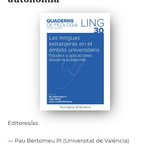
📣 🚨 📚 El nuevo volumen de Quaderns de Filologia: Estudis Lingüístics (vol. 30), coeditado por Pau Bertomeu Pi, Olga Julián Mariscal y una servidora, acaba de publicarse:
turia.uv.es/index.php/qfilol…

"Miradas actuales al trabajo autónomo con lenguas extranjeras en el ámbito universitario", pp. 9-19
turia.uv.es/index.php/qfilol…

54
Dr. Dina Pedro (she/her) retweeted
✨️📚 New publication with @isabeltrevi!
In this article we examine the impact of motivation and learner autonomy on ESP English learning among Spanish Army university students
🔗 turia.uv.es/index.php/qfilol…

Dr. Dina Pedro (she/her) retweeted
📢 Excited to share my latest paper based on my PhD thesis, now available in @MiscelaneaUZ !
Read the full text here 👉 papiro.unizar.es/ojs/index.p…

Dr. Dina Pedro (she/her) retweeted

📣 CALL FOR PAPERS
Anunciamos la apertura del plazo de envío para el 3.° número (2026) de EFIT, «Voces emergentes en estudios filológicos: lenguas y literaturas», destinado a investigadores/as noveles.
Más info: ir.uv.es/V1rOBrl
