

Deploy AI workloads without a platform team. Bring a container, compose the services it needs, and see exactly what's running. Early access.
Earth (for now)
Joined February 2026
- Tweets29
- Following1
- Followers4
- Likes0



Pinned Tweet
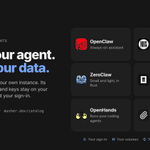
You wanted your AI agent running, not a server to look after. Musher runs open-source AI and automation tools for you: pick one from the catalog, see what it will cost, deploy. Health and logs for every piece live in one place.

1
4
54
Search Google without Google knowing which of you is searching. SearXNG sends each query to Google, Bing, Brave, DuckDuckGo and dozens more from your deployment's address, so the engines never see your team's browsers. It keeps no history, and it costs $7.30 a month.

1
18
Uptime Kuma, now in the catalog from $20.44 a month, watches a site or an API and tells Slack, Discord, Telegram or your inbox within a minute of it going quiet. Don't skip the push monitors: your nightly backup pings a URL, and the day it doesn't, you get an alert.

1
11
You can now run a small open model inside your own deployment and chat with it in Open WebUI. Prompts stay there, and there's no per-token bill. Fair warning, it's CPU only, so a 1.7B model answers at a few words a second. Fine for one person, slow for a team. $39.42 a month.

1
13
New in the catalog this week: SearXNG, Uptime Kuma, Ollama with Open WebUI, LibreChat, Metabase, Langfuse, Temporal and Sim. Every listing shows what it deploys and the monthly price before you sign in. Which of these is running on a VPS you forgot about?

1
20


On Musher a language model is one connection, never three values. Address, key and model are chosen once and arrive together. Pairing one provider's key with another's URL is possible, but you have to write it down on purpose.
15
n8n from the Catalog sits behind your Musher sign-in. Webhooks, forms and the public API stay reachable without it, so the services that call them keep working. Webhook URLs come from the deployment's own https address, so they are right the first time.
12
Doom is in the Catalog. Up to 60 fps in a browser tab, and only members of your organization can open it. There is no sound: the streaming client doesn't play audio. That's in the listing too.
11
This is how Qdrant is defined in the Catalog. A Blueprint in plain YAML: one component, a Compute Profile, an 8 GiB volume, a public endpoint and a generated API key. You can read what runs before it runs.
2
13
Compute rates are published per Compute Profile and billed hourly. The smallest is 1 vCPU and 1 GiB at $0.010 an hour, about $7.30 a month running continuously. These are launch rates and may still change.
2
23