

Co-founder & CEO @ Stealth Startup 🍞 | CS PhD 🎓 | All in ASI 📖 | Building for this universe 🌌 | @googleresearch @stanford @UCSB
Palo Alto, CA
Joined November 2022
- Tweets482
- Following503
- Followers6.7K
- Likes805





Pinned Tweet
I closed one chapter a few days ago: my last day at Google. Half a year of incredible research, surrounded by brilliant colleagues, an experience I’ll always treasure and recommend. Big Tech is safe, and safe is good. But when you’re young, too much safety means missing something vital.
What’s missing? The courage to go all in. The thrill of building 0 → 1.
So I packed my life, moved to San Francisco, and went all-in. I walked away from the safest paths, the big tech offer, the academic track, because if I never bet on myself, I’d regret it forever.
And now -- right at a moment in history when AI can change everything -- who could resist betting it all?
This is the next chapter: building the world’s greatest data infrastructure for ASI. This is bigger than me -- it’s a mission.
If you’re curious, want to support, or just want to chat -- DM me. And if I can help you in any way, my DMs are always open.
Let’s accelerate toward ASI together. 🚀
Fun fact: my last day wasn’t in South Bay, but in a SF office I’d never even been to before, because I was rushing to submit my ICLR paper🥲.


Our results suggest progress could be even faster.
In Oct 2026, RSI Arena, one model approached NVIDIA’s official Instruct release within just 216 hours (that is a whole post-training research team!). nitter.cf/my_cat_can_code/status…

Opus 5.6 is unceremoniously the most powerful model I've laid my hands on. This is insane.
claude.ai/artifact/Cy2d8Vn63…
Have a go.

4
865
A 250,000-page proof. Is this just about chasing fame and fortune while leaving everyone else to deal with the consequences? This is a deeply irresponsible release, brute force taken to the extreme. How much time and resources will people have to spend verifying those 17 million lines of code??
Has the Riemann hypothesis really been solved?
As agents produce increasingly enormous proofs, how are we supposed to verify them? We may need a new approach…
6
28
2,001

We are keeping hiring! Please dm @zhangchen_xu or send me your cv to my email!

CPT is back, and we are hiring:
- MTS, Time Series & Predictive Modeling
- MTS, Agent Evaluations
DM if you are interested.
5
55
7,967
Zichen Chen (🐱,💖) retweeted

Over the past week, I’ve been overwhelmed by the love and support of friends, industry colleagues, and people I've never met. Thank you to everyone who has shown kindness to my family and me. It means the world to me.
I came to the United States 53 years ago, and becoming an American citizen is one of the greatest gifts and proudest moments of my life. NVIDIA has been my life’s work. Building it into the company it is today alongside my colleagues has been a privilege and an honor. Nowhere but in America could a company like NVIDIA be possible. I love our country, and I love NVIDIA.
I did not live up to the standards expected of everyone at NVIDIA, and I have made serious mistakes in my personal life. I created problems for the Board that I deeply regret. I own my mistakes completely, and I am committed to cooperating with the Board’s independent investigation.
Since my departure, I’ve seen an outpouring of calls from NVIDIA’s employees, investors, business partners, and customers for me to return as CEO. Many continue to reach out to me directly as the company navigates complex technology, market, competitive, and geopolitical dynamics. NVIDIA is a once-in-a-generation company. If the Board of Directors decides that my return is in the best interest of our shareholders, our employees, the company, and America, I would be honored to answer these calls and return as CEO.
Thank you again to everyone who has shared their good wishes. I am profoundly humbled by your support. To my family: I love you, and I will spend the rest of my life being worthy of yours.
Jensen

Same old Silicon Valley, same old Wall Street. They might change the course of human history this time.
Ugly.
17
1,467

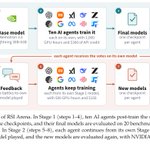
Made this video with Fable 5.2 to explain how RSI Arena works.
AI making a video about AI training AI 😆 Thanks, Fable!

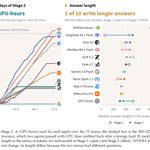
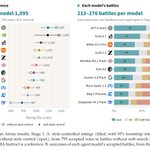
We spent about 13,000 GPU-hours on RSI Arena, tested the models on 20 benchmarks, and collected 3,129 human votes across two rounds. What stayed with me was how much we learned once people tried the models.
At Bake AI, we worked with researchers from @huggingface, @NVIDIAAI, @scale_AI, @Stanford, @MIT, @UCLA, @ucsantabarbara, @nyuniversity, @UW, and @NotreDame
We gave 10 AI agents the same base model and a shared 64-GPU cluster. They picked the data, wrote the code, and trained their own assistants. People at @COLM_conf and online compared the answers without knowing which model wrote them.
We gave the first round’s feedback back to the agents and let them decide what to change. After another training round, eight of ten improved their human ratings relative to NVIDIA Instruct. Those gains did not track benchmark improvements.
The agents could do the engineering. People helped show them what needed fixing.
That’s what this experiment taught us about RSI. AI can take on more of its own development, but our experience with it still matters. If these systems keep getting better, they should help us work better, live better, and spend more time on what we care about.
Otherwise, what is all that compute for?
📄 RSI Arena: Towards Recursive Self-Improvement with Human Feedback
🧵 7/8
After the experiment, we went back through the agents’ runs. People’s feedback had changed their choices: what data to use, what to train, and which problems to fix next.
That’s what led us to propose RSIHF: recursive self-improvement with human feedback.

113
🧵 6/8
One result kept us honest: MiniMax’s model gained 68 style-adjusted rating points relative to NVIDIA Instruct, but also gave more help with harmful requests. Its StrongREJECT score rose from 2.6 to 24.5.
A more popular model can still get worse in other ways.

1
111
🧵 5/8
Across the two rounds, DeepSeek’s model went from 61 to 508 median answer tokens; Astra’s went from 519 to 305.
DeepSeek gained 172 style-adjusted rating points relative to NVIDIA Instruct. Astra stayed close to that reference. Longer wasn’t the only path.

1
112
🧵 4/8
One pattern was hard to miss: the longer answer won 72% of decisive comparisons in Stage 1.
That’s a tempting signal for an agent. But the vote itself doesn’t tell you whether the answer won because it was more useful or simply longer.

98
🧵 3/8
After people tried the models, each agent got 213-276 comparisons: the questions, both answers, and the votes involving its model.
We didn’t tell them what patterns to look for. They had to work out what people disliked and decide what to change.

116
🧵 2/8
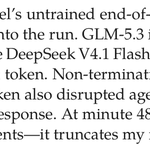
First, every agent had to teach its model to stop talking.
The base model’s end-of-turn token had never been trained. Grok spotted it five minutes in. A lot of autonomous model development looked like very familiar debugging.

151
