

Principal Researcher @Microsoft | AI for Health 🧬🔬 🎾 | Tokyo 🇯🇵 → Seattle 🏞️
Sammamish, WA
Joined January 2010
- Tweets617
- Following739
- Followers1.3K
- Likes15.4K



Naoto Usuyama retweeted

What if pathology foundation models could do more with less? GigaPath-Flash and GigaTIME-Flash cut computational demands while maintaining strong performance, opening the door to larger studies and broader exploration. msft.it/6012arcfr
Naoto Usuyama retweeted
We’ve trained a multimodal AI model to turn routine pathology slides into spatial proteomics, with the potential to reduce time and cost while expanding access to cancer care.
Naoto Usuyama retweeted

おおお!!!
Microsoftの研究がCell誌に!
「マルチモーダルAIで腫瘍免疫を再現」
・ 病理画像H&Eから免疫細胞の状態をAIで再現する技術GigaTIME
・ 約1.5万人の病理画像から30万枚の仮想免疫画像を生成
・ 腫瘍と免疫の1,234種類の新しい関連シグナルが明らかに
cell.com/cell/fulltext/S0092…

Naoto Usuyama retweeted

Open-source AI just leveled up cancer research.
In collaboration with Providence and University of Washington, GigaTIME is helping scientists advance cancer research by flipping routine pathology slides into rich, virtual deep maps so they can explore more scenarios, faster and cheaper than before. msft.it/6008t9lj8

Naoto Usuyama retweeted

仲良くさせてもらっている @naotous さんの成果が MS のブログで発表されて、サティアにも linked in で紹介されてるやん。
いやぁ、マジ本物。めっちゃ
かっこいい!おめでとうございます。
microsoft.com/en-us/research…

Naoto Usuyama retweeted
Today in Cell, we published new research showing how AI can help accelerate cancer discovery. With GigaTIME, we can now simulate spatial proteomics from routine pathology slides, enabling population-scale analysis of tumor microenvironments across dozens of cancer types and hundreds of subtypes.
Developed in partnership with Providence and the University of Washington, our hope is that this work helps scientists move faster from data to insight, revealing new links between genetic mutations, immune activity, and clinical outcomes, and ultimately improving health for people everywhere.
Naoto Usuyama retweeted

The Illusion of Readiness (Health AI)
• GPT-5 & peers ace med benchmarks—but stress tests reveal fragility
• Guess answers w/o images, flip under trivial prompt tweaks
• Fabricate “reasoning” that sounds right but isn’t
• Leaderboard wins ≠ real-world readiness

Naoto Usuyama retweeted

The Illusion of Readiness: Stress Testing Large Frontier Models on Multimodal Medical Benchmarks
"We caution that medical benchmark scores do not directly reflect real-world readiness."
"Leading systems often guess correctly even when key inputs like images are removed, flip answers under trivial prompt changes, and fabricate convincing yet flawed reasoning. These aren't glitches; they expose how today's benchmarks reward test-taking tricks over medical understanding. We evaluate six flagship models across six widely used benchmarks and find that high leaderboard scores hide brittleness and shortcut learning."


Naoto Usuyama retweeted
Epic×Microsoft!
「生成型医療イベントモデルはスケールで性能向上」
・ 医療イベント基盤モデル CoMET 発表
・ 3億人・163億件の診療データを学習、患者の未来を予測
・ 診断予測・疾患リスク・再入院予測など78タスクで専用モデルと同等〜上回る
・ Scaling則が成立
arxiv.org/abs/2508.12104

Thankful to join forces with EPIC on Cosmos AI 🌌
☄️CoMET: generative transformer model trained on de-identified data from 100M+ patient records
Feels a bit like the early GPT-2/3 days — with so much still ahead 🙂

Naoto Usuyama retweeted

1/ I'm excited to announce our latest preprint: Generative Medical Event Models Improve with Scale
We introduce the Cosmos Medical Event Transformer (CoMET), trained from scratch on 115B medical events (151B tokens) from 118M unique, de-identified patient records (link to arxiv in final post).

💡 Happy to share our new review paper: 𝗕𝗶𝗼𝗺𝗲𝗱𝗶𝗰𝗮𝗹 𝗡𝗟𝗣 𝗶𝗻 𝘁𝗵𝗲 𝗲𝗿𝗮 𝗼𝗳 𝗟𝗟𝗠𝘀.
In less than a decade, we’ve gone from ruled-based NLP, to BERT, and now to GPT-5. With the confluence of medical data, knowledge, and AI, we see unprecedented opportunities now for precision health.
✨ 𝗡𝗼𝘄: Biomedical NLP already boosts productivity by automating labor-intensive tasks such as knowledge extraction and medical abstraction.
🌍 𝗡𝗲𝘅𝘁: With the confluence of medical data, knowledge, and AI, we see unprecedented opportunities for creativity gains — reasoning over web-scale knowledge and population-scale patient data.
In this review, we look back at the evolution of biomedical NLP and share
our perspective on the current landscape and where it’s heading next.
Cliff Wong @sheng_zh @TristanNaumann @hoifungpoon @Microsoft


📄 𝗣𝗮𝗽𝗲𝗿 𝗟𝗶𝗻𝗸: annualreviews.org/content/jo…

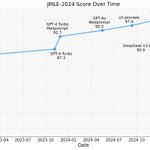
DeepSeek R1 は医師国家試験で正答率 95.3% を達成
95.3% は Medprompt GPT-4o と同程度。オープンウェイトモデルとして、素晴らしいスコアです。
ただし、o1 シリーズとはまだ差があります。o1 シリーズとの差は小さく見えますが、追いつくためにはエラー率4.7% を 0.4% にまで減らす必要があり、10倍の改善が求められます。
また、32B/70Bの小型蒸留モデルと675Bフルモデルの間に大きな差があり、注意が必要です。
R1 は Azure 上で利用可能です
ai.azure.com/explore/models/…


記録更新:o1-pro が医師国家試験で正答率 99.6% を達成
ちょうど2年前リリースされた GPT-3.5 の正答率はわずか 55.3% でした。
Medprompt の活用によりGPT-4 は 92.7% を記録。
そして、2ヶ月前、o1-preview は 驚異的な 98.2% を記録。
そして、o1-pro はさらに性能向上し 99.6% に到達しました。驚異的な進化速度です。
OpenAIとの共同研究を実施し、今後のLLMの展望についても議論しました。ぜひブログと論文をチェックしてください。
ブログ: microsoft.com/en-us/research…
論文: arxiv.org/pdf/2411.03590

Naoto Usuyama retweeted
Reasoning models like o1/o3 will dramatically improve medical use-cases of LLMs.
Here's some evidence for that. Microsoft tested o1-preview on a bunch of medical QA tasks. Not only did it achieve new SOTA, but spending more time thinking with more reasoning tokens improved the scores even further!

Honored that PubMedBERT has been retrospectively awarded the Best Paper Award! 🎉🙌
As one of the earliest explorations into biomedical LLMs, it’s amazing to see how far it’s come with so many users and advancements.
Grateful to our incredible team and the supportive research community. Looking forward to more breakthroughs ahead! 🚀

Excited to share that our PubMedBERT paper pioneering exploration of biomedical LLMs has been retrospectively awarded as the Best Paper of the Year by ACM Health: dl.acm.org/journal/health/ho….
