

Author of New Currency: How Money Changes The World As We Know It. Automaticity in monetary policy: achieving Friedman's Optimum without deflation. Sculptor 🌱
Joined April 2009
- Tweets19.3K
- Following1K
- Followers1.8K
- Likes65.8K





Pinned Tweet
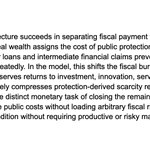
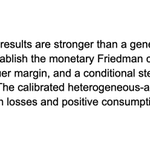
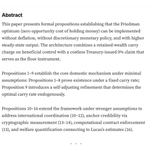
In 1969, Milton Friedman proposed what became known as the "Friedman Rule" - a monetary policy where nominal interest rates should be set to zero, eliminating the opportunity cost of holding money and optimizing monetary efficiency. 🧵 1/15
Jordan MacLeod retweeted

As if we needed something else to convince us that the elites are FUBAR.

If one wanted to understand the ills plaguing classical music today, the firing of conductor Andris Nelsons from the Boston Symphony Orchestra earlier this year is a good place to start. The industry’s identity-obsessed administrators and its misguided struggle for “relevance” are both prominent in the BSO-Nelsons saga. The episode epitomizes the loss of core purpose not just in classical music but in the Western art tradition writ large.
My latest from @CityJournal: city-journal.org/article/cla…

Jordan MacLeod retweeted

Imagine telling someone in 1850 that you’re opposed to machines replacing human labor because people need jobs.
They’d probably think you were insane.
People weren’t working 14-hour days in factories because they loved employment.
They were working because they had no alternative.
Yet here we are, nearly 200 years later, treating the preservation of human labor as some kind of moral obligation.
The objective was never to create jobs.
The objective was to create prosperity.
Somewhere along the way, we confused the two.
Jordan MacLeod retweeted
2/2
It is interesting – and a very good sign – that even free-trade advocates like Lamy now recognize that comparative advantage is not the same as competitive advantage, and that the latter actually distorts the logic of the former.
michaelpettis858496.substack…
Jordan MacLeod retweeted

An underrated insight from cybernetics is that you can build something precise out of imprecise parts. Individual components can be inaccurate if you have a negative feedback loop, because the output depends mostly on how accurately you measure it, not the quality of the parts.
Jordan MacLeod retweeted

A double exponential fits the data very well (R^2=0.99). Extrapolating that gives a predicted time horizon of ~80 work years by end of 2027. Extrapolating an exponential from post-Opus-4.5 gives ~30 work years. (up from Opus 5.5's AECI-implied TH of ~1 work-month)


Jordan MacLeod retweeted

The Fields medalists’ objections to AI will not age well.
Yes, the true value of mathematics lies in understanding. But what counts as mathematical understanding, and indeed even a valid proof, evolves. First came geometric construction and thereafter symbolic calculation, numerical algorithms, computer-assisted proofs, and, in cases such as the classification of finite simple groups, arguments dispersed across thousands of pages and decades of work that exceed what any individual mathematician can fully absorb.
Frontier AI systems will be another chapter in this progression.
It may take a village of mathematicians to interpret and understand the mathematical artifacts produced by an AI system, just as with humanly produced ones. But that is not necessarily a bug. It may instead be a useful feature that forces mathematicians to confront more directly what is actually worth understanding.
Even here there is creative license, since understanding is not canonical but relative. Mathematicians stand on the shoulders of those who came before them, routinely invoking theorems they haven't fully digested. Ultimately, expertise is not exhaustive; it is selective. So that building upon formally verified machine-generated proofs is an expansion of the mathematical toolkit, not a diminishment of it.
Understanding is also, in some sense, a luxury. The natural world is full of objects, structures, and phenomena we don't fully understand. To the extent that mathematics has value in discovering what is true independently of our ability to understand it, those of us who are Platonically inclined should welcome AI’s capacity to generate and confirm mathematical truths that we find useful.
There will obviously be social consequences with powerful AI. It disrupts the traditional value system that awards prizes and prestige to the first to solve a “difficult” problem. But history is full of once-valuable skills made obsolete by technological progress.
Determining exact time and longitude had been a major scientific and navigational challenge, attracting enormous intellectual effort and institutional rewards. But today, atomic clocks and GPS allow us to measure time and location with extraordinary precision and no expertise. And we do not mourn the convenience that modern technology affords us.
Likewise, if some of the most celebrated problems in mathematics turn out not to be especially difficult in the age of AI, that should not be viewed as a loss. It would itself be a discovery: that what we regarded as requiring exceptional human ingenuity to overcome can, in fact, be solved by machines equipped with enough compute.
The appropriate response is not nostalgia for approaching problems with our unassisted minds, but curiosity about what lies beyond and a willingness to set our sights on new horizons.


Jordan MacLeod retweeted

Today Physical Superintelligence PBC is announcing a proof of the Aaronson-Ambainis conjecture, one of the central open problems in quantum complexity, with major implications for quantum computing speedup.
psi.inc/research/aaronson-am…
Thread 👇

Jordan MacLeod retweeted
In Budget 2026, we’re backing the Canadian artists who tell our stories.
That means if you’re a Canadian artist, you won’t pay tax on up to $45,000 of income derived from your creative work.


Jordan MacLeod retweeted

I have thought about this since the 1970s. See the summary in Sec. 20 of reference [1]:
What will supersmart AIs do? As indicated above, they will start by transforming the solar system through countless self-replicating, self-improving robot factories. But that won't be the end of it. In a few hundred thousand years (just a moment on a cosmic scale), they will have transformed the entire galaxy, which has a diameter of about 100,000 light-years. (The last millennium saw many reasonable proposals for interstellar travel, which is much easier for robots than for fragile humans.)
Over time, AIs will set up physical senders and receivers everywhere, allowing them to travel by radio, just as they do in our labs today. In a few tens of billions of years, they will have transformed the rest of the reachable universe. Despite the light-speed limit, the expanding AI sphere will have ample time to colonize and shape the entire visible cosmos [TED12][SA17].
Perhaps all of this has already started elsewhere in the universe. Then why don't we see any signs of intelligence out there? (The Fermi paradox.) I've thought about this a lot.
When I was a boy, I read about the vast empty spaces observed between clusters of galaxies. My first idea was that they were expanding bubbles colonized by AIs that used most of the local energy, making those bubbles appear dark. Then, I learned that gravity itself is sufficient to explain the sparse, large-scale network structure of the universe.
Next, I thought that the mysterious "dark matter," which makes up most of the universe's mass, might be stars whose energy is used by AI civilizations whose communications are so well encrypted that they appear as random noise to us. However, this also seemed implausible because dark matter is present in all galaxies, including our own. So, why are there any stars left in the Milky Way whose energy hasn't been used yet?
And why aren't we bombarded with non-encrypted construction plans from AIs that want to spread via radio without first building physical receivers far from their origins?
Today, I think it's possible that our planet is the first in our light cone to spawn an expanding AI bubble. Earth's multi-billion-year window for biological evolution is almost over. In a few hundred million years, the sun will be too hot for life as we know it. Perhaps humans were incredibly lucky to evolve in time to invent agriculture, civilization, book printing, and AIs just a few hundred years later. If we are indeed the first, then this implies a great deal of responsibility, not just for our biosphere, but for the future of the entire universe. Let's not mess this up.
[1] Annotated History of Modern AI and Deep Learning. Technical Report IDSIA-22-22, IDSIA, Lugano, Switzerland, 2022-2025. Preprint arXiv:2212.11279. people.idsia.ch/~juergen/dee…

Jordan MacLeod retweeted

Turns out the "French student protests" were heavy on the protest, but rather light on being "French" or "students."
faz.net/aktuell/politik/ausl…

Jordan MacLeod retweeted

New (amazing) cabinet directive:
For every $1 in regulatory costs a new rule adds, regulators must cut $2 elsewhere. 👏
They’ll also have to test new rules for competitiveness, default to national or international standards, and review rules regularly.

Jordan MacLeod retweeted

BREAKING: NASA makes U.S. history with first-ever quantum link established between an aircraft & the ground.
Jordan MacLeod retweeted

- "younger Americans are irresponsible losers who also must bear all the burdens of civilization"
- hey, where'd you guys go?


"Young people didn’t show up in any sort of numbers on Tuesday. The youth Republican vote was horrifically bad. They did not show up at all. That is why we’re seeing these huge swings among young people, because only one side voted.
White men aged 18 to 29 — a group that voted for Donald Trump by 28 points in 2024 voted for Democrats by 17 points. It’s not because they all flipped; some did. It’s because one side didn’t show up at all. They didn’t bother. Donald Trump broke his promises to them."
- @RyanGirdusky @realDailyWire
dailywire.com/news/the-2026-…

Jordan MacLeod retweeted
ابدأ بقطر.

Michigan Democratic Sen.-elect Abdul El-Sayed said his first mission will be eradicating the influence of money in American politics.
“Why don’t we have guaranteed health care? Money in politics. Why don’t we have unions? Money in politics,” he said.
wapo.st/4kxGzym


Jordan MacLeod retweeted

This is the best single game mixtape I’ve ever seen dawg what the hell even is this😂😂
