

15 years formulating supplements. Then a stent at 44 with “perfect” labs. Now I audit longevity claims against the primary evidence — and name who funded them.
Iowa, USA
Joined June 2025
- Tweets416
- Following63
- Followers25
- Likes25




Pinned Tweet
1/ Most of the longevity advice you scroll past was written by someone selling something.
I spent 15 years on the other side of that, running supplement companies. Then at 44, with "perfect" labs, I needed a coronary stent.
Here is what that taught me, and what I do now. 🧵
I had no coronary calcium. At 44, I still had an 80 percent blockage in a heart artery and needed a stent.
A calcium score is a CT scan that only sees plaque, the fatty buildup in an artery wall, once it has hardened. Mine was soft.
If a calcium score of zero has reassured you, ask your doctor what that scan can and can't see.
A customer testimonial on a supplement website is a study with one subject, no control group, and a discount code.
I had an 80% blockage at 44 and never had a day of crushing chest pain.
Most plaque ruptures never cause a heart attack. A small clot forms, the artery heals over it, and the plaque grows a layer. A few of those and a mild narrowing becomes a severe one.
The full story, with every study:
I lifted weights for 25 years and never measured my VO2 max, the strongest exercise predictor of how long you live. At 44 I needed a stent.
The benefit from lifting peaked at 30 to 60 minutes a week. Survival kept climbing with cardio fitness, with no ceiling. Here's how I rebuilt my week.
The full story, with every study:
My calcium score was zero on three heart scans. At 44, I needed a stent for an 80% blockage.
A calcium scan only sees plaque that has already hardened. Soft plaque, the kind that can tear, takes a CT angiogram to see. In one large trial, 1 in 10 people who had a heart attack had a calcium score of zero.
The full story, with every study:
What we still don't know about resveratrol: your gut and liver tag most of it before it reaches your blood, so the tagged forms are what circulate. Whether those tagged forms do anything on their own is an open question.
That gap cuts both ways. It isn't proof resveratrol works, and it isn't proof it doesn't.
If you take it, know that's where the science sits, and spend accordingly.
Full article, with every study: link in my bio.

Resveratrol's mechanism held up, under the right conditions. In 2013, changing one amino acid in its target enzyme largely erased the effect, one of the strongest tests in biochemistry.
It still didn't extend life in mice on a normal diet, at three separate labs.
So when someone says a supplement "has a solid mechanism," ask what happened in animals eating normally, and then in people.
Full article, with every study: link in my bio.

I passed four heart tests: an ECG, an echo, a 48-hour monitor and a nuclear stress test. Then a CT angiogram found an 80% blockage in my right coronary artery. I was 44.
Those tests ask whether blood gets through today. None of them looks at the artery wall, where plaque grows first.
The full story, with every study:
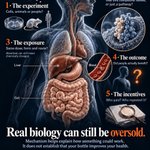
A mechanism explains how a supplement could work. It doesn't show that your bottle improves your health.
Five questions to ask before you buy, in one graphic.
Full article, with every study: link in my bio.

Two minutes, three examples, three places a supplement or peptide falls apart: the dose and route, absorption into your blood, and the mechanism itself.
BPC-157, apigenin and resveratrol. Sound on.
Full article, with every study: link in my bio.
Nick Hanson, MS, RN, CEN retweeted

'It has a solid mechanism' really is the line that sells the bottle. A mechanism explains how something could work — the controlled human data, in the form people actually buy, is where BPC-157 still comes up almost empty.

The only controlled human trials of BPC-157 with results gave it as an enema. Online it's sold as a shot or a pill. And the blood tests couldn't detect it.
I ran supplement companies for 15 years. "It has a solid mechanism" is the line that sells the bottle.
New article: what a solid mechanism actually is, resveratrol's $720 million enzyme story, and four questions that separate real biology from a sales pitch.
Full article, with every study: link in my bio.

In one study, beet juice lowered blood pressure about three hours later. Volunteers who spat out all their saliva instead of swallowing it got no drop.
The bacteria on your tongue are part of how your body makes nitric oxide, the signal your arteries use to relax. Some mouthwashes wipe them out.
I made a 13-minute episode on what the rinse trials actually show, and the one word on your label that tells you which kind you have:
youtube.com/watch?v=XXYR0USM…

To get the dose of resveratrol that's actually been tested in a human trial, you'd have to drink about 8 liters of red wine a day.
That's roughly 60 drinks. A lethal amount of alcohol, long before the resveratrol could do anything. And even that dose (75 milligrams a day, in a 2012 trial in women) "did not affect cellular signaling or result in metabolic benefits," in the authors' own words.
I spent 15 years running supplement and wellness companies, and this is how a health halo gets built: a compound that's technically in the product, a dose nobody can reach from it, and a story that sounds like science.
Resveratrol as a supplement is its own question, and that's my next post. For now, if resveratrol is your reason for the red, it isn't a reason.
I used to order red wine at business dinners because I thought it was the healthy choice.
Then my Oura ring started telling on me. After one or two glasses close to bedtime, my overnight heart rate was often 20 percent higher, and my heart rate variability (HRV, the beat-to-beat variation that shows how well your nervous system is recovering) sometimes dropped by half.
Those are my numbers, not a rule for everyone. But a sleep-lab study of 26 adults found the same direction: one drink for women or two for men raised heart rate for the first four hours of sleep and lowered HRV.
I'd been judging the wine by whether I woke up hungover. I was missing what it did while I slept.
If you wear a tracker, check your overnight heart rate the morning after your next glass, and tell me what you see.
I think we should stop telling people red wine is good for their heart.
I believed it too. But a lot of the studies behind that advice counted former drinkers as "non-drinkers," including people who quit because they were already sick. Of course not drinking looked dangerous.
A 2023 analysis of 107 studies corrected for that and for study quality. Light drinkers no longer had a significantly lower risk of death than people who never drank.
Enjoy wine because you like it. That's a fine reason. Just stop calling it health food, and stop letting anyone sell it to you as medicine. If you do choose to keep drinking, check the alcohol percentage on the bottle and measure how much you actually pour, so you aren't tilting into the heavy-drinker column of risk.
The whole article on one page is above. The full article, with the studies behind each panel:
calibratedsignal.com/r/x/alc…

Wine gets sold as good for your heart. It's also tied to atrial fibrillation (AFib), the most common serious heart rhythm problem.
In a European study of 107,845 people, about one drink a day came with a 16 percent higher risk of developing AFib. That's a relative increase from an observational study, so it shows a link, not proof that the drink caused it.
In AFib, the top chambers of the heart stop squeezing and just quiver. Blood can pool in a small pouch, a clot can form and travel to the brain, and in the Framingham Study, AFib itself came with nearly five times the risk of stroke.
Speaking from experience in the ED, I am surprised by the number of people who arrive with no history of AFib and no idea they have it. Many do have symptoms, but not all. They don't know they have this dangerous heart rhythm until they get an EKG, and they walk around untreated with a significant risk of stroke.
If your heart has ever fluttered or raced after a drink, tell your doctor. Don't wait for it to happen twice.
Are you a heavy drinker without even knowing it?
A standard pour of wine is 5 ounces. Pour 6 every night and a woman is already over the heavy-drinking line, and two of those a night puts a man over it too.
If you are a wine drinker, pay attention to the percentage also. Heavy drinker definitions for measuring wine are based on 12% alcohol, and plenty of reds contain 14%. So this alone can tip you over into the definition of heavy drinker if you have two glasses a day as a man or one as a woman.
And small amounts still add up over the years. About one drink a day is tied to a higher risk of AFib (an irregular heart rhythm), and roughly 1 in 6 alcohol-related cancer deaths happen in people drinking within the US guidelines.
This isn't about a toast at a wedding, it's the nightly glass. Watch the pour, then measure yours tonight.
In 2018, the NIH (the US government's medical research agency) shut down a $100 million trial testing whether a daily drink protects your heart. Alcohol companies had pledged $67.7 million of it.
The lead researcher had pitched the trial to alcohol executives as "a unique opportunity to show that moderate alcohol consumption is safe." An NIH advisory committee said the outreach "calls into question the impartiality of the process." It was stopped with 105 of a planned 7,800 people enrolled.
So the big randomized trial that could have settled the question never ran, and the "moderate drinking is good for you" idea still rests on the observational studies that fell apart once researchers fixed who counted as a non-drinker.
What would change my mind: an independent randomized trial in middle-aged adults showing a daily drink lowers heart attacks, strokes or deaths. Until then, the burden of proof is on whoever is recommending the drink. Who paid for the research matters. It's the first thing I check:
calibratedsignal.com/r/x/alc…

Alcohol is the third leading preventable cause of cancer in the US. Only tobacco and obesity rank higher.
That's from the US Surgeon General's January 2025 advisory: alcohol contributes to nearly 100,000 cancer cases and about 20,000 cancer deaths a year. Most of those deaths happen at heavier drinking, but about 1 in 6 happen in people drinking within the US guidelines.
One reason: your body turns alcohol into acetaldehyde, a compound that sticks to DNA. It can also impair your body's ability to repair DNA damage, and unrepaired DNA damage is a root cause of cancer.
None of that means a glass at a wedding gives you cancer. It means "moderate" isn't the same as "safe," and the label on the bottle still doesn't say so. If wine is in your routine for your health, this is the number to weigh it against.