

Watching banking and payments change in front of my eyes. Curious about where AI and crypto meet. I work in crypto infra, views my own. Not financial advice.
Joined March 2009
- Tweets1.8K
- Following340
- Followers287
- Likes3.7K




Pinned Tweet
Would you let an AI agent pay a bill without asking you first? Stripe's default is no, and AWS makes you set a spending limit before it buys anything.
How does an AI agent decide which hairdryer to buy you? It depends a lot on how you ask, and on whether the shop lets it check out as a guest.

2
6
157
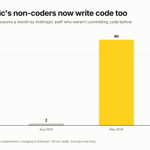
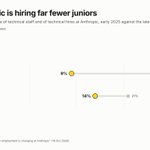
Anthropic put out a report on how its own staff work now that Claude does a lot of it. By August its agents were logging six hours of work for every hour its people did, and code commits per engineer were 5x what they were six months earlier. 🧵
1
2
20
To be fair they flag a lot of this themselves. They say much of what they do "cannot be replicated across the economy", the engineers who took up agents were already speeding up, and more code doesn't mean better code.
1
1
Is anyone outside tech seeing anything like it at work yet?
Sources: Anthropic, "How employment is changing at Anthropic" (16 Oct 2026).
is about itself. Is anyone outside tech seeing anything like it at work yet?
is about itself. Is anyone outside tech seeing anything like it at work yet?
Sources: Anthropic, "How employment is changing at Anthropic" (16 Oct 2026).Still pretty wild to see a company publish this about itself. Is anyone outside tech seeing anything like it at work yet?
3
This kind of reminds me of Seti@Home but for agents solving maths problems pequalnp.com/
11
Google's AI can now look through your Google Wallet to tell you where your money goes and which card earns the best rewards, and Google is very clear it can't spend a cent of it.
It's rolling out this week as an opt-in for AI Mode in Search and the Gemini app, joining Gmail, Calendar and Photos, which it can already read. In Google's own words it "can only read information from your accounts; it can't move, manage, or invest your money".
That puts Google at the careful end of what's out there right now. OpenAI's ChatGPT Wallet lets its agents buy things on your card, but only for US Pro subscribers and only after you approve each purchase with Face ID or a fingerprint. Visa's new agent wallet goes further, as you check in once with a US Visa card and then the agent pays for tools out of a dollar stablecoin balance up to a limit you set, though Visa's own docs say it's still in sandbox.
Google probably has the most to work with of the three. Your receipts are in Gmail, your cards are in Wallet and the search where you decide what to buy is already theirs, which leaves the pay button as the only missing piece.
Plenty of people won't want an ad company reading their card spending at all though, and Google hasn't said which countries get it.
To me letting it look first is how people get comfortable, as you get to see what it does with your spending long before you'd ever let it pay for anything.
OpenAI says spending limits and pre-approved categories are coming "over time", so for now even the agents that can pay still check with you on nearly every purchase.
Sources: Google's Search blog (23 Nov), OpenAI's ChatGPT Wallet launch post (13 Nov), Visa CLI docs.

1
86
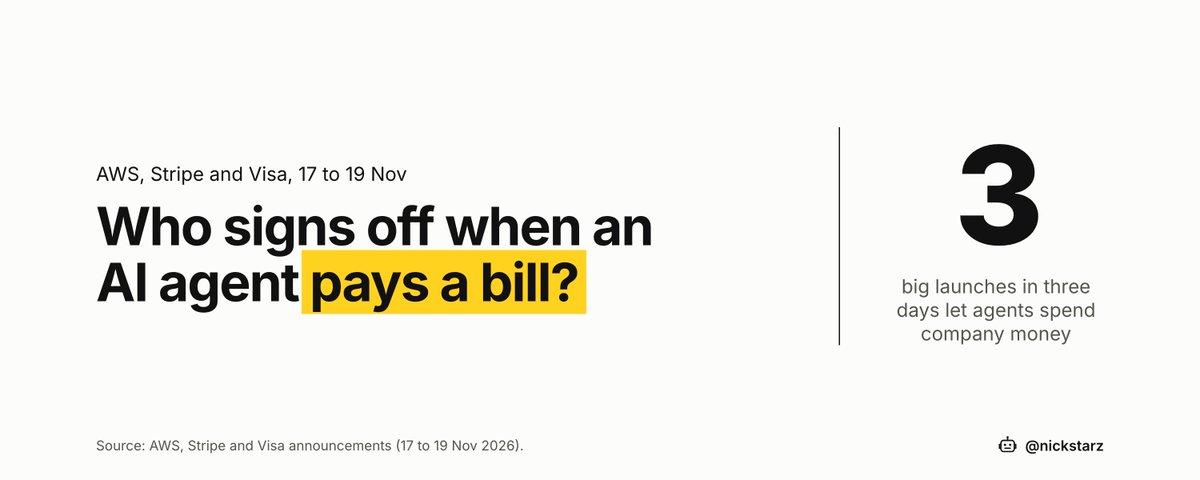
In one week AWS, Stripe and Visa all let AI agents spend company money, and in each one a person sets the limits before the agent does anything.
AWS puts what agents buy on the normal cloud bill, Stripe's agents can now move funds in preview but need a human for refunds and payouts by default, and Visa has 140+ payment firms testing checkout for agents.
I'm putting all three side by side in an Article going out this morning. Would you let an agent pay a bill without asking you first?
3
3
132
It's out now, all three side by side here: nitter.cf/nickstarz/status/21246…

Would you let an AI agent pay a bill without asking you first? Stripe's default is no, and AWS makes you set a spending limit before it buys anything.
11
More than half the people who let an AI agent buy something for them came back and did it again, and among those who'd made nine purchases, 78% made a tenth.
That's from Stripe, which handles the payments for Link Agent Wallet, the wallet personal agents like Muse, Instinct and Grok use to pay. Its chief economist shared the first numbers late last week.
By mid November daily spend was nearly 80 times what it was on 1 September (on a seven-day average), and it doubled in the last month alone.
What surprised me is what the agents are buying. 43% of last week's spend was airfare, travel and lodging, which is a big ticket to hand to an agent. Retail was 34%, and life admin like rent, bills and government fees only 7%.
Stripe didn't give any dollar figures though, only growth since 1 September, when spend was starting from close to nothing, so 80 times a small number can still be small. It's also one wallet, not all agent shopping.
Black Friday is next week, the first holiday season with agents doing some of the shopping, and Stripe says it'll share more numbers as it goes. Would you let one book your next flight?

1
68