

Something New • Previously Founder/CEO @ Popchew (exited). 3-sided marketplace ($10M raised + $20M sales) • @ CobaltRobotics • Others
New York
Joined October 2012
- Tweets436
- Following1.4K
- Followers1K
- Likes20.6K






‘Mercor turns open models into frontier specialists.’
Can’t imagine their frontier lab customers love this positioning?

At Fireworks Forge today, Mercor's CEO @brendanfoody spoke on how Mercor turns open models into frontier specialists.
The core idea is that training data has changed. In 2020 it meant crowdsourcing: SFT, RLHF and behavior cloning, done at scale by people with no particular expertise. Today, the data that moves frontier models comes from experts. They write the rubrics, unit tests and RL environments that teach a model to do real professional work.
The same expert judgment also measures the results. Our APEX benchmarks test frontier models on real knowledge work. Professionals design the tasks and grade them against rubrics, so we can see where a model holds up on the job and where it falls short.
Experts train the model, and experts check it. That's how an open model becomes a specialist.
See the latest results at mercor.com/apex.
Thank you to @FireworksAI_HQ for having us.


My wife (extremely skeptical of AI, no matter how much I jump up and down about it)
Whose new job of two weeks came with a Claude subscription
Just stood up from her computer, said 'Wow, I love Claude' ... and nonchalantly walked past me
I dropped my fork.
Praying for all my friends at @thelinqapp today.
Dot on iMessage.
Instinct group chats.
Godspeed to the engineering team! 🫡


Instinct group chats just dropped.
If they get this right $30B is going to look cheap.
Agents in the group chat are going to reshape economies.
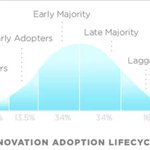
Adoption is about to go parabolic. 🔥

Read two of the S-1's data risks together:
Synthetic data "could... contribute to model degradation"
Weak provenance "could create legal exposure"
Both cheap ways around buying data carry real risk.
The takeaway: real-world data with a clean paper trail is about to get a lot more valuable, not less.
nitter.cf/SHUBH17_/status/211509…


A list of data takeaways from the Anthropic S-1:
- the easy public data, gathered through web crawling and book scanning, has largely been used up. Licensed, commissioned, and synthetic data now sit beside it as training sources
- data acquisition will be a major cost for the labs, alongside compute, training, and safety
- relationships with data providers, licensors, and partners will be key to unlocking datasets they can't get today
- claude now helps generate and process its own training data, and the filing flags synthetic data as a risk to quality, including model degradation
- third-party datasets come with contractual restrictions intended to keep personal data out
- weak documentation of where training data came from, or its chain of custody, is flagged as a legal and diligence risk
- a substantial portion of traffic runs on zero data retention policies and customers hold a lot of proprietary datasets Anthropic doesn't have
It’s also clear that practically all of the Fortune 500 use or have used Anthropic models, including 9/10 of the largest pharma companies, 8/10 of the largest healthcare companies, and the 10 largest banks. Most of the bets are in industries where the most valuable data sits in regulated records that are yet to be unlocked for Claude for Financial Services and Claude for Healthcare.
nitter.cf/AnthropicAI/status/211…
Anthropic's data spend is exploding, +184% YoY.
2024: ~$165M
2025: ~$330M
2026: ~$936M (pace)
Ant is 1 buyer.
@deedydas 's research says there are now 100+ neolabs often with a $1B+ valuation.
Plus the frontiers... all competing for and buying data.
Most data deals are exclusive for 2+ years.
What do y'all think this means for the data market in 2027? 👀
nitter.cf/fleetingbits/status/21…

some thoughts on anthropic's s-1
1) most of what is in anthropic's s-1 is already known to careful observers of the scene.
2) anthropic had $16b of revenue in h1 2026 with 85% gross margins; it spent $6.6b on r&d compute; the company has compute margins of about 45%.
3) gross margins have increased sharply recently: 36.6% in 2023, −94.8% in 2024, 39.5% in 2025 and 85% in h1 2026. i do not think this is a fully optimized business.
4) something interesting is that anthropic spends relatively little on data vendors compared with its r&d compute spend.
5) and, this share has trended down over time.
6) anthropic's estimated data vendor spending was ~$165m in 2024, ~$330m in 2025 and ~$388m in h1 2026. the trend gives ~$936m for 2026.
7) data vendor spending was equivalent to 9.3% of r&d compute spending in 2024, 7.2% in 2025 and 5.9% in h1 2026; purchased data has become a progressively smaller expense relative to compute.
8) i think this is probably because anthropic has increasingly been able to substitute synthetic data for purchased data; compute can substitute for data.
9) anthropic has also long been rumored to spend less on data than the other major labs: google, meta and openai.
10) i'm not sure if this is a reason to be bearish on the data market; anthropic's estimated data spend will still nearly triple this year relative to last year.
11) but i think it is a good sign that we should generally expect data spend to grow more slowly than compute spend, all things being equal.
12) one complication is that @justjoshinyou13 noticed that anthropic's employee count (~5,300) is much higher than reported elsewhere (~3,500).
13) it is possible that some of this extra ~1,800 employees consists of data labelers who are in-house in some sense, which would complicate the above numbers.
14) also interesting, we learn that anthropic's revenue in h1 2026 was 20% subscription-based and 80% consumption-based; subscriptions include enterprise subscriptions.
15) this suggests that incremental api margins could be higher than 85%, since my understanding is that subscription plans tend to be subsidized.
16) another interesting thing in the s-1 is that we get insight into the division between the cloud service provider sales channel and anthropic's direct sales channel.
17) in h1 2026, 48% of anthropic's revenue came through cloud service providers; this has been trending up over time, from 32% in 2024 and 47% in 2025.
18) this means that roughly half of anthropic's revenue comes through amazon, gcp and azure; it appears that in h1 2026, these platforms took a ~35% cut of that revenue.
19) i think that in the long term, anthropic will prefer for this revenue to be direct; anthropic is currently paying ~17% of its revenue in distribution fees.
20) after those fees, its 85% gross margin becomes a margin of about 70%.
21) i guess a final interesting thing, which i will not be able to fully cover, is the company's complicated governance structure.
22) a majority of anthropic's board seats are appointed by the long-term benefit trust (ltbt) but the founders, employees and common shareholders can vote to undo it.
23) the ltbt looks interesting until you realize that its powers can be revoked if it tries to do something unpopular, like remove dario.
24) if the founders want to undo it, it's in the economic interest of the employees and common shareholders to do so too, so it's hard to imagine it wouldn't pass.
25) this seems to be a very common pattern with the anthropic founders; they like to make loud charitable statements but then always make then non-binding
26) like they pledged of 80% of their shares to charity; but, it turns out that is revocable and legally nonbinding.
27) this is very similar to the anthropic public benefit fund; which holds 5% of anthropic's shares, but which is an llc and is fully controlled by anthropic
28) which means the company still controls how the shares are distributed (if at all)
29) so, some of these things sound like loud costly commitments but which turn out on closer inspection to not be so costly at all, at least as of yet

Tibo did us a HUGE favor by giving us credits instead of more resets.
I've been paying $200/month for Codex for a long time and never spent $1 on credits.
Yesterday I burned through ~$1,000 worth of those credits in two hours.
We all knew the subsidy would end. I don't think we realized how big it was. (I certainly didn't)
A reset gives you more time inside the subscription. Credits let you see what your workflow costs outside it.
I was going hard. Probably eight things running concurrently. But that's the point. I am building a company where everyone works this way. Agents everywhere. Parallel execution. People doing substantially more than they could alone.
Assuming a "normal" day is ~$500 in credits, that's $10,000/month. $120,000/year. For one person's workload.
At the equivalent of six figures a year, I'm not running much through Astra.
A pretty shocking wake-up call, and honestly incredible marketing for open weights.
At $200/month, I can afford to be lazy about which model does what. At $120,000/year, figuring out how to get the same work done for less becomes one of the most valuable things I can do.
We'll all need to get good at choosing where expensive models earn their keep, where cheaper models are enough, and what we can run on open weights.
A lot sooner than we thought.



Nick Sopchak 🏴☠️ retweeted

If you hold a secret meeting with competitors and propose forming a cartel, it’s a crime. But if you put out a tweet signaling that you’re willing to do it, it’s a Silicon Valley saturday.


Now the recovery thread got bricked. Im just trying to hydrate my CRM using my own systems.
Whats going on?? @OpenAIDevs
Call me when AI can touch grass

Year 2028: Claude Fable 7.2 solves a Millennium Prize problem.
Academia: "Technically not AGI. It just interpolated high-dimensional data points from existing literature. It doesn’t understand what it did."
Human connects dots across 50 papers = Genius.
AI connects dots across 50M papers = "Glorified autocomplete."
The definition of "real intelligence" is just whatever AI can’t do yet.