

Doctor of Laws, serial administrator, international mediator and arbitrator, Strategic Policy Adviser, Legal scholar, farmer, Joseph the husband of Mary
Abuja, Nigeria
Joined March 2018
- Tweets1.6K
- Following3K
- Followers4.6K
- Likes20.3K
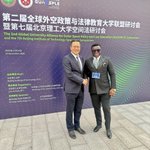









My participation in this conference is motivated by the desire to deepen my understanding of emerging developments in international space law and policy, establish meaningful academic partnerships, explore opportunities for institutional collaboration and contribute to the development of an African perspective on global space governance. I am particularly interested in how Nigerian and African universities can participate in space law education, research, legislative development and international policy formulation."


1
6
113
For nearly two decades, critical electricity infrastructure, including transformers, cables, switchgear, and other transmission equipment, reportedly remained trapped at our ports while Nigerians endured epileptic electricity supply, businesses struggled, and successive governments made promises about improving the power sector. Suddenly, following a presidential directive, Customs has commenced its clearance. It is commendable that the equipment is finally being released, but governance should not be reduced to last-minute discoveries and dramatic announcements. One is tempted to ask whether the urgency stems from a genuine awakening to the country’s developmental challenges or from the political anxiety of an approaching electoral contest. Nigerians deserve more than election-season activism. They deserve responsible, consistent, and accountable governance. The real achievement will not be the ceremonial release of containers from the ports; it will be installing, commissioning, and delivering reliable electricity to Nigerian homes, businesses, and industries.
@ADCNig @adc @nigerelectric @apc
1
126
THE ADC JUDGMENT: A SETBACK FOR MULTI-PARTY DEMOCRACY?
The judgment against the African Democratic Congress leadership is deeply troubling. It raises fundamental questions about protecting political pluralism and the survival of Nigeria's multi-party democracy. Our democracy was not secured through decades of struggle so that the political space could gradually become the exclusive preserve of one political party. The constitutional guarantee of freedom of association and the right to form and belong to political parties must be protected in both letter and spirit.
While we acknowledge the authority of the judiciary, judicial decisions are not beyond appellate scrutiny. Where a judgment raises questions of law, constitutional interpretation or substantial injustice, the appropriate response is to pursue the available judicial remedies. We must also remain vigilant against any political development that could weaken opposition parties, undermine political competition or encourage the concentration of power in a single political establishment. Nigeria belongs to all of us. Our democracy must accommodate divergent political opinions, competing political parties and the genuine aspirations of citizens to seek political change. We shall resist every attempt to diminish our democratic space, but we must do so constitutionally, peacefully and resolutely. This is not merely about the ADC. It is about the future of political pluralism in Nigeria. Defending multi-party democracy is a collective constitutional responsibility.
@adc @ADCVanguard_ @AAsupportOrg

Yesterday, together with other Senatorial candidates, I paid a courtesy visit to the ADC Presidential Candidate at his residence. It was a warm and cordial meeting marked by meaningful conversations and mutual respect. I appreciate the gracious reception and look forward to continued engagement in the interest of our party and our nation's progress.
@AAsupportOrg @atiku @adc


The name November comes from the Latin word novem, meaning nine. In the ancient Roman calendar, which traditionally began in March, November was the ninth month. When January and February were added to the calendar and the year began in January, November became the eleventh month, but it kept its original name. Beyond its position in the calendar, November can be viewed in several meaningful ways:
A season of reflection: An opportunity to look back on the year, assess achievements, learn from setbacks, and renew our sense of purpose.
A season of gratitude: A time to appreciate God's goodness, the gift of life, family, friendship, and the people who have contributed to our journey.
A season of preparation: With only one month remaining after November, it offers an opportunity to prepare for the end of the year and the beginning of another.
A season of hope: Unfulfilled dreams and delayed expectations can still inspire renewed effort, faith, and determination.
Happy new month, family.
1
12
317
Last week at the Nigerian Association of Law Teachers conference in Benin, I delivered a paper on INCENTIVIZING GREEN INNOVATION, GREEN CREDIT, AND GREEN FINANCE THROUGH LAW IN NIGERIA:
Green innovation involves developing and adopting environmentally sustainable technologies, products, and production processes, while green credit refers to lending facilities that support projects advancing environmental sustainability. The paper argues that Nigeria requires a coherent, enforceable, and incentive-driven legal framework that aligns environmental protection with financial regulation, technological advancement, and industrial development. It recommends harmonizing relevant laws and policies, introducing targeted tax incentives for green enterprises, developing a national green credit framework, strengthening environmental disclosure and accountability requirements, and improving access to finance for small and medium-sized enterprises engaged in sustainable innovation. Ultimately, the paper contends that law should actively stimulate sustainable innovation, reduce investment risks, and redirect financial resources towards environmentally responsible economic activities.


5
192
WHEN LAW TEACHERS MEET
When law teachers meet, intellect converges, jurisprudence deepens, ideas are interrogated, and the frontiers of justice are expanded. It is more than an academic gathering; it is an encounter of minds committed to shaping legal thought, influencing public policy, and nurturing the next generation of legal minds. When those who teach the law meet, the law itself is examined, challenged, refined, and reimagined.#NALT


4
189
The Lagos–Calabar Coastal Highway is presented as a landmark infrastructure project that will connect coastal communities, facilitate trade, create employment, stimulate tourism and transform Nigeria’s economic landscape. These are attractive promises.
But the fundamental question is this: Does the promise of a megaproject automatically justify its cost, procurement arrangements, environmental consequences and financial implications?
Why should Nigerians be expected to finance an undertaking of this magnitude without a transparent account of the assumptions, alternatives, and decisions that underpin it?
The government must answer the questions surrounding procurement, financing, environmental safeguards, compensation, route changes, and the project’s overall economic justification. Legislators, auditors, procurement regulators, environmental authorities and anti-corruption institutions must discharge their respective responsibilities.
Nigeria needs infrastructure, not extravagance disguised as development. It needs economic transformation, not monumental expenditure insulated from scrutiny. And it needs public officials who understand that the resources entrusted to them are held in trust for the people.
Political slogans cannot replace the burden of public accountability.

6
223
The spectacle of public school students embarking on fee collection drives is a disturbing indictment of our educational priorities, particularly in an oil-rich nation recording increased government revenues following petroleum subsidy removal.
Our children belong in classrooms, not on the streets collecting school fees. Section 18 of the 1999 Constitution (as amended) enjoins government to promote equal educational opportunities and progressively provide free education. Although generally non-justiciable under section 6(6)(c), the Compulsory, Free Universal Basic Education Act 2004 gives statutory force to aspects of this obligation.
The legal consequences are significant. Section 3 of the Act prohibits the charging of fees for services provided in public primary and junior secondary schools. Consequently, compulsory fees imposed contrary to this provision may be challenged in court, declared unlawful and subjected to appropriate judicial remedies. Officials responsible may also face administrative or disciplinary sanctions where applicable.
Furthermore, section 2 imposes obligations concerning compulsory basic education, with statutory penalties for parents who fail to ensure their children’s attendance, subject to the conditions prescribed by law. Government cannot reasonably demand compulsory school attendance while permitting unlawful financial barriers to education.
Although senior secondary education falls outside the Act’s basic education fee prohibition, state governments remain bound by applicable laws and their legally enforceable educational commitments. Where, then, are the dividends of subsidy removal if parents must still struggle to finance public education? If Nigeria can sustain the enormous cost of governance, it must demonstrate the political will to educate its children.
Free education must be a practical reality, not a political slogan.

1
105
To enrich, deepen, and sustain our democracy, the opposition must survive. Democracy is not strengthened when everyone belongs to the ruling party or when dissenting voices are gradually silenced. It thrives on choice, competition, accountability and alternative ideas. A credible opposition scrutinises government, questions policy, exposes shortcomings and presents citizens with an alternative platform. International IDEA similarly identifies effective opposition as essential to accountability, political pluralism and meaningful electoral choice. The opposition must, however, be constructive—not opposition merely for opposition’s sake. It should acknowledge what government gets right, challenge what it considers wrong, and offer better ideas where it disagrees. Those in government today may be in opposition tomorrow. That possibility is itself one of democracy’s greatest safeguards against the abuse of power. We must therefore protect the political space in which both government and opposition can flourish. Democracy needs a government capable of governing—and an opposition capable of holding it to account.


1
10
302
THE ABSENTEE PRESIDENT
The absence of President Bola Ahmed Tinubu from Nigeria reopened an important constitutional question: when a President proceeds on vacation outside Nigeria, at what point should the Vice-President perform the functions of President as Acting President? The answer lies principally in section 145 which provides that whenever the President is “proceeding on vacation or is otherwise unable to discharge the functions of his office,” he shall transmit a written declaration to the President of the Senate and the Speaker of the House of Representatives. Following that declaration, the Vice-President performs the functions of President as Acting President until the President communicates his availability to resume his functions. The provision is couched in mandatory language: “shall transmit.”
Section 145 cannot properly be understood without recalling the constitutional crisis surrounding President Umaru Musa Yar’Adua’s prolonged medical absence which led the National Assembly to resort to the doctrine of necessity in recognising Jonathan as Acting President. The Constitution was subsequently altered in 2010 to prevent a repetition of such uncertainty. The significance of section 145(2) is profound: what previously required resort to the doctrine of necessity is now substantially addressed by the written Constitution itself.
Other Constitutional Democracies:
Ghana: Ghana provides one of the clearest African examples. Article 59 of the 1992 Constitution of Ghana provides that the President shall not leave Ghana without prior written notification to the Speaker of Parliament.
South Africa: Section 90 of the Constitution of the Republic of South Africa 1996 is equally explicit. Whenever the President is absent from the Republic or otherwise unable to fulfil presidential duties, the Deputy President acts as President. An Acting President assumes the responsibilities, powers and functions of the President.
Kenya: Article 147(3) of the Constitution of Kenya 2010 provides that, subject to specified constitutional limitations, whenever the President is absent or temporarily incapacitated, the Deputy President acts as President.
India: Article 65(2) of the Constitution of India provides that when the President is unable to discharge presidential functions because of absence, illness or any other cause, the Vice-President discharges those functions until the President resumes duty.
United States: The United States adopts a different model. The Twenty-Fifth Amendment does not make foreign travel the trigger. Its concern is presidential inability.
United Kingdom: The United Kingdom presents a different constitutional structure altogether. As a parliamentary system operating substantially through conventions rather than a single codified constitution, the Prime Minister’s foreign travel does not automatically create an office of “Acting Prime Minister.”
The Comparative Lesson:
The constitutional mechanisms differ, but the underlying objective is remarkably similar: continuity, certainty and accountability in the exercise of executive power. The question is not simply whether modern communications technology enables a President to govern from London, Paris, New York or anywhere else. The constitutional question is who is legally entitled to exercise presidential authority, and whether the procedure prescribed for temporary presidential absence has been observed. The larger constitutional principle, however, transcends the present administration. Section 145 was designed after Nigeria’s difficult experience with presidential absence to ensure that the country would not again be left uncertain about the lawful exercise of executive authority. The Constitution is concerned not merely with where the President is, but with certainty as to where presidential authority resides. That is the enduring lesson of section 145—and the constitutional significance of the absentee President.


2
189
SUNDAY INSPIRATION
Every Sunday reminds us that no matter how demanding the past week has been, God gives us another opportunity to renew our faith, restore our strength, and begin again. Don't be discouraged by delays, disappointments, or closed doors. What seems like a setback today may be God redirecting your steps toward something better. Keep doing what is right, keep serving others, and keep trusting the process. As Scripture assures us: “Those who hope in the Lord will renew their strength.” — Isaiah 40:31. May this Sunday bring peace to your heart, strength for the journey ahead, and grace to accomplish all that God has placed before you. Have a peaceful, blessed, and inspiring Sunday.

1
18
309
Section 145 of the Constitution of the Federal Republic of Nigeria 1999 (as amended) provides that whenever the President proceeds on vacation or is otherwise unable to discharge the functions of his office, he “shall” transmit a written declaration to the President of the Senate and Speaker of the House of Representatives, whereupon the Vice-President performs those functions as Acting President.
Crucially, section 145(2) addresses failure to transmit the letter. If the President is unable or fails to transmit it within 21 days, the National Assembly shall, by a simple-majority resolution of each House, mandate the Vice-President to perform presidential functions as Acting President. This subsection was introduced by section 14 of the Constitution of the Federal Republic of Nigeria (First Alteration) Act 2010, substantially to prevent a recurrence of uncertainty over presidential authority.
The Supreme Court’s reasoning in Attorney-General of the Federation v Abubakar (Atiku) (2007) 10 NWLR (Pt 1041) 1; (2007) 2 All NLR 58 is instructive. The Court emphasized both the constitutionally integrated relationship between President and Vice-President and the principle that the Constitution governs the tenure and powers of those offices, not executive discretion. It also reaffirmed that clear constitutional language should ordinarily receive its plain meaning.
Thus, if President Tinubu has proceeded on vacation and has not transmitted the section 145(1) declaration, the constitutional issue is one of non-compliance with section 145. After 21 days, section 145(2) places a duty on the National Assembly to activate the constitutional mechanism for the Vice-President to act. This preserves continuity of executive authority and prevents uncertainty about who constitutionally exercises presidential powers.
The nation waits with bated breath.
2
113
I recently drove past the old premises of the West African Peoples Institute in Calabar, founded by Prof. Eyo Ita in 1938, and was compelled to stop. What caught my attention was a piece of our history apparently surrendering, almost unnoticed, to abandonment and physical transformation. I stopped, came down and took a photograph. On the weather-beaten façade of one of the surviving structures, above broken windows and walls stained by decades of exposure, an inscription remains remarkably visible:
“DEDICATED TO WEST AFRICAN YOUTH.”
Those four words stopped me. They also raise a question that should concern Cross River State and, indeed, Nigeria: How did a place conceived with such an extraordinary vision for African youth come to this? My concern is heightened by what appears to be happening around the historic premises. Some of the old structures that formed part of the West African Peoples Institute complex are disappearing and giving way to modern development, reportedly connected with a hotel project. Irrespective of who owns the land today, an important question of public heritage arises: Should structures of demonstrable historical significance disappear because the land on which they stand has acquired greater commercial value? There is nothing inherently wrong with building a hotel. Calabar needs investment. It needs good hotels, tourism infrastructure, jobs, and urban renewal. But development and preservation are not enemies. Some of the world’s most successful tourism cities have learned that their old buildings are economic assets precisely because they are old. Historic structures are restored and incorporated into contemporary developments. Former schools become museums. Railway stations become galleries. Warehouses become cultural centers. Historic districts accommodate restaurants, hotels and businesses while retaining the architecture that gives those places their identity.
The most famous hotel in Spain located in an ancient building is the Hostal Real de Santiago de Compostela. It is a five-star hotel situated directly next to the main Catedral de Santiago de Compostela, opened in 1499 by the Catholic Monarchs as a royal hospital to shelter weary pilgrims finishing the Camino de Santiago. It features a striking Plateresque stone facade, four grand historic cloisters, and traditional antique furnishings inside the rooms. I was awed by the level of preservation when I visited and slept there.
A hotel can be built almost anywhere. The West African Peoples Institute can only exist where history placed it. Once an original structure is demolished, no amount of money can reproduce its authenticity.
A replica is not heritage; A photograph is not heritage; A commemorative plaque erected after demolition cannot substitute for the building on which Eyo Ita’s generation placed the words:
“Dedicated to West African Youth.”
What should be done?
Therefore, there should be no rush to demolish any surviving historic WAPI structure. Before further irreversible alteration of the site, the Cross River State Government, relevant federal heritage authorities, historians, architects, town planners, the present owners or occupiers of the property, the WAPI community and representatives of Professor Eyo Ita’s family should undertake a comprehensive heritage assessment of the entire premises.
The first task should be documentation: What structures remain? When was each constructed? What purpose did each serve? Which retain their original architectural fabric? What archival records, photographs, plans, furniture, workshop equipment, school registers, publications and personal papers survive? The historically significant structures should then be conserved and restored. Most importantly, the surviving workshop building bearing the inscription “Dedicated to West African Youth” should be preserved in situ.
The historic core of WAPI could become an Eyo Ita and West African Peoples Institute Heritage Center.

3
16
425
The tragic death of thirty-seven miners while in the custody of the Nigeria Security and Civil Defence Corps in Niger State deserves unequivocal condemnation and an immediate, independent and transparent investigation. We must also be careful with the indiscriminate labeling of citizens as “illegal miners.” The Nigerian Minerals and Mining Act expressly recognises artisanal and small-scale mining as part of the country’s mining framework. While mining without the requisite mineral title or authority may constitute an offence under the Act, that allegation does not extinguish the constitutional rights of the persons concerned or transform suspects into convicts.
These men were arrested. They had not been tried, convicted or sentenced. Yet thirty-seven human beings reportedly entered the custody of a public security institution and never returned alive.
The explanation of a “suspected disease outbreak” cannot, by itself, close the matter. The precise cause of death, the conditions under which the deceased were detained, the number of persons confined in the facility, the ventilation and sanitation available to them, and the medical attention provided must all be independently established.
The right to life and the dignity of the human person remain fundamental constitutional guarantees. State custody imposes an especially grave responsibility to protect those whose liberty the State has taken away.
I therefore call for a credible investigation, independent autopsies, and full public disclosure of the findings. Where negligence, misconduct or criminal responsibility is established, those responsible must be held accountable in accordance with law. The families of the deceased also deserve justice and, where liability is established, appropriate compensation.
Thirty-seven lives cannot simply become another statistic. Justice must be done—and must be seen to be done.

1
18
386
‘Nsibidi’ complicates the conventional description of Nigerian customary law as “unwritten law”. Among the Ejagjam people and within the Cross River legal order, normative authority could be expressed through an ecology of oral tradition, institutional practice, ritual performance, visual inscription, and specialized signs. The absence of alphabetic legislation was therefore not the absence of legal textuality.
PETER OBI AND REV. FR. HYACINTH ALIA: FAITH SHOULD RISE ABOVE POLITICAL BOUNDARIES
Peter Obi and Governor Rev. Fr. Hyacinth Alia are both sons of the Catholic Church. One is a Catholic Papal Knight; the other is an ordained Catholic priest. Their political affiliations and ambitions may differ, but their common faith should provide sufficient moral ground for mutual respect, restraint and brotherhood. Politics must never be allowed to destroy relationships that transcend partisan boundaries. Political parties are temporal institutions; our shared humanity, Christian brotherhood and commitment to the common good are much deeper.
Peter Obi has every right, subject to lawful security requirements, to visit any part of Nigeria, including Benue State. In the same way, Governor Alia deserves the respect due to the elected Governor and Chief Executive of Benue State. Courtesy requires that prominent political leaders visiting a state communicate appropriately with the relevant authorities, especially where security arrangements may be necessary. But protocol should facilitate security and mutual respect; it should never become an instrument for restricting legitimate freedom of movement.
Whatever misunderstanding may have arisen over Obi’s visit should therefore not be allowed to degenerate into a personal confrontation between these two Catholic brothers. Indeed, their faith places an even greater responsibility upon them to demonstrate that political differences need not produce political enmity. They can disagree on policy, party and political strategy while respecting each other’s legitimate spheres of responsibility.
At a time when Nigeria is already deeply divided along political, ethnic and religious lines, the country needs leaders who can disagree without becoming enemies.
Let Peter Obi respect the legitimate boundaries of the Governor’s constitutional responsibilities, and let Governor Alia equally respect Peter Obi’s constitutional freedom of movement and legitimate political engagement. Neither loses anything by extending courtesy to the other.
Nigeria will be better served when our leaders remember that political offices and political parties will pass away, but the values of fraternity, dignity, peace and service to humanity endure.
For two prominent Catholics, reconciliation would not signify weakness. It would demonstrate leadership—and perhaps offer Nigeria an example of the kind of politics we desperately need.


2
159
A PRAYER FOR THE PEOPLE WE LOVE ❤️
To the people we love, we pray for you and wish you nothing but the very best in the coming week. May God go before you and make every crooked path straight. May He grant you favour where you least expect it, open doors of opportunity, protect you from harm, and give you the wisdom and strength to overcome every challenge. May this new week bring you good news, answered prayers, peace of mind, sound health, success in your endeavours, and reasons to smile.
May your family and loved ones be blessed, and may you never lack the grace, mercy, and provision of God.
Have a beautiful, fruitful, and blessed week ahead. May everything work together for your good.
Amen. 🙏🏽
1
174
The Annual General Meeting of the Nigerian Bar Association provided another wonderful opportunity to participate in stimulating intellectual and professional sessions, engage with contemporary issues affecting the legal profession and, importantly, unwind after the demands of professional life.
Conferences of this nature offer benefits far beyond the formal sessions. They provide an avenue for continuous professional development, exposure to new ideas, exchange of knowledge and experience, professional networking, mentorship, collaboration and the discovery of new opportunities. They also enable practitioners and academics to compare notes, discuss emerging trends, share experiences and gain fresh perspectives on the challenges confronting the profession and society.
For me, one of the most rewarding aspects was the opportunity to meet and greet old friends, classmates and colleagues, some of whom one may not have seen for years. These encounters remind us that professional relationships are among the most valuable assets we build throughout our careers. The warmth of reconnecting, reminiscing about the past and discussing the present is itself a form of renewal.
The AGM also offered an opportunity to step away briefly from the routine pressures of work, relax, reflect and recharge. Sometimes, we need to leave our familiar environment, listen to others, engage in different conversations and simply breathe. We return with renewed energy, fresh ideas and a clearer perspective on the challenges ahead.
Another particularly fulfilling moment for me was visiting my publisher’s book stand, where I had the pleasure of signing autographs and interacting with readers and colleagues around my published works. There is something deeply gratifying about seeing one’s intellectual efforts transformed into books that others can read, consult and learn from.
As the AGM now comes to an end, I return home refreshed, re-energised and intellectually enriched, carrying with me new ideas, renewed friendships, memorable encounters and a stronger appreciation of the profession to which I belong.
Conferences end, but the conversations, relationships, ideas and lessons they generate continue.
It is now time to return to the realities of the day-to-day — to work, to responsibilities, to leadership and to the challenges that await.
The break was worthwhile. The encounters were memorable. The learning was invaluable. And now, refreshed and recharged, it is time to get back to work.
#NBAAGM #NigerianBarAssociation #LegalProfession #ProfessionalDevelopment #Networking #ContinuousLearning #LegalEducation #BackToWork


