



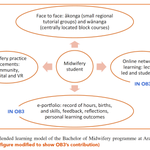


ALT This figure 18.1 is on the blended learning model of the Bachelor of Midwifery programme at Ara Institute of Canterbury. The concept “midwifery student” inside a circle are in the middle of the figure. Four arrows come out of it and used to introduce the four main elements of the model. Left arrow leads to encircled element “midwifery practice placements: community, hospital and VR”. Top arrow leads to encircled element “Face to face: ākonga (small regional tutorial groups) and wānanaga (centrally located block courses). The figure has been modified to show OB3’s contribution to two elements. Right arrow leads to element “online networked earning: lecturer and student led” with OB3. Bottom arrow leads to element “e-portfolio: record of hours, births, and skills, feedback, reflections, personal learning outcomes” with OB3. This figure appears in the journal article titled “A Networked Distributed Model for Midwifery Education” co-authored by Rea Daellenbach, Mary Kensington, Kathle


ALT This image is of a table containing the results of a comparative study of four online forum technologies. This was undertaken by an enterprise client enrolling 14000 students yearly. The table has six columns. From left to right, column one is labeled “evaluation criteria”, column 2 “description”, column 3 “OB3”, column 4 “Moodle”, column 5 “ONCN, and column 6 “MS Teams”. The evaluation criteria is comprised of 10 topics “flexible learning”, “social and constructivist learning”, “learner driven learning”, “learner inclusivity”, “data ownership”, “hypermediality”, “user friendly”, “scalability”, “integration to other technologies”, and support and support resources”. OB3 came on top on each criteria and with a warning that it could be “potential for disruption to BAU”. This table is used with permission.

ALT This image is titled "co-creating journal club entries in OB3". It is inspired on content from our poster “Student-led Journal Club with a Technology for Asynchronous Discussions In-line with Content”. Also, it includes a drawing illustrating how students co-create articles for a journal club in OB3. One or two students develop summaries on a journal article and establish the clinical implications for science lectures. Then, fellow students discuss and expand on these ideas. They build a collaborative online document analyzing scientific evidence, other articles, the relevance to basic science and future directions of research.


ALT This image contains a concept map describing the collaborative development model of an Otago-Sydney universities posgratuate medical programme. On the left side, the concept map includes concepts describing the facilitation of personalised learning, students engagement and co-construction for understanding. In the middle, the map describes the activities carried out by lecturers, tutors, and students. In the right side, the descriptions are about the types of collaborative assignments students carry out independently, but with the facilitation of lecturers and tutors. students. In the right side, the descriptions are about the types of collaborative assignments students carry out independently, but with the facilitation of lecturers and tutors.

ALT This image is titled "co-creating study content with OB3". It is the scan of a drawing made with black and white calligraphy pens. It depicts the schematic of an OB3 page in the center of the image. Lines are coming out of elements in the image to show who is creating what. The elements represent one heading, two paragraphs, one video, one image three discussion posts, and one embedded survey On the left side of the image there are three icons of people representing an academic and two students. The legends next to each icon say: "an academic provides a title and introduction", "a student contributes and image", "a student contributes to a survey". On the right side of the image, there are four icons of people, representing an academic and four students. The legend next to each icon says: "A student contributes a video", "An academic contributes a paragraph", and "A few students contribute to a discussion sparked by the resource being created"


ALT Image with DEL22 logo and also the photos of the panel hosts, design and health educator panellists.

ALT This image contains a quote that says “Students and lecturers… enjoy the commentary and the discussion in OB3. They work interactively and contribute ideas and materials that they have encountered by sharing URLs and uploading materials themselves.” (Daellenbach, Davies, Kensington & Tamblyn, 2014, p. 572)

ALT This image comes from our INTED22 presentation, slide 6. It showcases research and publications advancing the area of students and teachers co-designing learning. The areas are "students as partners", "students co-creators of learning", "student-generated content", "student involvement", "students as producers". Supported in OB3, our area is identified as "student-led content" and "student-derived content".

ALT This image is a black and white illustration. It illustrates the challenge that OB3 addresses. It shows three icons representing one teacher and two students. The icons are arranged forming a sort of circle and are linked to each others with three curved double spearheaded arrows. Next to each arrow there is a word: collaboration, learner interaction and giving feedback.