Abímbọlá (LNSPS) (@oladiran) header
Abímbọlá (LNSPS) (@oladiran) profile picture

Professor of Atmospheric Physics. President of the Nigerian Society of Physical Sciences (NSPS: https://nitter.cf/t.co/076RWVTxQd). https://nitter.cf/t.co/wW7khZxMJr

Lafia, Nigeria
Joined May 2008
Photo by Abímbọlá (LNSPS) (@oladiran)Photo by Abímbọlá (LNSPS) (@oladiran)Photo by Abímbọlá (LNSPS) (@oladiran)Photo by Abímbọlá (LNSPS) (@oladiran)Photo by Abímbọlá (LNSPS) (@oladiran)Photo by Abímbọlá (LNSPS) (@oladiran)Photo by Abímbọlá (LNSPS) (@oladiran)Photo by Abímbọlá (LNSPS) (@oladiran)Photo by Abímbọlá (LNSPS) (@oladiran)Photo by Abímbọlá (LNSPS) (@oladiran)
🌟 𝐒𝐏𝐎𝐓𝐋𝐈𝐆𝐇𝐓 𝐌𝐄𝐌𝐁𝐄𝐑 𝐎𝐅 𝐓𝐇𝐄 𝐖𝐄𝐄𝐊: 𝐃𝐑. 𝐁𝐄𝐌𝐆𝐁𝐀 𝐁𝐄𝐕𝐀𝐍 𝐍𝐘𝐀𝐊𝐔𝐌𝐀 Meet 𝐃𝐫. 𝐁𝐞𝐦𝐠𝐛𝐚 𝐁𝐞𝐯𝐚𝐧 𝐍𝐲𝐚𝐤𝐮𝐦𝐚, NSPS Spotlight Member of the Week, whose research explores underutilized mineral resources for scientific discovery and technological innovation. Dr. Nyakuma is an Associate Professor of Materials and Energy Chemistry and Head of the Department of Chemical Sciences at North-Eastern University, Gombe, Nigeria. His journey into scientific research began at Abubakar Tafawa Balewa University, Bauchi, where he obtained a degree in Industrial Chemistry in 2006. Driven by a growing interest in energy and materials, he proceeded to Delft University of Technology in the Netherlands, where he earned an MSc in Sustainable Energy Technology in 2010, before completing his PhD in Chemical Engineering at Universiti Teknologi Malaysia in 2018. READ MORE @ nsps.org.ng/news/post.php?sl…
1
20
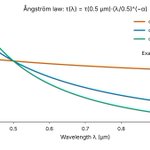
How do we tell dust from smoke by sunlight? Ångström law: τ(λ) = β·λ^(−α). τ: aerosol optical depth, λ: wavelength (µm), α: exponent. α near 0 means coarse dust (harmattan); α above 1.5 means fine smoke. #AtmosPhysics
10
𝗣𝗵𝘆𝘀𝗶𝗰𝗼𝗰𝗵𝗲𝗺𝗶𝗰𝗮𝗹 𝗣𝗿𝗼𝗽𝗲𝗿𝘁𝗶𝗲𝘀, 𝗟𝗶𝗽𝗶𝗱 𝗖𝗼𝗺𝗽𝗼𝘀𝗶𝘁𝗶𝗼𝗻, 𝗮𝗻𝗱 𝗙𝗮𝘁-𝗦𝗼𝗹𝘂𝗯𝗹𝗲 𝗩𝗶𝘁𝗮𝗺𝗶𝗻𝘀 𝗼𝗳 𝗢𝗶𝗹𝘀 𝗮𝗻𝗱 𝗔𝗻𝘁𝗶𝗼𝘅𝗶𝗱𝗮𝗻𝘁 𝗔𝗰𝘁𝗶𝘃𝗶𝘁𝘆 𝗼𝗳 𝗠𝗲𝘁𝗵𝗮𝗻𝗼𝗹 𝗘𝘅𝘁𝗿𝗮𝗰𝘁𝘀 𝗳𝗿𝗼𝗺 𝗧𝘂𝗯𝗲𝗿𝘀, 𝗣𝗲𝗲𝗹𝘀, 𝗮𝗻𝗱 𝗟𝗲𝗮𝘃𝗲𝘀 𝗼𝗳 𝗦𝘄𝗲𝗲𝘁 𝗣𝗼𝘁𝗮𝘁𝗼 (𝗜𝗽𝗼𝗺𝗼𝗲𝗮 𝗯𝗮𝘁𝗮𝘁𝗮𝘀 𝗟.) 𝗶𝗻 𝗡𝗶𝗴𝗲𝗿𝗶𝗮 A recent study published in African Scientific Reports compared the physicochemical properties, lipid composition, vitamins, phytochemicals, and antioxidant activity of sweet potato tubers, peels, and leaves collected in Nigeria. Oils were extracted with n-hexane, while separate methanol extracts were used for water-soluble vitamins, phytochemicals, and antioxidant testing. Leaf oil contained the highest total unsaturated fatty acids at 60.1%, total phospholipids at 152.0 mg/100 g, total phytosterols at 185.3 mg/100 g, and vitamin E at 53.1 mg/100 g. Leaf methanol extract also showed the strongest apparent antioxidant activity, with an extrapolated DPPH IC50 of 31.6 µg/mL. Peel oil had the highest carotenoid content, expressed as vitamin A, at 7.08 mg/100 g, while peel methanol extract had the highest riboflavin content at 16.11 mg/kg. Tuber oil recorded the lowest peroxide value at 0.6 meq O₂/kg. The findings suggest that sweet potato leaves and peels may have potential value as sources of bioactive compounds, although the results require confirmation using independent biological samples and quantified oil yields. 📖 Read the full article here: nsps.org.ng/news/post.php?sl…
1
12
𝗛𝘂𝗺𝗮𝗻 𝗔𝗰𝘁𝗶𝘃𝗶𝘁𝘆 𝗥𝗲𝗰𝗼𝗴𝗻𝗶𝘁𝗶𝗼𝗻 𝘄𝗶𝘁𝗵 𝗮 𝗙𝗶𝗻𝗲-𝗧𝘂𝗻𝗲𝗱 𝗖𝗟𝗜𝗣 𝗩𝗶𝘀𝗶𝗼𝗻 𝗧𝗿𝗮𝗻𝘀𝗳𝗼𝗿𝗺𝗲𝗿 𝗮𝗻𝗱 𝗘𝗳𝗳𝗶𝗰𝗶𝗲𝗻𝘁𝗡𝗲𝘁-𝗕𝟬 𝗕𝗮𝘀𝗲𝗹𝗶𝗻𝗲 A recent study published in African Scientific Reports evaluated 15-class human activity recognition using a fine-tuned CLIP ViT-B/16 and an EfficientNet-B0 baseline under a leakage-controlled protocol. The researchers grouped near-duplicate images before splitting 12,600 labelled images into training, validation, and test sets and applied augmentation only to training batches. The CLIP ViT achieved 91.44% test accuracy, 91.45% macro-F1, and 99.55% macro AUC, while five-fold group-stratified cross-validation produced 91.53 ± 0.74% accuracy. EfficientNet-B0 achieved 80.93% accuracy with far lower computational cost. The ViT therefore improved accuracy by about 10.5 percentage points but required roughly 21 times more parameters, 46 times more FLOPs, and about 4.8 times more energy per image. Overall, the study shows that strong human-activity recognition can be achieved without train-test leakage, while also revealing a clear trade-off between recognition accuracy and computational efficiency. 📖 Read the full article here: nsps.org.ng/news/post.php?sl…
1
22
𝐓𝐇𝐄 𝐅𝐈𝐑𝐄 𝐀𝐌𝐎𝐄𝐁𝐀: 𝐀 𝐑𝐄𝐌𝐀𝐑𝐊𝐀𝐁𝐋𝐄 𝐃𝐈𝐒𝐂𝐎𝐕𝐄𝐑𝐘 𝐓𝐇𝐀𝐓 𝐈𝐒 𝐑𝐄𝐃𝐄𝐅𝐈𝐍𝐈𝐍𝐆 𝐓𝐇𝐄 𝐓𝐄𝐌𝐏𝐄𝐑𝐀𝐓𝐔𝐑𝐄 𝐋𝐈𝐌𝐈𝐓𝐒 𝐎𝐅 𝐂𝐎𝐌𝐏𝐋𝐄𝐗 𝐋𝐈𝐅𝐄 𝐎𝐍 𝐄𝐀𝐑𝐓𝐇! In a remarkable scientific breakthrough announced in September 2026, NASA-supported researchers reported the discovery of an extraordinary microscopic organism known as Incendiamoeba cascadensis, popularly called the "fire amoeba." This newly identified species was discovered in the geothermal waters of Lassen Volcanic National Park in California, United States. What makes this discovery particularly fascinating is its extraordinary ability to thrive in temperatures previously considered too extreme for complex cellular life. The organism can grow and reproduce at approximately 63°C (145.4°F), establishing a new record for the highest temperature at which a known eukaryotic organism can actively reproduce. Eukaryotes are organisms whose cells contain a nucleus and specialised internal structures called membrane-bound organelles. This group includes animals, plants, fungi and numerous microscopic organisms. Before this discovery, the upper temperature limit for the active growth of known eukaryotes was approximately 60°C (140°F), a threshold associated with certain fungi and algae. The discovery of Incendiamoeba cascadensis therefore challenges established scientific assumptions about the ability of complex cells to withstand extreme environmental conditions. 📖 Read more: nsps.org.ng/news/post.php?sl…
1
1
27
Why does each extra CO₂ add less forcing? ΔF = 5.35·ln(C/C0) W/m². C: CO₂ now, C0: reference (280 ppm). Logarithmic as central absorption bands saturate. Doubling gives 3.7 W/m²; 420 ppm gives 2.2. #AtmosPhysics
5
Why does humid air reach dew sooner? Magnus formula: Td = bγ/(a − γ), γ = ln(RH/100) + aT/(b + T). a = 17.27, b = 237.7 °C, T in °C. T = 30 °C, RH = 60% gives Td ≈ 21.4 °C. #AtmosPhysics
8
Why does wind turn with height near the ground? Ekman depth D = √(2K/f). K: eddy viscosity, f: Coriolis parameter. Friction, Coriolis and pressure gradient balance. Example: K = 10 m²/s, f = 10⁻⁴ s⁻¹ gives D ≈ 450 m. #AtmosPhysics
16
Why do forecasters use mixing ratio? w = 0.622e/(p − e). e: vapour pressure, p: total pressure, 0.622: molar mass ratio of water to dry air. Conserved in unsaturated parcels. e = 23.4 hPa at 1000 hPa gives w ≈ 15 g/kg. #AtmosPhysics
12
How does radar estimate rain? Marshall-Palmer: Z = 200R^1.6. Z: reflectivity (mm⁶/m³), R: rain rate (mm/h). dBZ = 10·log10(Z). 40 dBZ ≈ 12 mm/h. A rough guide: real drop sizes vary. #AtmosPhysics
20
Why is wind weaker near the ground? Neutral log wind profile: u(z) = (u*/κ)·ln(z/z0). u*: friction velocity, κ ≈ 0.4 (von Kármán constant), z0: roughness length. Rougher surfaces slow low-level wind more. #AtmosPhysics
27
Why do cloud droplets stay aloft? Stokes' law: v = 2r²gΔρ/(9μ). r: droplet radius, g: gravity, Δρ: water minus air density, μ: air viscosity. A 10 µm droplet falls about 1.2 cm/s, easily offset by weak updrafts. #AtmosPhysics
11
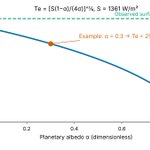
Why is Earth's surface warmer than its radiative balance? Effective temperature Te = [S(1−α)/(4σ)]^¼. S: solar constant (1361 W/m²), α: albedo (0.3), σ: Stefan-Boltzmann constant. Te ≈ 255 K; observed ≈ 288 K. #AtmosPhysics
13
Why is humid air lighter than dry air? Virtual temperature Tv ≈ T(1 + 0.61q). T: air temperature (K), q: specific humidity (kg/kg). Vapour (18 g/mol) displaces N₂ and O₂ (about 29). At 300 K, q = 20 g/kg adds 3.7 K. #AtmosPhysics
10
Why does a sea breeze blow inland by day? Hypsometric equation: Δz = (Rd·T̄/g)·ln(p1/p2). Rd: dry-air gas constant, T̄: mean temperature, g: gravity. Warmer land columns are thicker, tilting upper pressure surfaces seaward. #AtmosPhysics
1
15
Why do saturated updrafts cool slower than dry ones? Latent heat from condensation offsets expansion cooling: Γm = Γd(1 + Lv·rs/(Rd·T)) / (1 + Lv²·rs/(cp·Rv·T²)). Γd ≈ 9.8 K/km; Γm ≈ 4 K/km at 20°C. #AtmosPhysics
5
Precipitable water: how deep if all vapour condensed? W = (1/g)∫q dp. q: specific humidity, p: pressure, g: gravity. 1 kg/m² of vapour = 1 mm of water. Tropical columns often hold 50 mm or more. #AtmosPhysics
7
Why do jet streams sit over strong temperature contrasts? Thermal wind: ∂Vg/∂z = (g/fT)|∇T|. g: gravity, f: Coriolis parameter, T: mean temperature. Colder poleward air means westerlies strengthen with height. #AtmosPhysics
13
How can a flat surface preserve enough information to recreate a three-dimensional image? ✨ Dennis Gabor’s invention of holography showed how interference patterns can record both the intensity and phase information of light. Watch the video to see how light can be used to reconstruct depth. #Physics #Holography #DennisGabor #Optics #NobelPrize
1
39
🌟 𝐒𝐏𝐎𝐓𝐋𝐈𝐆𝐇𝐓 𝐌𝐄𝐌𝐁𝐄𝐑 𝐎𝐅 𝐓𝐇𝐄 𝐖𝐄𝐄𝐊: 𝐃𝐑. 𝐉𝐎𝐒𝐄𝐏𝐇 𝐎𝐍𝐘𝐄𝐊𝐀 𝐄𝐌𝐄𝐆𝐇𝐀 The Nigerian Society of Physical Sciences (NSPS) is pleased to celebrate 𝐃𝐫. 𝐉𝐨𝐬𝐞𝐩𝐡 𝐎𝐧𝐲𝐞𝐤𝐚 𝐄𝐦𝐞𝐠𝐡𝐚, our Spotlight Member of the Week. Dr. Emegha is a physicist, materials researcher, and educator in the Department of Physics at Edo State University, Iyamho, Nigeria. His research focuses on semiconductor materials, thin-film physics, optoelectronics, renewable energy, and environmental applications. His scientific career has developed from a foundation in Physics Education and Electronics into sustained research on semiconductor and functional materials. This progression has shaped his interest in how the composition and preparation of materials influence their structural, optical, and electrical properties, particularly in metal-sulphide thin films with potential applications in electronics, optoelectronics, sensing, and energy technologies. READ MORE @ nsps.org.ng/news/post.php?sl…
1
33