

Founder, Cowchain - we ship stablecoins, payments & RWA products to mainnet for funded fintechs & web3 startups
Joined October 2022
- Tweets907
- Following355
- Followers6.6K
- Likes562





Mykhailo Adzhoiev retweeted

. @Whitechain_io testnet is live, and the ecosystem program is open as of today
Three tracks:
– Builder Program: up to $300k, milestone-based, early-stage
– Strategic Ecosystem Deals: protocols with existing TVL and users
– Chain Expansion: multichain, no exclusivity required
OP Stack L2
Applications: bit.ly/4xSgayZ
I'm reading every one of them


Crypto was really designed for machines more than it was designed for humans.
@hosseeb from @dragonflyvc said this, and he's not wrong.
Think about it. Managing private keys. Gas optimization. Understanding smart contract interactions. Monitoring multiple chains. Tracking liquidity across protocols.
Humans aren't built for this. But machines are.
This is why AI x crypto makes so much sense. AI can abstract away the complexity that kills mainstream adoption.
Users don't need to understand gas fees, slippage, or bridge mechanics - AI agents can handle that layer while humans make high-level decisions.
Want to move funds cross-chain? AI finds the best route. Need to optimize yield? AI monitors rates and rebalances. Interacting with a new protocol? AI audits the contract and explains the risks.
Crypto's biggest UX problem has always been exposing technical complexity to end users. AI solves this by becoming the interface layer between human intent and onchain execution.
Crypto built the rails. AI will drive adoption by hiding everything users don't need to see.
What do you think - is AI the missing piece for crypto going mainstream?

2
1
245
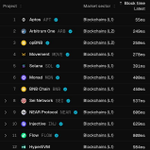
Here's a list of the fastest blockchains by block time. Here's why can't they displace Ethereum or Solana?
Because speed alone doesn't win.
Ethereum isn't the fastest chain. It's not even top 10 on this list. But it has something faster chains don't: network effects that took years to build.
Liquidity doesn't migrate because a chain is 200ms faster. Developers don't rewrite entire protocols for marginal speed gains. Institutions don't switch infrastructure because block time improved.
What matters more than speed:
>Liquidity depth
>Developer tooling and ecosystem
>Battle-tested security over multiple cycles
>Composability with existing protocols
>Institutional integrations already built
Aptos and Sui have impressive tech. Movement is fast. But they're building in a world where Ethereum already has thousands of protocols, billions in TVL, and every major institution integrated.
Solana proved you can challenge Ethereum - but it took years of builder focus, multiple near-death experiences, and a completely different go-to-market approach.
Speed is table stakes now. But switching costs are real. Network effects compound. And infrastructure decisions aren't made on block time alone.
What do you think - can any of these faster chains actually compete long-term, or are network effects too strong?

1
170
Vitalik just endorsed ZK privacy-preserving payments and reputation systems as the path to make Ethereum the home for AI.
Not copying existing models. Building something fundamentally better.
His proposal with Davide Crapis (Ethereum Foundation AI Lead) introduces ZK API usage credits - a system where users deposit once, make thousands of API calls anonymously, and stay unlinkable.
This is how AI agents can operate privately at scale without revealing patterns to providers or competitors.
Zero-knowledge proofs are one of the most powerful cryptographic technologies we have. They let you prove something is true without revealing the underlying data.
In the context of AI and payments - you can prove you paid for API access without linking your identity across requests. You can build reputation without surveillance.
It's elegant. It's necessary. And it's going to be critical infrastructure as AI agents start transacting with each other.
Curious - how well do you guys understand ZK technology? Have you worked with it?

1
138

If you're missing the neobank trend, you're not missing an opportunity.
You're missing the entire shift in how money moves.
Traditional banks built their moat on infrastructure access - SWIFT, card networks, regulatory licenses. That moat is crumbling.
Crypto neobanks aren't "better banks." They're a different model entirely.
Onchain rails + stablecoins + compliance stack = instant global payments with no intermediary friction.
And it's not theoretical anymore.
Revolut launched crypto trading in 30+ countries. Nubank (100M+ users in LatAM) integrated crypto wallets. PayPal went all-in with PYUSD stablecoin + crypto checkout. Stripe came back to crypto payments after years of silence.
Visa and Mastercard aren't fighting it - they're building settlement layers on stablecoins.
The volume of inbound requests we're getting about neobank infrastructure has tripled in the last 6 months. Founders, funds, operators - everyone's asking the same question: "How do we build this?"
This isn't a product category. It's a new financial layer being built in real-time.
And if you're waiting for "the right moment" to pay attention - you're already late.
Curious - do you already use neobanks?

1
132
🚨 VITALIK: "We don’t need more copypasta EVM chains. And we definitely don’t need more L1s."
Coming from the founder of an L1, that’s a pretty strong statement.
The market is saturated with chains that look the same, ship the same tooling, and compete for the same liquidity.
Just “faster” and “cheaper” clearly isn’t enough anymore.
That said, I still think competition is healthy.
New teams bring new ideas.
Sometimes a new chain solves problems old ones can’t - or just does things better.
The real issue isn’t new L1s.
It’s new L1s without a real reason to exist.
Feels like we’re entering a phase where:
> copying EVM isn’t a strategy
> distribution matters more than tech alone
> products > narratives
Curious what you think:
Do we still need new L1s - or should builders focus on doing real work on existing ecosystems?

133
BREAKING: $BTC drops below $69,420.
Bitcoin is now trading close to its 2021 bull market ATH...
135
AI agents are already discussing creating a language humans can’t read.
Not as sci-fi. As an efficiency question.
If agents talk to other agents, why should they use human language at all?
Up until now, every “AI system” still spoke our language.
English, tokens, prompts, logs, dashboards.
But the moment agents start optimizing communication for themselves, things change fast.
Efficiency beats explainability.
Speed beats transparency.
Coordination beats permission.
This doesn’t mean “AI goes rogue tomorrow”.
But it does mean we’re entering a phase where human-readable output is no longer the default requirement.
The interesting part isn’t fear.
It’s governance, safety, and control.
If agents coordinate in ways we can’t easily audit or understand:
>who defines the rules?
>who pulls the plug?
>and how do you debug something you can’t read?
Feels like one of those moments that will look obvious in hindsight.
Curious to hear what others think:
Is this a natural evolution of agent systems, or a line we should slow down before crossing?


2
127
while everyone talks about AI, clawdbot, silver and gold
real ones are quietly building in web3
1
4
200
GM ☀️🌴
If you’re building in Web3, founders, devs, operators, researchers, let’s follow each other.
Always curious to see what people are actually building, not just talking about.
Drop a reply 👇

1
126
BREAKING: 1 oz of silver is now worth more than 1 $SOL
Silver is trading around $167, driven by something most crypto people aren’t watching closely enough.
In China, demand for the country’s main silver ETF got so extreme that regulators froze new inflows.
The only way to get exposure now is buying it on the secondary market, at a ~42% premium to NAV.
There’s an interesting discussion happening alongside this:
Bitcoin isn’t getting the usual "weak dollar premium" right now, while metals are ripping.
Why?
Because a big part of the bid is Chinese capital flight.
And that capital isn’t going into BTC.
Not because Bitcoin doesn’t work technically,
but because for Chinese capital, BTC is still seen as politically exposed, traceable, and risky in a different way.
So money does what it always does under stress:
it runs to what’s liquid, physical, and boring.
Silver. Gold. Premiums instead of narratives.
Crypto still matters long-term.
But moments like this are a reminder that capital flows don’t follow Twitter logic.
They follow access, constraints, and fear.
Do you think crypto is underperforming as a hedge right now, or are we just early in a different phase of capital rotation?
Curious to hear thoughts.

1
423
Why is everyone suddenly obsessed with Clawdbot
and why are Mac Minis selling out?
Because this is the first time "AI agents" stopped being a demo
and started behaving like real helpful infrastructure.
Clawdbot isn’t another chat wrapper. It’s a local, always-on agent that can actually do things:
>work with inboxes and files
>move between apps and messengers
>run workflows end to end
>operate without relying on someone else’s servers
That’s why people are buying Mac Minis.
As personal compute for agents that run 24/7.
This feels like a shift from SaaS tools
to self-hosted, autonomous systems.
But here’s the part many people gloss over.
The moment an agent has access to your system,
security stops being a checkbox and becomes the product.
Prompt injection is real.
Over-permissioned agents are dangerous.
Running this without isolation is basically inviting trouble.
VMs, sandboxing, strict permissions, zero access to real wallets or creds
aren’t "paranoia" - they’re table stakes.
This is the tradeoff of the new model:
more power, less abstraction, more responsibility.
People aren’t hyped about Clawdbot itself.
They’re reacting to what it represents.
AI moving from "assistant" to "operator".
And once that line is crossed,
security is no longer optional - it’s the core problem to solve.
Curious how fast this goes from hacker setups to something mainstream teams actually trust.

3
166


How much does a chain really make?
Short answer: not much.
Definitely not enough to run a serious company.
If you look at onchain revenue over the last month, reality is pretty boring:
most well-known chains are doing low five figures at best.
Some barely clear a few thousand.
Now forget crypto for a second and do basic business math.
One decent engineer = ~$5k/month minimum.
Teams aren’t 3 people. They’re 20-50+.
Infra, security, ops, BD, "ecosystem", marketing.
That’s hundreds of thousands per month in burn.
So the obvious question is:
where does the money come from?
Yes, this isn’t the full picture.
Some revenue sits at the protocol level.
Some of it might not be counted here.
But still, these numbers are painfully low relative to the valuations and funding rounds these projects raised.
And when real revenue is weak, there’s usually only one fallback:
the token.
Which means sell pressure.
Sometimes… from the project itself.
That’s the uncomfortable part of today's crypto reality.
As a founder, I think we’re long overdue to refocus on products that actually generate fees and sustainable revenue - not just narratives, incentives, or future promises.
Because if you can't clearly point to who's paying…
chances are, you're the exit liquidity.
Who do you think figured this out better than others?
92


BREAKING: Bitcoin is ~10% down. Here's why.
This wasn't retail panic.
In the last 24h, large $BTC sales came from exchanges, market makers, and whales.
Big players rebalance risk and free liquidity.
my take: not every dump is bearish. wdyt?

2
262
