

We partner with budget analysts, community organizers & advocates in 100+ countries to make budgets work for people. #Openbudgets
Americas, Asia, Europe, Africa
Joined April 2009
- Tweets14K
- Following3.9K
- Followers14.7K
- Likes4.6K





Pinned Tweet
“You can have transparency, but so what?”
At the @IMFNews Town Hall in Bangkok, @OpenBudgets Yuna Farhan asked Kristalina Georgieva how the IMF could better support civil society, oversight institutions and government reformers who hold budgets to account.
Her response: transparency needs accountability mechanisms behind it—and civil society brings ideas the IMF can help governments adopt.
Today, we launch the #OBS2025 Asia results, measuring transparency, public participation and oversight together.
🕑 14:00 Bangkok | 07:00 GMT
#AM2026Thailand #BudgetAccountability
@IbpIndonesia
Parliaments approve the borrowing, yet they are often left out when a country restructures its debt after a default.
Our Global Research Coordinator @cubangondi moderated a panel at the AFROPAC 6th Annual General Meeting on how parliaments can navigate crises and global reforms to the financial landscape.
The final word: effective oversight needs scrutiny that is strong and coordinated before, during and after a debt crisis.
Thank you AFROPAC for the opportunity to contribute.
#debt #publicfinance #parliament #tax


Congratulations to the Hewlett Foundation on 60 years! We’re honored to feature in your anniversary timeline. Thank you for supporting IBP and helping advance budget transparency and people’s voice in how public money is spent.
hewlett60.org/

How can local governments finance climate resilience?
IBP Afrique Francophone joined officials from Senegal and France and partners to highlight the role of transparent budgets, accountable spending and adequate public resources in responding to climate shocks.
#ClimateFinance


Accountability slips at the moment it matters most.
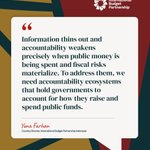
This week’s #QuoteOfTheWeek comes from Yuna Farhan, our Country Director in Indonesia. When public money is being spent and fiscal risks materialize, information thins out. Her answer is accountability ecosystems that hold governments to account for how they raise and spend public funds.
Share this with someone working to close that gap.

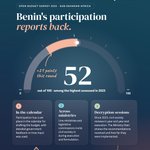
DID YOU KNOW? Benin added 21 points to its public participation score in the latest Open Budget Survey. It now stands at 52 out of 100, among the highest assessed in 2025.
What changed? Opportunities to take part are built into the calendar for drafting the budget, and the government gives detailed feedback on how citizens’ input was used. Line ministries and legislative commissions also invite civil society in during execution and formulation.
Since 2023, “decryption sessions” have let civil society review and discuss in year and year end budget execution. The Ministry of Economy and Finance then follows up with a record of the recommendations received and how far they have been implemented.
Participation that reports back is participation people can trust. Which of Benin’s practices would you want to see at home?

What will it take to make Lebanon's budget more transparent and open to public input?
At the Fiscal Transparency Forum in Beirut this week, IBP's Emad Emam discussed the country's Open Budget Survey (OBS) 2025 results with representatives from civil society, development partners, parliamentarians, oversight bodies, and the Ministry of Finance. Across four consultations, participants tackled concrete steps: timely budget reports, stronger budget oversight and real ways for citizens to have a say.
The event was organized by @TI_Lebanon with the @IOFLebanon @openbudgets and @UNICEF, and funded by the @EU_commission @EUinLebanon.
📊 Lebanon’s full results: internationalbudget.org/open…
#OpenBudgetSurvey hashtag#FiscalTransparency hashtag#PublicFinance


🇲🇿 In Mozambique, @OpenBudgets joined a convening hosted by the Ministry of Finance, supported by UNICEF and our partner @CIPMoz. Alexandre Ciconello shared OBS methodology and a diagnostic with government, oversight institutions and development partners.
The goal: a Budget Transparency and Participation Plan integrated into Mozambique’s public financial management strategy. The deputy budget director committed his department to taking this work forward.
A two-day workshop also brought together 35 civil society participants to explore budget analysis, advocacy, health and debt. Thanks to the Ministry of Finance, @UNICEF, @CIPMoz and all participating partners.
#BudgetTransparency #Mozambique


Governments are publishing more budget data, but that’s not enough to get education money to schools.
At the 5th GPE KIX Africa Research Symposium in Nairobi last week, hosted by @unicef and @gpforeducation, IBP’s Global Research Coordinator Cuba Houghton shared three lessons from 20 years of the #OpenBudgetSurvey:
📅 Timing matters. Governments are publishing more budget information, but in the 71 countries we tracked from 2017 to 2025, legislatures are receiving and approving budgets later. Fewer than half publish a Mid-Year Review on time, so we know least about spending on bursaries and school construction exactly when money should be turning into services.
💸 Debt stays in the dark. In our 11-country study of public debt, only one government linked its planned borrowing to specific projects. That makes it hard to see what borrowing buys for education, or what debt repayments crowd out.
🔍 Information alone isn’t enough. Senegal scored above the Sub-Saharan Africa average on budget information, yet its hidden debt was uncovered by its Court of Auditors, not by published documents.
Transparency is one pillar of accountability. Oversight and participation are what turn budgets into services.


Public budgets work better when people have a say. 🇰🇭
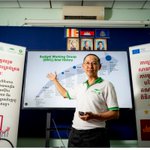
This month, we’re spotlighting our Cambodia partner, NGO Forum, which is helping communities build budget knowledge and influence how public money is spent.
The Budget Working Group it helped establish now brings together 30+ civil society groups using budget analysis to advocate for their communities’ needs.
Progress includes a 2023 law requiring publication of the full draft budget—a change NGO Forum had long advocated for. Cambodia’s transparency score also rose 11 points, from 43 to 54, in the 2025 Open Budget Survey.
NGO Forum is also bringing disability groups into budget discussions to raise concerns about inaccessible public buildings and missing funding for disability services, while working with partners to examine barriers to social and health protection.
This work is funded by the @EU_Commission.
#Cambodia #OpenBudgetSurvey #BudgetAccountability

Bu Husnani hauled water by cart. Then she took her community’s data to the budget planners.
In Tallo, Indonesia, she joined other coastal women to map local needs and advocate for clean water. Working with @ibp_indonesia’s PRIMA coalition and KPPI, they brought their evidence to government planners and the public water company—helping secure regular tanker deliveries that reached more than 200 households.
But temporary relief is only part of the story. A year later, deliveries have fallen to once a week, and promised pipes have yet to arrive. Bu Husnani and her community are still organizing, asking questions and pressing officials to deliver.
Her story shows why public participation in budget decisions matters—and why accountability must continue until commitments become services people can rely on.
🎥 Watch her story and the continuing push for piped water.
#BudgetAccountability #PublicParticipation #WaterAccess #WomenLead #Indonesia
Governments are tagging spending for women and girls. Far fewer are asking whether anything has changed.
Roughly half of the 82 countries in the Open Budget Survey 2025 report using at least one gender responsive budgeting tool, such as tagging, gender budget statements or gender impact assessments. Far fewer use the tools that test whether those commitments produce results.
Only three countries, Norway, South Africa and Benin, assess how tax and welfare policies are distributed. Taxes shape women’s lives as much as spending does.
Gender budgeting has moved from the margins to the mainstream. The next test is whether it changes lives. What would you want a gender budget to prove?
Read our blog for more insights: internationalbudget.org/the-…

The @OECD has launched important guidance for members to inform development efforts to #endpoverty. The guidance on reducing poverty and inequalities through development assistance has a strong people-centered approach, recognizing the essential role communities and civil society can play in driving solutions.
Our senior director for strategic engagement Cynthia Romero joined the launch, stressing how development partners can help governments raise and spend public funds effectively toward these goals. She urged development partners to:
1️⃣ Foster government's own domestic capacities.
2️⃣ Provide long-term, flexible funding to civil society so they can build civic infrastructure and bring their lived experiences, data and solutions to bear esp. on budget execution challenges.
3️⃣ Support oversight allies (legislatures, auditors, media) and their partnerships with civil society.
"If ODA is leveraged to help governments raise and spend their own public resources better, it can a transformative impact in the fight against poverty and inequality."
Watch remarks here: bit.ly/4zNlPHt.
Read the full guidance here: bit.ly/4zNlrbZ and policy highlights here: bit.ly/4ixvzj8.
#EndPoverty #SDG1 #openbudgets


Fourteen countries publish their audit report. Six executives say what they did about it.
That is the gap across Asia and the Pacific, per the Open Budget Survey 2025. Audit oversight outscores legislative oversight in 16 of 18 countries, but that strength reflects formal protections more than follow through.
It can be done. Malaysia’s Auditor General’s Dashboard keeps audit issues public until resolved. Vietnam’s National Assembly examined the 2022 state budget accounts within weeks and published its findings.
Swipe for the myths, and tell us what would make audit follow up easier to track where you live.
internationalbudget.org/open…


How can IMF program negotiations strengthen democratic accountability?
On October 16, IBP joined a roundtable hosted by Verité Research on “Guarding Democratic Governance within IMF Programme Negotiation” at the Annual Meetings in Bangkok.
The discussion examined how negotiations conducted almost exclusively with executive branches can sideline legislatures, courts and independent institutions—and how a more inclusive process could strengthen domestic oversight.
Participants explored practical reforms, including sharing information earlier with legislatures and incorporating program benchmarks that reinforce domestic checks and balances.
Bringing oversight actors meaningfully into the process can help ensure that decisions with lasting consequences for public budgets are subject to democratic scrutiny.
#AM2026Thailand #DemocraticGovernance #Accountability #PublicFinance


Debt risks outside conventional debt management systems can have real consequences for public budgets, essential services and households.
At the IMF–World Bank Annual Meetings in Bangkok, IBP co-hosted “Debt Governance 2.0: Governing Risk Beyond the Debt Perimeter” with the International Institute for Sustainable Development (IISD), the Sovereign Debt Forum and Energy for Growth.
Our Global Lead for Policy and Research, Sally Torbert, moderated a session at the October 12 opening roundtable and spoke at the October 16 Civil Society Policy Forum panel.
The discussions explored risks arising from state-owned enterprises, public-private partnerships and government guarantees. Using energy financing as a case study, participants examined how these obligations can affect government budgets—and the people who depend on them.
A central focus: strengthening fiscal risk disclosure, institutional oversight and accountability so governments can identify and manage risks before they become public liabilities.
#AM2026Thailand #DebtAccountability #FiscalTransparency #PublicFinance


That’s a wrap on Bangkok! 🎉
IBP was at #IMFWBAM2026, launching the #OpenBudgetSurvey 2025 Asia Pacific results and asking how countries can move from budget disclosure to real accountability.
Our @IbpIndonesia Country Director @yunafarhan shares 4 takeaways 🎥👇
How can donors help tackle poverty & inequality?
At the OECD guidance launch, IBP’s Cynthia Romero outlined 3 priorities:
🔹 Strengthen government delivery
🔹 Fund civil society for the long term
🔹 Build accountability partnerships
#BudgetAccountability

Budget information must be timely, understandable and useful—and people need the knowledge and opportunities to act on it.
That message ran through today’s “Beyond Disclosure” dialogue in Bangkok, marking the launch of the Open Budget Survey 2025 regional report for Asia and the Pacific at the @IMFNews – @WorldBankGroup Group Annual Meetings - #AM2026Thailand.


2/ From making transparency part of everyday government practice to asking who will bear the cost of debt, speakers explored what meaningful accountability requires. They emphasized stronger collaboration among civil society, legislators, audit institutions and government reformers to turn public information into better decisions and services.
These reflections from Yuna Farhan, Hon. Kim Robert de Leon, EnP., Nishan de Mel and Patrizia Tumbarello bring that challenge into focus.
Check out their insights. What needs to change for budget transparency to make a greater difference in people’s lives?


3/ Thank you to our regional partners, @SECO_CH , @FCDOGovUK @EU_Commission and our regional partners for their support and collaboration.