

Making AI models smaller, faster, and more efficient.
Europe
Joined January 2026
- Tweets47
- Following58
- Followers26
- Likes14





Pinned Tweet
🚀 We're releasing our 3-bit quantization of Qwen3.8-27B: 5.3× smaller (10.17 GB vs. 53.79 GB) while retaining ~95.4% of base quality.
Matches or beats other low-bit builds in our evals, and runs on a single RTX 5090 at ~90 tok/s with the standard llama.cpp runtime!
Open-sourced under the Apache 2.0 license 👇
huggingface.co/oracomputing/…
This is just v1. More evals and even more capable versions are coming very soon, plus a blog post with the full details.
Stay tuned! 👀
#AI #LLM #Quantization #OpenSource

🚨 We are launching Qwen3.8-27B-NVFP4-Efficient — a quantized Qwen3.8-27B that thinks wisely
⚡️ 27% faster than Unsloth’s NVFP4, and 2.4x faster than BF16
🚀 30% fewer output tokens
🎯 Same accuracy within error bars
🤗 Model on HF: huggingface.co/oracomputing/…

💡 What did we do to solve this problem? We used two insights:
🛠️ Mixed NVFP4/FP8 quantization of weights and activations. Our algorithm gives more bits to sensitive layers, keeping low KL divergence with BF16 under a fixed size budget
oracomputing.com/blog/where-…
💪 Quantization-aware training with On-Policy Self-Distillation. We teach the quantized model to think more efficiently and spend tokens wisely
oracomputing.com/blog/ora-qa…

📊 Ours vs Unsloth’s NVFP4 in numbers:
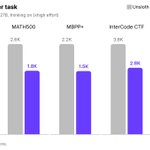
AIME25: 82.9 vs 77.1 and −35% median tokens
MATH500: 94.0 vs 94.6 and −30% mean tokens
MBPP+: 80.7 vs 82.8 and −30% mean tokens
CTF: 82.1 vs 80.8 and −26% thinking tokens
🎯 Every accuracy gap is within 2 standard errors
🚀 Token spending is way more efficient for our Ora NVFP4!

Extreme quantization can look great on benchmarks. Long reasoning is where it starts to bite.
Bonsai 2 27B from @PrismML squeezes Qwen3.8-27B down to just 5.9 GB and posts impressive results on many benchmarks.
But when we gave it the classic "pagoda challenge", generating a single HTML file that renders a voxel pagoda garden, it fell short. The task sounds simple, but the model has to place every voxel and set up the renderer itself, in one shot, which takes long chains of reasoning.
Our Qwen3.8-27B-ORA-Q2 makes a different trade-off. At 10.2 GB, with nearly twice the bits per weight of Bonsai, it holds up against the BF16 baseline while still being 5x smaller. Those extra 4.3 GB are what make the difference on long-reasoning tasks like this one.
How we got there, in short: mixed-precision bit allocation combined with efficient Quantization-Aware Training (QAT).
ORA-Q2 is currently available only to Ora Computing customers, and full technical details are coming soon.
If you're interested in running capable models on much smaller hardware, get in touch.
Existing speculative decoding methods boost inference by around 5.5x. At Ora Computing, we push this even further to 6.5x 🚀
Below is a sneak peek of STDraft: our new algorithm for speculative decoding that builds on top of @inco_ai #DFlash 2.
We compared native MTP, DFlash 2, and STDraft on the original Qwen3.8-27B deployed on a single RTX PRO 6000. The result: across math, code, and plain text, the aggregated throughput is dramatically different:
-Native MTP: 65.0 tokens/s
-DFlash 2: 87.9 tokens/s
-STDraft: 104.5 tokens/s
Our STDraft is 18.8% faster than #DFlash 2 and 60.6% faster than MTP 🔥
And all this without any additional model training or weight changes! This is an early demonstration; stay tuned for more things to come 👀
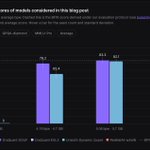
Aggressively quantizing LLMs usually means significantly dropping their quality. We're changing that.
Meet OraQuant: our new quantization stack, which we used to quantize Qwen3.5-9B down to 2.84 bits per weight (bpw), an 82% footprint reduction while keeping it capable. 🧵

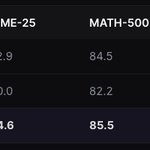
Same memory budget, different encoding — and EXL3 wins decisively. At ~2.8 bpw: EXL3 scores 64.6 on AIME-25 vs 40.0 for the GGUF model. Format is a real lever once you go low bits.

Full story in the blog post: oracomputing.com/en/blog/whe…
Grab the models on Hugging Face 🤗
→ OraQuant-GGUF: huggingface.co/oracomputing/…
→ OraQuant-EXL3: huggingface.co/oracomputing/…
#AI #MachineLearning #OpenSource #LLM
Today we are at the @awscloud Summit Zurich 2026!
Reach out if you want to chat about how we make AI smaller, faster, and more efficient.

Our compression stack makes models smaller and faster. But great compression tech is only half the story. The other half is getting it into customers' hands fast, without the project turning into chaos. Here is the infrastructure we built to do it. 🧵

