

Money changes people. fame | finance | betrayal
Joined September 2026
- Tweets129
- Following79
- Followers173
- Likes140


Pinned Tweet
Phil Mickelson owed money to his Las Vegas gambling buddy, Billy Walters. Billy gave him a secret stock tip, Phil made $931,000 in a week and paid him back. Billy went to prison for 5 years. Phil was never charged.
When Billy got out, he wrote a book about Phil.
More than $1 billion in bets, by Billy's count.
In the video below, Billy tells ESPN what would have kept him out of prison.
Billy spent decades as one of the biggest sports bettors in America. Phil was his golf partner, his friend and a man who owed him money.
July 2012. Phil owes Billy gambling money. Billy calls him and tells him to buy Dean Foods.
Billy's information came from a Dean Foods board member. He owed Billy money too.
A week later, the stock jumped 40%. Phil sold with more than $931,000 in profit. In September, he paid Billy back, partly with that money.
The money went in a circle. Only one man went to prison.
In 2016, the SEC named Phil a "relief defendant." That means he wasn't accused of anything, but he was holding money that wasn't his to keep. He paid back $1,037,029 and never admitted or denied a thing.
In 2017, Billy was convicted and got 5 years. Phil never testified.
"All Phil had to do was publicly say it. He refused," Billy wrote.
While Billy was inside, his daughter died. He wrote that he still believes he could have saved her if he'd been on the outside.
In 2023, his book came out. At least $1 billion wagered. At least $100 million lost. More than 1,115 bets over $100,000. Phil denied one claim: "I never bet on the Ryder Cup."
$931,000: what Phil made on the tip.
5 years: what Billy got.
$1 billion: what Billy says Phil bet.
Phil kept his silence, his career and a reported $200 million LIV deal.
Billy kept the receipts.
Orbitalis retweeted
Kobe Bryant asked his mother to give back his high school jerseys and championship rings. She promised she would. Then she took $450,000 from an auction house to sell them.
Her answer, according to Kobe: "Yes, but you never said you wanted it either."
In the video below, the tweet Kobe sent the week it all went public.
Five NBA titles. 18 All-Star games. And everything from his Lower Merion years sitting in a New Jersey storage unit.
Here's how the deal worked. Goldin Auctions paid Pamela Bryant $450,000 up front. She planned to buy a house in Nevada with it. Once the money was out, Goldin said it couldn't cancel the sale.
Kobe told the court: "I never told my mother that she could have my personal property, let alone consign it for public auction."
He said he was saving those things for his kids.
Sources told ESPN he'd offered her $250,000 toward a home. She wanted the full $450,000.
In June 2013 they settled. His parents apologized in writing for the "unintended pain" and thanked him for his financial support. The vast majority of his things were pulled from the sale.
One detail made it even more painful.
The two rings made for his parents after the 2000 title were among the six lots that still sold.
Dad's ring: $174,184
Mom's ring: $108,153
All six lots: $433,531
To her, he never said he wanted it. To him, he never said she could sell it.
Kobe died in 2020. He was 41.
Most people will side with Kobe. Plenty will say the woman who raised him was owed more than a $250,000 house.
Orbitalis retweeted

Jordan Belfort went to federal prison for scamming investors out of millions of dollars. Years later, it came back around: a hacker broke into his crypto wallet and walked off with about $300,000.
In the video below, he admits it on live TV, almost in passing.
Belfort ran Stratton Oakmont, the Long Island brokerage behind The Wolf of Wall Street. His brokers cold-called ordinary people, pushed them into penny stocks the firm controlled, then dumped their own shares on them.
1,513 clients. Roughly $200 million in losses.
In 1999 he pleaded guilty to securities fraud and money laundering. He wore a wire on his own partners, got four years and served 22 months.
His cellmate was Tommy Chong. Chong told him to write it all down. The book became a Scorsese movie with Leonardo DiCaprio.
The court ordered him to pay back $110.4 million. He later agreed to a minimum of $10,000 a month, for the rest of his life.
BusinessWeek reported that out of roughly $1.2 million he got for the movie rights, $21,000 went to his victims.
In 2021, a hacker got into his MetaMask wallet. About $300,000 in tokens, gone. He brought it up on Yahoo Finance while explaining why FTX was a fraud.
That's what his $10,000-a-month minimum sends his victims in two and a half years.
For once, the money moved the other way.
Orbitalis retweeted
Evan Spiegel and Bobby Murphy locked their frat brother out of the app he came up with. That app became Snapchat, worth close to $30,000,000,000 when it went public. Each of them ended up with more than $5,000,000,000. Reggie Brown got $157,500,000, and only after he sued.
In the video below, Spiegel tells Steven Bartlett whose idea it was, 14 years later.
The Snapchat story you've heard has two founders. The lawsuit had three.
Reggie, Spiegel and Bobby Murphy were brothers in the same Stanford fraternity. In the spring of 2011, Reggie came up with an app for photos that disappear. Spiegel called it a "million-dollar idea," according to court documents. The plan, Reggie says: Spiegel would be CEO, Murphy would write the code, and Reggie would run marketing. His lawsuit says he also came up with the first version of the ghost logo Snapchat still uses.
In August, Reggie filed a patent application for the app. Later that month, a phone call with Spiegel got heated and Spiegel hung up. Days later, the passwords were changed and Reggie was out.
In February 2013, he sued for a third of the company. That summer, investors valued Snapchat at $800,000,000. That November, Spiegel turned down $3,000,000,000 from Mark Zuckerberg.
In his deposition, Spiegel at first said Reggie hadn't really worked on the app with them. Then he was shown his own email from July 2011: "I just built an app with two friends of mine." Asked who the two friends were, he said: "Bobby and Reggie."
Murphy said he had never listed Reggie as an employer of the app. Then he was shown a Facebook notification where he had tagged Reggie under "Employers." His answer: "Well it looks like here that I did something to that effect."
Asked if Reggie deserved anything, Spiegel said: "Reggie may deserve something for some of his contributions."
In September 2014, Snap settled for $157,500,000 and said it acknowledged "Reggie's contribution to the creation of Snapchat." The amount stayed secret until the IPO filing in 2017.
Reggie Brown came up with the idea and got a check. Bobby Murphy wrote the code and got his name next to Spiegel's as co-founder in the IPO filing.
Orbitalis retweeted
Shohei Ohtani's interpreter, who was also his best friend, bet on credit with an illegal bookie until he owed over $40,000,000. So he called the bank, introduced himself as Shohei Ohtani and took $17,000,000 to pay off the bookie. Then he spent $325,000 of Ohtani's money on baseball cards, including signed cards of Ohtani himself.
In the video below, you can hear Ippei on the phone with the bank, pretending to be Ohtani. He tells them a $200,000 wire is for a car loan.
Later, Ohtani had to go to court to get those cards back.
When it all came out, Ippei texted: "Technically I did steal from him. It's all over for me."
Ippei Mizuhara met Ohtani in 2013, when Ohtani was an 18-year-old rookie in Japan. In 2018 he followed him to America. He translated every interview, drove him around until he got his license and even caught for him at the 2021 Home Run Derby.
He also helped him open his first US bank account. In 2021 he started betting, and he switched the phone number and email on that account to his own. When the bank called to confirm a wire, it reached Ippei. Some of the wires to the bookie were labeled "loan."
About 19,000 bets in two years. His winning bets, $142 million, went into his own account. His losing bets came to $183 million. Prosecutors said the money he took was almost half of everything Ohtani earned with the Angels.
Everyone remembers the interpreter. Almost nobody remembers the man on the other end.
Mathew Bowyer took bets from more than 700 clients in Southern California and Las Vegas. He was a big player at Caesars Palace from 2017 to 2024. Nevada regulators said Caesars never checked where his money came from, even after a tip that he was a bookie.
In 2025, Nevada fined three casino companies over illegal bookies, Bowyer among them:
Resorts World: $10.5 million
MGM: $8.5 million
Caesars: $7.8 million
Caesars' CEO said: "We didn't catch Bowyer and we should have."
Ippei got 57 months. For Bowyer, prosecutors asked for 15. The same judge gave him 12 months and a day, and his lawyer said he had already paid back the $1.6 million he owed the IRS.
Ippei's lawyer called it an addiction. Prosecutors said there was almost no sign he gambled before he started stealing.
Addiction can explain 19,000 bets, but it doesn't explain lying to your best friend and stealing money from his bank account.
Orbitalis retweeted

In February 1992, a woman screamed "Jeffrey, I hate you" and charged at Jeffrey Dahmer in a Milwaukee courtroom. Later that day he stood up and told the judge he had never wanted to go free. He had wanted to die.
Between 1978 and 1991, Dahmer killed 17 men and boys. Wisconsin tried him for 15 of them. He pleaded guilty but insane, so the whole trial came down to one question: was he sick, or did he know exactly what he was doing?
On February 15 the jury said he was sane. Two days later the families got to face him. Between them stood an 8-foot wall of bulletproof glass, built just for this trial.
Errol Lindsey was 19 when Dahmer killed him in April 1991. His oldest sister, Rita Isbell, walked up to the microphone and said she didn't even need it.
In the video below she calls him Satan and says she never wants to watch her mother go through this again. Then she breaks. She starts toward him, and deputies have to pull her back.
Then it's Dahmer's turn. He reads from a paper in a flat voice. He says this was never about getting out. He says he didn't do it out of hate, and that he understands why the families hate him.
"I didn't ever want freedom. Frankly, I wanted death for myself."
Near the end he apologizes to two police officers. Nine months earlier they had walked a drugged 14-year-old boy back into his apartment and left. Both were fired. Dahmer says they did their best and he simply fooled them.
The boy was dead by morning. In 1994 a judge gave both officers their jobs back, with $55,000 each in back pay. One of them later became president of the Milwaukee police union.
Dahmer got 15 life sentences in a row. Wisconsin has no death penalty. Two years later another inmate beat him to death in prison. He got what he asked for, just not from the court.
The part almost nobody knows: Errol Lindsey had a daughter. She was born six months after he died, so she never met him. In 2022 Netflix recreated her aunt's speech in its Dahmer series almost word for word. Rita said nobody from Netflix ever called her, and that she hadn't planned a single word of what she said that day.
Orbitalis retweeted
Terrance Watanabe lost $127,000,000 in Las Vegas in 2007, about 5.6% of what Caesars' parent company won in Vegas that year. Witnesses say he fell asleep at the tables and was dealt back in. When he didn't pay back the last $14,700,000, he faced up to 28 years in prison.
In the video below, he explains what it was like to face 28 years in prison over casino credit.
Watanabe ran Oriental Trading, the party-supply company his father started in Omaha. He sold his stake in 2000, and the money went to the tables.
In 2007 he bet more than $825,000,000. Almost all of the $127,000,000 he lost went to Caesars Palace and the Rio.
The casino made sure he stayed. Per the Wall Street Journal, it created a new loyalty tier above its highest one and gave him $12,500 a month for flights, $500,000 in gift-shop credit and 15% cash back on table losses over $500,000.
A Harrah's marketing executive at the Rio had opposed raising his credit limit, calling him "out of control." The credit kept coming. The last $14,700,000 went from October to December 2007.
A former Caesars security officer said he spent 25 to 30 hours a week around Watanabe from June to December and never once saw him sober. A bellman said no employee "ever attempted to cut off or even slow down" his drinking or gambling, and that he saw security bring painkillers to his room in a children's candy box.
He had already paid back $112,000,000. The rest was 38 markers, the credit slips players sign at the table, from $200,000 to $875,000 each. In Nevada, an unpaid marker can be prosecuted as a bad check. It was the largest criminal case the Las Vegas bad check unit had ever handled.
He sued back, saying the casino kept him drunk and on pills to keep him betting. Harrah's called him "a criminal defendant who faces imprisonment for theft and writing bad checks."
Caesars' own investigators found that as many as 15 people saw him use marijuana or cocaine on the property, but rejected his claim that the casino supplied the drugs. He settled, and the charges were dropped.
He owed them $14,700,000 and got four felony charges. They took $112,000,000 from a man asleep at their table and got a $225,000 fine.
Orbitalis retweeted
Michael Milken made $550,000,000 in a single year. His ally Ivan Boesky got caught for insider trading and faced a choice: go to prison or give someone up. He started secretly recording Milken. Boesky served 20 months. Milken paid $600,000,000 and got 10 years.
In the video below, Milken tells Barbara Walters what he thought of the man who turned him in.
Milken was the junk bond king at Drexel Burnham Lambert. Companies the big banks wouldn't touch came to him for money, and his share of the profits made him the best-paid man on Wall Street.
Boesky was Wall Street's biggest takeover gambler. He bought a company's stock right before a takeover was announced, using tips from bankers who knew about the deal first. That's insider trading.
One of those bankers worked at Milken's own firm. In May 1986, Drexel banker Dennis Levine was charged with insider trading. Levine gave up Boesky. Boesky gave up Milken.
Before his deal went public on November 14, 1986, Boesky secretly taped three conversations with Milken. Prosecutors also had a $5,300,000 payment Boesky made to Drexel that year. Boesky had called it a "consulting fee." Prosecutors said it was Milken's share of illegal profits.
In 1989, Milken was indicted on 98 counts. Prosecutors charged his younger brother Lowell too. In 1990, Michael pleaded guilty to six counts, and the case against his brother was dropped.
The judge gave him 10 years. "I believe that a prison term is required for the purposes of general deterrence," she said.
How it ended:
Boesky: $100,000,000 fine, 20 months in prison
Milken: $600,000,000, a 10-year sentence, 22 months served
Six months before his deal went public, Boesky told Berkeley graduates, "Greed is all right, by the way." The next year, the movie Wall Street gave Gordon Gekko his own version: "Greed is good."
Three years after Boesky got out, his divorce came through. His wife, worth about $100,000,000, had to give him $20,000,000 in cash, a $2,500,000 house in La Jolla and $180,000 a year for life.
I keep going back and forth on who the villain is here. The man who sold out his ally to save himself, or the man who made $550,000,000 in a year and swore he never made a dishonest penny.
Orbitalis retweeted

Bill Gates didn't build his fortune alone. In 1980 his mother sat on a charity board with IBM's president, and weeks later IBM hired her son's tiny company. Now he's worth $119 billion and leaves his kids less than 1%. Guess he doesn't love them the way she loved him.
What IBM's president said about her son's company in 1980 gives it away.
"Oh, that's run by Bill Gates, Mary Gates' son."
In the video below, Gates explains why giving his own kids more "wouldn't be a favor to them."
Mary Gates was one of the best-connected women in Seattle. She was the first woman on the board of First Interstate Bank of Washington, sat on the boards of US West and KIRO, served 18 years as a University of Washington regent, and was on the national board of United Way next to IBM's president, John Opel.
She talked to Opel about her son's company. Weeks later, IBM hired it to build the operating system for its first personal computer. The man running it was a 25-year-old Harvard dropout. That deal is where the fortune starts. The kid who "did it himself" had his mother in the room.
In his memoir, Gates quotes her: "With wealth comes the responsibility to give it away." He took that literally. He's giving 99% of what's left to his foundation, which will spend $200 billion on the world's poorest and close in 2045. His three kids get a great education and less than 1% of the money. "It's not a dynasty," he says.
Mary Gates looked out for her son. Her son is looking out for everyone's kids except his own.
Orbitalis retweeted

ELON MUSK: "MY BRAIN HURTS AND MY HEART HURTS. I WORKED 22 HOURS A DAY..." OTHERWISE TESLA WOULD HAVE DIED, AND ME ALONG WITH IT
2018. Axios on HBO sits down with Elon, and he looks nothing like the guy on stage
tired eyes. hand on his face. long pauses
they ask why this was the hardest year of his career
he doesn't talk about the stock or the critics. he talks about the factory
"Tesla really faced a severe threat of death due to the Model 3 production ramp"
"the company was bleeding money like crazy"
"if we didn't solve these problems in a very short period of time, we would die"
how close?
"single-digit weeks"
think about what that means. a car company with billions in revenue, thousands of employees, a stock everyone argues about. and the real number that mattered was weeks of cash
so what does the CEO do with single-digit weeks?
22 hours a day
7 days a week
sleeping in the factory
working the paint shop, general assembly, the body shop himself
"do you ever worry about yourself imploding?"
"yeah, absolutely. no one should put this many hours into work. this is not good"
then the line that hits different:
"it hurts my brain and my heart hurts"
"this is not recommended for anyone. I just did it because if I didn't do it, Tesla, good chance, would die"
here's the part people forget
in the same year he described Tesla as weeks from death, Tesla posted a ~$312M profit in Q3 2018. the market had been betting on bankruptcy. the factory floor bet against it
the comeback is on the stock chart. the price isn't
no investor deck has a line for "founder sleeps under his desk for months". but that was the actual collateral behind the Model 3
he's not selling hustle here. he's warning you off it
the stock chart shows the miracle. the factory floor shows the bill

Orbitalis retweeted
Phil Mickelson owed money to his Las Vegas gambling buddy, Billy Walters. Billy gave him a secret stock tip, Phil made $931,000 in a week and paid him back. Billy went to prison for 5 years. Phil was never charged.
When Billy got out, he wrote a book about Phil.
More than $1 billion in bets, by Billy's count.
In the video below, Billy tells ESPN what would have kept him out of prison.
Billy spent decades as one of the biggest sports bettors in America. Phil was his golf partner, his friend and a man who owed him money.
July 2012. Phil owes Billy gambling money. Billy calls him and tells him to buy Dean Foods.
Billy's information came from a Dean Foods board member. He owed Billy money too.
A week later, the stock jumped 40%. Phil sold with more than $931,000 in profit. In September, he paid Billy back, partly with that money.
The money went in a circle. Only one man went to prison.
In 2016, the SEC named Phil a "relief defendant." That means he wasn't accused of anything, but he was holding money that wasn't his to keep. He paid back $1,037,029 and never admitted or denied a thing.
In 2017, Billy was convicted and got 5 years. Phil never testified.
"All Phil had to do was publicly say it. He refused," Billy wrote.
While Billy was inside, his daughter died. He wrote that he still believes he could have saved her if he'd been on the outside.
In 2023, his book came out. At least $1 billion wagered. At least $100 million lost. More than 1,115 bets over $100,000. Phil denied one claim: "I never bet on the Ryder Cup."
$931,000: what Phil made on the tip.
5 years: what Billy got.
$1 billion: what Billy says Phil bet.
Phil kept his silence, his career and a reported $200 million LIV deal.
Billy kept the receipts.
Orbitalis retweeted
A 5-minute voice note to Opus 5.5 became a music video watched more times than Los Angeles has people. 4,000,000 f*cking views. You're paying for the exact same model.
That voice note was 1,700 words long:
A song that already existed. An ElevenLabs key for sound. A video model for the base shots. Then Claude told to redraw it all in code on top.
He went to bed. Claude worked 12 hours straight.
Tony Dinh went smaller. A year ago he paid ~$1,000+ for a launch video. This time Opus 5.5 made one in under 30 minutes after 3 extra lines: his URL, "use actual product screenshot, logo, assets" and "must have music."
Most people copied the 26-word "showreel" prompt and got the same clip as everyone else.
The CLAUDE.md I'd use instead is in the first reply.
Opus 5.5 can make a 4M-view music video. It still can't make you talk to it for 5 minutes.
Paste this into CLAUDE.md, swap in your URL, run it in Claude Code on Opus 5.5:
Make a 20s vertical launch video for [PRODUCT] ([URL]).
Assets: open the site with Playwright. Use the real screenshots, logo, colors and fonts. Never draw the UI from imagination.
Engine: one index.html with window.seek(t) that paints any frame from time alone. No timers, no CSS transitions, no Math.random. Render headless at 60fps, encode with ffmpeg.
Motion: springs, never linear. Something new every 2-3s. Banned: centered title on a gradient, everything fading in, glow, particle bursts.
Story: 0-2s the problem in 5 huge words, then the product builds itself, 3 features as real cursor actions, one proof number, logo + CTA.
Sound: original 120 BPM track made in code, every cut on the beat.
Before the final render: contact sheet, one frame per beat. Score 1-10 on hook, phone readability, motion, sound sync. Fix the 3 worst. Repeat until all are 8+.
Orbitalis retweeted
3.5 f*cking cents. That's what a model that can't even write a sentence charged to sort 500 emails in seconds. You spend 11 hours a week on the same job and still think your inbox needs you.
It does need you for one thing.
The 500 emails were Riley Brown's test of Jev 1.13. Hassan ran 1,018 AI research papers through it for 8 cents, a quarter second each.
Jev only picks: reply or wait, relevant or not. You hand it the options, it hands back one answer with a probability.
McKinsey found 28% of the workweek goes to email. A lot of that is just picking.
The clip simulates it at scale: 10,000 picks across seven jobs. Inbox, papers, browser, routing, model choice, compaction, approval gates.
The part that never makes the demo: a 0.9 confidence doesn't mean 90% right. And when it says "done," nothing proves the file was actually saved.
That one thing is checking its work. Congrats, you just got promoted to babysitter for a 3.5-cent intern.

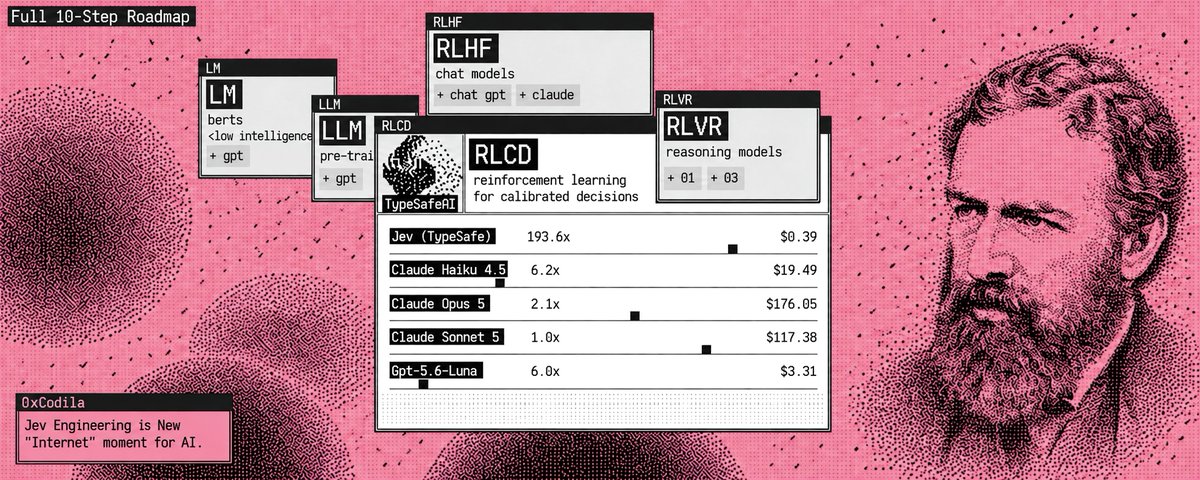
3.5 f*cking cents. That's what a model that can't even write a sentence charged to sort 500 emails in seconds. You spend 11 hours a week on the same job and still think your inbox needs you.
It does need you for one thing.
The 500 emails were Riley Brown's test of Jev 1.13. Hassan ran 1,018 AI research papers through it for 8 cents, a quarter second each.
Jev only picks: reply or wait, relevant or not. You hand it the options, it hands back one answer with a probability.
McKinsey found 28% of the workweek goes to email. A lot of that is just picking.
The clip simulates it at scale: 10,000 picks across seven jobs. Inbox, papers, browser, routing, model choice, compaction, approval gates.
The part that never makes the demo: a 0.9 confidence doesn't mean 90% right. And when it says "done," nothing proves the file was actually saved.
That one thing is checking its work. Congrats, you just got promoted to babysitter for a 3.5-cent intern.
Orbitalis retweeted
I was burning $60–80 a day on Opus 5.5 for decisions that never needed a frontier model.
"Keep going?" "Which tool now?" "Is this good enough?" Every one billed at Opus prices. Jev 1.13 handles 10,000 of them for 42 cents.
I moved them over in one evening. Here's the setup.
Jev can't write a sentence. It only picks from the options you give it, which is exactly the job. Everything runs from Claude Code:
1 → Make a TypeSafe account and grab an API key. Never paste it into chat.
2 → Add the official skill: npx skills add typesafe-ai/skills --skill typesafe-ai
Then ask: "Install typesafe-sdk and build me a decision router that picks research / write / review / cheap from the task's current state."
3 → Spell out the options:
• research: sources or evidence missing
• write: enough context, just ship it
• review: unclear, needs a human
• cheap: formatting, lookup, classification
4 → Run one task you do daily (morning brief, inbox, content plan) and watch where Jev sends it.
5 → Start the confidence bar at 0.85. Below it goes to you or to Opus. Above it stays cheap.
6 → Hard limits: max actions per run, max spend per day, a kill switch. Drafts get written, never sent. Publishing waits for you.
Opus still does the thinking and the writing. Jev just picks the road.
Anyone calling that risky hasn't opened their own Opus bill.