

||CBO||Working in Nairobi's informal settlements||Youth empowerment|| #ClimateAction|| Conservation||[email protected]||
Nairobi, Kenya
Joined April 2021
- Tweets2.2K
- Following632
- Followers961
- Likes896





Pinned Tweet
We advocate for inclusion of women and youths in decision-action forums, because peace, development and environmental protection are inherent and indivisible, as yet these opportunities should be aligned for the rightful people. #ClimateAction. #TunakujaMtaaYako


Water is at the center of economic and social development; it is vital to maintain health, grow food, generate energy, manage the environment, and create jobs. #WorldWaterDay

We are excited to host a joint event with our esteemed partners @MazingiraHub in their Nairobi-Karen space(Google Pin goo.gl/maps/CDr2r8TPEkjEFjso…). The event dubbed "Green Men's conference" will be an empowerment program open to everyone.
Welcome
#NatureKwanza #GreenValentineEdition

Wetlands can be thought of as "biological supermarkets." They provide great volumes of food
that attract many animal species. These animals use wetlands for part of or all of their life-cycle.
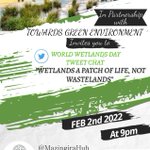
@mazingirahub @org_tge #NatureKwanza #WorldWetlandsDay
Before European settlement of North America, there were an estimated 220 million acres of
wetlands in what are now the contiguous 48 states. @mazingirahub @org_tge #NatureKwanza
#WorldWetlandsDay
Wetlands conservation is one of the most important and sensitive natural resource issues in our
country today. @mazingirahub @org_tge #NatureKwanza #WorldWetlandsDay
Restoring our lost and degraded wetlands to their natural state is essential to ensure the health of
watersheds. @mazingirahub @org_tge #NatureKwanza #WorldWetlandsDay
Mangrove forests provide protection and shelter against extreme weather events, such as storm
winds and floods. A mangrove can reduce the destructive force of a tsunami by up to
90%.@mazingirahub @org_tge #NatureKwanza #WorldWetlandsDay
More than one-third of the United States' threatened and endangered species live only in
wetlands, and nearly half use wetlands at some point in their lives. @mazingirahub @org_tge
#NatureKwanza #WorldWetlandsDay
According to EPA, up to 1.5 million gallons of floodwater can be stored in an acre of wetland
thereby qualifying as a natural flood control mechanism. @mazingirahub @org_tge
#NatureKwanza #WorldWetlandsDay
Far from being useless, disease-ridden places, wetlands provide values that no other ecosystem
can. Protecting wetlands can protect our safety and welfare. @mazingirahub @org_tge
#NatureKwanza #WorldWetlandsDay
In the Arctic, the main ecosystems are wetlands accounting for approximately 60% of the
Arctic’s total surface area. .@mazingirahub @org_tge #NatureKwanza #WorldWetlandsDay
Half of the Earth’s wetlands are Peatlands. Peatlands include areas such as permafrost tundra,
peat swamp forests, bogs, moors, and mires. Uganda alone, for instance, has a total permanent
swampland area cover of 64,000 hectares. .@mazingirahub #NatureKwanza
#WorldWetlandsDay
It is approximated that Africa’s wetlands ecosystems cover an area of more than 131 million
hectares. They include peatlands, flooded forests, rice-fields, mangroves, and river basins.
.@mazingirahub @org_tge #NatureKwanza #WorldWetlandsDay
It is a proven fact that wetlands from where water meets the land because they usually serve as
the link between water and land. .@mazingirahub @org_tge #NatureKwanza
#WorldWetlandsDay
Wetlands only cover about 3% of the earth’s surface and store up to a third of the world’s total
carbon. They have long lifespans therefore qualifying as sustainable and long-term systems of
keeping carbon out of the atmosphere.@mazingirahub #NatureKwanza
#WorldWetlandsDay
Surprisingly, wetlands can remove up to 60% of metals contained in the water, trap, and hold up
to 90% of sediment from runoff and get rid of up to 90% of nitrogen. @mazingirahub @org_tge
#NatureKwanza #WorldWetlandsDay
“Kidneys of the landscape.” wetlands can absorb fertilizer runoff making it a fundamental asset
in agricultural areas and can help address the problem of eutrophication and dead zones.
@mazingirahub @org_tge #NatureKwanza #WorldWetlandsDay
At River Malewa in Naivasha, Malewa wetland that once spanned 1,350 hectares, twenty years
ago, the wetland diminished to 450 hectares today. @mazingirahub @org_tge #NatureKwanza
#WorldWetlandsDay