

Astrophysicist - Planet formation, Hydrodynamics and High Performance Computing
Santiago, Chile
Joined February 2014
- Tweets109
- Following205
- Followers154
- Likes267




New ApJ paper led by José Gomez (w/@ximexram & @oguilera1): self-consistent gas+dust simulations of migrating planets show that dust feedback can trap super-Earths in stable limit cycles while larger cores undergo runaway migration. arxiv.org/abs/2610.27071

Pablo Benitez Llambay retweeted

py-sphviewer 2.0 is now live on GitHub.
Rebuilt with a novel super fast algorithm. Native C++ multithreading. Native rotations and panning. Deferred Rendering, and more. Is it worth a try? Ask Grok 😉
Source, Intallation & Tutorials here: github.com/alejandrobll/py-s…
You open X and see NASA tweeting about your brother’s discovery. Massive congratulations to @bllalejandro (PI) and his team for their work on Cloud-9. This is huge for dark matter research!

A team using @NASAHubble has made the first confirmed detection of a new type of astronomical object: a starless, gas-rich, dark-matter cloud, nicknamed Cloud-9. Here's what this object is teaching us about dark matter and the early universe: go.nasa.gov/3YYPVqU

ALT A magenta cloud is radio data representing the location of the dark-matter cloud. There is a yellow dashed-line circle roughly in the center of the image, marking where researchers focused their search for stars. There are some galaxies in the background; they are mostly located away from the magenta cloud. Credit: Image: NASA, ESA. G. Anand (STScI), and A. Benitez-Llambay (Univ. of Milan-Bicocca); Image processing: J. DePasquale (STScI)
Our new paper with @ximexram on a comoving framework for planet migration is on arXiv!
Simulating planets moving through their disk is computationally expensive. Our new method solves this by keeping the planet fixed, making simulations over >10x faster!
The key is transforming the fluid equations themselves, which avoids numerical errors and overhead of other methods. Our test show excellent agreement with traditional simulations, right up until the point where traditional methods fail due to boundary effects (see the video)
1
212
This framework boosts efficiency and provides clearer physical insight. It’s a powerful tool for long-term studies of planet-disk interaction and a step toward population synthesis with full hydro simulations.
Link: arxiv.org/abs/2510.07282

1
195
Pablo Benitez Llambay retweeted

This is very cool. Ben Cassese, Malena Rice @malena_rice and Tiger Lu release a differentiable (based on JAX) Solar System integration code.
arxiv.org/abs/2509.19549
From preprint to final publication! The journey for this review on planet-disk interaction is complete.
The officially published version is now available online. I hope it serves as a useful resource for the community!
Published version: doi.org/10.1016/B978-0-443-2…

Preprint of my review chapter on planet-disk interactions for the upcoming Encyclopedia of Astrophysics is on arXiv. It provides a first solid approach into planet-disk interactions for both undergraduate students and researchers from other fields.
arxiv.org/abs/2410.00374


Pablo Benitez Llambay retweeted
This month’s Nature Astronomy cover features our recent paper led by Davide Tornotti, in which we image a filament connecting 2 QSOs. The cover was created in seconds using our new py-sphviewer 2.0 code, which renders N-body simulations with unprecedented spatial dynamic range.

Our April issue is now available to read! The cover image shows the (simulated) filaments of the cosmic web, and comes courtesy of the Tornotti et al. paper within the issue: nature.com/natastron/volumes…

Draft of our recently submitted paper is on ArXiv! Led by @oguilera1, we investigate the impact of dust torque on the migration of planetary cores including disk evolution, dust growth, and planet migration.
arxiv.org/abs/2501.16169 🧵

1
4
294
2) The dust torque mitigates inward migration of planets beyond the water ice-line but does not significantly alter their paths, as the dust-to-gas ratio diminishes rapidly due to rapid pebble drift and the brief timescales of planet formation in these areas.
1
167
Pablo Benitez Llambay retweeted

***Astronomy faculty job alert*** ASIAA has several faculty openings. Now is the golden time to join Taiwan's community, mature enough to make an impact, but still young enough for junior faculty to take leading roles.
asiaa.sinica.edu.tw/jobopeni…

Pablo Benitez Llambay retweeted

#IngenieríaYCienciasUAI | Revisa la inauguración de la infraestructura de Cómputo de Alto Rendimiento (HPC) de la Facultad #UAI. Esta permitirá potenciar investigaciones con simulaciones avanzadas, inteligencia artificial y modelado de sistemas físicos.
Mira las fotos acá: ⤵️


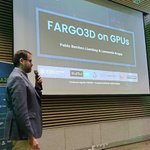
Last day at La Plata Observatory! I presented my research on dusty protoplanetary disks and gave a workshop on hydrodynamics and #FARGO3D. Huge thanks to @oguilera1 and @PiulliR for everything and to the entire @AstrofisicaLP team for the warm welcome!


17
400

It's amazing to see what we can achieve by applying our recent developments! #nebula and #sphviewer2 bring efficient and exciting ways to render numerical simulations!

When our new tech for sphviewer2 intersects with the genius of @pabllam and his new nebula code, you get stunning images like this: an SPH dusty galaxy. I don’t recall seeing anything this cool! Stay tuned for more exciting developments in simulation rendering tools!

In this experiment with my new code nebula I simulate the ethereal beauty of light penetrating dense clouds. By leveraging the power of GPUs, we can explore the intricate interplay between light and volumetric media, creating visually stunning and immersive experiences.
Pablo Benitez Llambay retweeted

A great review article by @pabllam on planet-disk interaction. The article covers many aspects of planet migration with a thorough and yet simple description. Excellent text for both uninitiated and advanced students. Highly recommended arxiv.org/abs/2410.00374