

" If we are to preserve culture we must continue to create it."
uk
Joined May 2025
- Tweets4.6K
- Following635
- Followers11.5K
- Likes61.1K





the pantomathwar retweeted

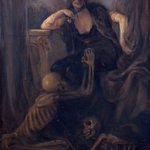
Fikirleriyle Batı felsefesini sarsan filozof Friedrich Nietzsche'nin (1844-1900) cinnet halindeki son günleri.
Sonra 11 yıl sessizlik. Tipi dinmişti.
Ablası Elisabeth onu Jena'dan Weimar'a taşıdı, evinin bir odasına koydu.
Battaniye, sakal ve boş gözler.
Felsefenin en acımasız adamı şimdi sadece bir gölgeden ibaret.


The pigs are black, there are too many to count, and every one of them is running toward the edge.
In 1883 Briton Rivière painted the moment from the Gospels when a herd takes in the demons driven out of a man, and carries them over a cliff.
Pigs have better luck in the legends of Saint Anthony. In one, he is a swineherd. In another, he heals a pig, and becomes the patron of every animal people keep. In a third, a pig keeps him to his hours of prayer. The smallest pig in any litter still carries his name.


the pantomathwar retweeted

At first glance, this looks like nothing more than a young Jesus stretching at the end of a long day in the carpenter’s shop.
But look at the wall behind him…
It was painted by the English artist William Holman Hunt, and it imagines him years before his ministry began, working with wood like any other young man in Nazareth. He has just put down his saw, and he lifts his arms above his head to stretch his tired body. It’s the most ordinary human gesture imaginable.
But his shadow falls on the wall behind him, right across the wooden rack where the carpenter’s tools hang, and suddenly it takes the shape of a man with his arms nailed to a cross. On the floor, his mother Mary has been kneeling by an old chest, looking at the gifts the Magi gave her son when he was a baby. She turns, sees the shadow, and freezes...
Once you notice the shadow, the rest of the room begins to speak too: a red headband lying at his feet foreshadows the crown of thorns, a star-shaped window above him recalls the star that once led the Magi to his cradle, and the arched window behind his head forms a halo. Hunt called the painting The Shadow of Death, and in one ordinary evening it holds a whole life: the gifts that welcomed his first breath, and the cross that would take his last...

How did we get here , to the point where we`ve come to celebrate ugliness as something special, as a measure of authenticity ? It`s hard to understand. I can hope that this is just a passing trend.
And this trend is everywhere: architecture, literature , fashion. People included, yes.
We`ve lost our sense of what beauty really is. And I fear I may not live to see a reversal of this trend, if it ever comes.
Sally Rooney is one example of this tendency , no matter how many will tell me that can be deliberate.
Or Ottessa Moshfegh.
Or Balenciaga.


