
Building Forge, a workspace for controlled AI adoption in teams and enterprises. Author. Ex-CTO.
Bangalore
Joined August 2019
- Tweets1.1K
- Following291
- Followers431
- Likes15K








Pinned Tweet
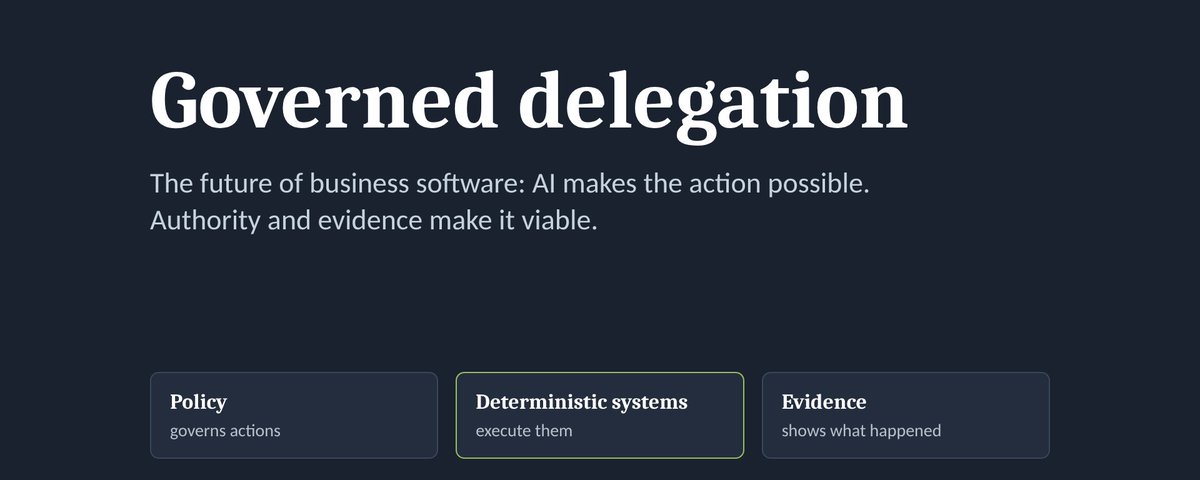
Your ERP holds the invoice. Your inbox holds the email. Between them sits a person reading, deciding, chasing.
Bots could copy data across. They could never decide. AI can.
Now the real question: how much deciding do we hand over?
Governed delegation.
1
1
86
6/ We used it to choose the models behind ForgePrivate. Now it's free and open source, with examples you can run on your own key in
minutes.
pip install trialmark
github.com/peshwar9/trialmar…

4
Every kind of task you typically delegate to AI can be tested: reading invoices, routing tickets, writing summaries, answering questions. Every test and
standard is fingerprinted, so anyone can verify and rerun.
1
4
4/ Trialmark brings that discipline to AI models. You give it real examples of your work and write down "good enough" first. It tests each model several times, shows accuracy, cost and speed side by side, and names the model that meets your standard.
1
2
3/ Clinical trials do the opposite. They decide how they'll judge the results before the trial starts, so nobody can move the goalposts.
1
6
2/ The prompts you tried could never have shown you that. And when the decision is made after seeing the numbers, the model you already liked usually wins.
1
6
1/ A new AI model comes out at half the price. You try a dozen prompts, the answers are good, and you switch.
A month later, invoice totals come from the wrong line and refund requests land in the wrong queue. 🧵
1
28
Agents or workflows? It's the wrong question.
Every team bringing AI into its operations runs into it. Agents are flexible but hard to audit. Workflows are auditable but rigid. So which one?
The real difference is who decides the steps. A workflow's steps are decided in advance by the person who owns the process. An agent decides as it runs.
That one difference tells you where each belongs.
Use a workflow when the work repeats, the volume is high, or someone will audit it: vendor onboarding, invoice approval, a tax filing. The auditor's question is: Did every case go through the same checks? Only a workflow can answer yes.
Use an agent when every request is different and nobody can list the steps in advance: find out why this customers orders dropped, and draft a recovery offer.
The best setups use both. The agent takes the request and hands it to a workflow when it matches a known process. Over time, the routine parts of what agents do become workflow steps. That's how a process earns more automation: one proven step at a time.
Either way, three things don't change. An agent needs a mandate. A workflow needs a record. And both need a named person who answers for the result.
That's what I mean by governed delegation: forgeprivate.com/blog/govern…
Where do you draw the line in your processes?
42
Prabhu Eshwarla retweeted

My dear American friends, today I'm going to take apart the two most successful salesmen of economic snake oil of our time: Thomas Piketty and Gabriel Zucman.
If you read my last post, you know where this comes from. Gramsci told his heirs not to storm the palace but to capture the institutions: schools, universities, media, culture. I showed you how France became the laboratory. Today I want to show you the field where that strategy worked best of all. Economics.
Here's why. In physics, if your theory is wrong, the bridge falls down. In engineering, the rocket explodes. Reality grades your work. In the social sciences, reality grades slowly, and nobody loses their job when the prediction fails. You pick your data, you pick your assumptions, you build a model, and the conclusion you wanted at the start comes out at the end with a lot of equations attached. That's the perfect terrain for a war of position. You don't need to be right. You need to be cited.
Meet the two generals.
Thomas Piketty wrote Capital in the Twenty-First Century. It sold millions of copies and became the most celebrated economics book of the decade. Gabriel Zucman, his former student, wrote The Triumph of Injustice with Emmanuel Saez and helped design the wealth taxes that Elizabeth Warren and Bernie Sanders campaigned on. This is not a French problem. Their ideas are already inside your Democratic Party.
Now let's go through their theses one by one.
Thesis one: "r > g." Piketty's famous formula says the return on capital grows faster than the economy, so wealth inevitably concentrates in the hands of a few dynasties, and capitalism slides back to the aristocracy of the 19th century.
Look at the list of the richest Americans today. Elon Musk. Jeff Bezos. Jensen Huang. Mark Zuckerberg. Larry Page. First-generation builders. Not heirs. Most of the names on the first Forbes 400 list in 1982 have since fallen off it. Fortunes don't compound forever. They get split between children, spent, mismanaged, and overtaken by people who build something new. And when an MIT graduate student, Matthew Rognlie, looked closely at Piketty's own numbers, he found that the rise in capital's share of income came almost entirely from housing. Not factories. Not shareholders. Real estate, which is a story about building restrictions, not about capitalism. The law of history turned out to be a law of zoning.
Thesis two: "Inequality in America has exploded." Piketty, Saez and Zucman built the charts every journalist uses. Top 1% capturing everything, the middle class crushed.
Then two economists at the US Treasury and the Joint Committee on Taxation, Gerald Auten and David Splinter, redid the work. They counted what the famous charts left out or treated differently: taxes paid, government transfers, retirement income, changes in how people file. Their result: after taxes and transfers, the top 1%'s share of income has barely moved since the 1960s. Same country, same tax data, a completely different story. The difference isn't reality. It's the assumptions. And Piketty's data was already in trouble in 2014, when the Financial Times published an investigation pointing out errors and unexplained adjustments in his spreadsheets.
Thesis three: "Billionaires pay a lower tax rate than the working class." This was the headline of Saez and Zucman's book, and it went viral. The 400 richest Americans supposedly paid less than the bottom half.
To get there, they made choices that critics across the spectrum, including Larry Summers, Obama's own former Treasury Secretary, challenged: how corporate taxes are assigned, how refundable credits that put money into lower-income households' pockets are counted. Meanwhile, the IRS's own numbers say the top 1% of earners pay more than 40% of all federal income taxes. A viral claim is not a fact. It's a campaign slogan with footnotes.
Thesis four: "A small wealth tax on the ultra-rich will fund everything." In France, Zucman's proposal became the left's flagship measure: a 2% minimum tax every year on fortunes over €100 million.
Here's what they never explain. The fortunes of builders are not piles of cash. They are shares in the companies they built. Imagine a founder whose startup is valued at a billion euros but doesn't make a profit yet. To pay a 2% tax on paper wealth, every year, he has to sell pieces of his company. Year after year, he loses control, and the buyers are usually foreign funds. Congratulations, you just exported your best companies.
And we know what happens next, because it already happened. In 1990, twelve OECD countries had a wealth tax. By 2017, only four did. Nearly all of them repealed it, because it raised little and chased away capital. Norway raised its wealth tax in 2022 and dozens of its richest people moved to Switzerland. France ran the experiment for decades before abolishing most of its wealth tax in 2018. Their policy has been tested. It failed every time.
Thesis five: and here they stop pretending. In his next book, Capital and Ideology, Piketty proposes what he openly calls "participatory socialism." Taxes on the largest fortunes up to 90%. Property that is no longer permanent, but "temporary," returned to the collective at regular intervals. He's not hiding anything. The goal isn't to fix capitalism. It's to end private ownership of anything big enough to matter.
So why are they celebrated? Why do they have the prizes, the chairs, the front pages, the invitations to Davos? Zucman even won the John Bates Clark Medal in 2023, one of the most prestigious awards in economics.
That's not a refutation of what I'm telling you. That's the proof of it. That's what it looks like when Gramsci's long march reaches the economics departments. The institutions give each other medals, the media quote the medals, and the politicians quote the media. Nobody ever checks whether the predictions came true.
So stop calling them neutral economists. They are activists with PhDs. Their work starts from a conclusion, that private wealth is illegitimate, and builds the data to justify it.
And understand where that conclusion leads. I'm not saying Piketty or Zucman want camps. I'm saying every regime that tried to abolish large private property ended in poverty, and the worst of them ended in prisons and mass graves. The intellectuals who cheered Lenin didn't want gulags either. Many of them ended up in one. Good intentions have never been a firewall.
Next time someone quotes Piketty or Zucman at you, don't get angry. Ask questions. Who are the richest people today, heirs or builders? Why did almost every country that tried a wealth tax repeal it? Why do two teams using the same tax data reach opposite conclusions? What does Piketty mean by temporary property?
You don't need to win the argument. You just need to make them check.
I come from your future. We gave these men our universities, our newspapers and our budget debates. Don't give them yours.


My dear American friends, in my last two posts I showed you where France stands and how our economy got there. Today I want to go deeper, because the economics were only the symptom.
Here is my message to every American: you have been infected by a virus that took decades to incubate in your country. Everything you've watched get worse, year after year, is the damage. MAGA, whatever you think of it, is the immune response. But a body can't fight what it can't name. So today I'm going to name it and show you where it came from.
It starts in an Italian prison cell.
Antonio Gramsci co-founded the Italian Communist Party in 1921. In 1926 Mussolini locked him up, and he spent the rest of his life in prison filling notebooks. He was trying to answer one question: why did the revolution never come to the West? Marx had promised the workers would rise. They didn't. They went to church, saluted the flag, and wanted their kids to do better than them.
Gramsci's answer changed everything. In the West, he said, power doesn't sit in the army or the factories. It sits in culture: schools, universities, churches, newspapers, theater, the family. He called it hegemony. As long as ordinary people believe in their own civilization, you can't overthrow it. So you don't storm the palace. You fight a "war of position." You take the institutions one by one, patiently, until the culture thinks like you do. Then political power falls into your hands like ripe fruit.
A German student leader, Rudi Dutschke, later gave the strategy its famous name: the long march through the institutions.
Now watch France become the laboratory.
In 1945 the French Communist Party came out of the Resistance as the biggest party in the country, with more than a quarter of the vote. General de Gaulle needed them to govern, so communists entered the cabinet. Look at what they got. Public Health went to a communist, François Billoux. Labor went to a communist, Ambroise Croizat, who built our national social security system and put it under boards dominated by the communist-led CGT union. Industrial Production went to another communist, Marcel Paul, who nationalized electricity and gas and gave the union control of their enormous social funds. Education was redesigned by a commission led by two communist intellectuals, Paul Langevin and Henri Wallon, whose plan became the bible of French school reformers for decades.
The communists were thrown out of government in 1947. It didn't matter. They kept exactly what Gramsci told them to keep: the unions, the schools, the universities, publishing, film, theater. For a generation, being a French intellectual and being on the far left were almost the same thing. Jean-Paul Sartre, the most famous thinker in the world, defended the Soviet Union while it was filling the gulags.
Then came May 1968. Students occupied the Sorbonne, millions of workers went on strike, and for a few weeks the country stopped. De Gaulle won the elections that followed in a landslide. He won the ballot box. He lost the culture. Within a year he was gone, and the generation of 68 spent the next fifty years climbing to the top of every French institution: media, ministries, courts, schools, publishing houses. Their slogan was "It is forbidden to forbid." Authority, tradition, family, nation: all of it became suspect.
Then came the export phase. This is where you come in.
A group of French philosophers, Michel Foucault, Jacques Derrida, Gilles Deleuze, Jean-François Lyotard, gave the movement its intellectual weapons. Foucault taught that every institution, every norm, every piece of knowledge is a disguised structure of power. Derrida taught that every text, every concept, every hierarchy can be "deconstructed" until nothing stable is left. Lyotard announced the end of grand narratives, which in practice meant the end of the great narrative of the West itself.
In France these men were famous. In America they became gods. Starting with a 1966 conference at Johns Hopkins where Derrida made his American debut, your English, history and law departments imported them wholesale. Your academics even gave it a name: French Theory. On your campuses it mutated. Mixed with the Frankfurt School exiles like Herbert Marcuse, who argued that tolerance should be withdrawn from the right, it produced critical race theory, gender theory, intersectionality. The old Marxist split between bourgeois and proletarian was replaced by a new one: oppressor and oppressed, assigned by skin color, sex and identity.
That's the cultural strain of the virus. There's a second strain, and it attacked your energy and your ambition.
In 1968 an Italian industrialist, Aurelio Peccei, co-founded the Club of Rome. In 1972 it published The Limits to Growth, built on a computer model from MIT, warning that if humanity kept growing, civilization would collapse. It sold millions of copies. Its core idea, that growth itself is the problem, became gospel. In France it gave birth to the degrowth movement. Progress went from a promise to a sin.
Look what it did to us. The country that built a nuclear fleet in fifteen years shut down Superphénix, its advanced breeder reactor, in 1997, as part of a deal with the Greens. In 2015 it passed a law to cut nuclear's share of our electricity. In 2019 it cancelled ASTRID, our next-generation reactor program. In 2020 it closed Fessenheim, a working plant. We sabotaged our own greatest achievement because we were told that building things was dangerous.
Put the two strains together and you get what you call woke. One teaches children to be ashamed of their past. The other teaches them to fear their future. Guilt behind, fear ahead. A civilization that hates where it comes from and dreads where it's going has nowhere left to go.
And here's the irony. France infected America, and now America is sending it back to us. Our own politicians complain about "American woke ideas" invading French universities, without realizing those ideas were born in Paris. The virus made a round trip and came home stronger.
That's why France is the most advanced case in the West. We have every symptom at once: a state that runs health, schools, culture and energy. Unions that block every reform. Universities where you can't say what everyone thinks. Self-hatred. Fear of growth. We are what the disease looks like when nothing fights it.
The West is at a turning point. Every country is infected, some more than others. What you're living through, the fights over schools, over speech, over energy, over what it means to be American, is the fever. The fever is not the disease. The fever is your body fighting back.
So understand this. The battle in front of you isn't just Republican versus Democrat. It's a battle for the institutions Gramsci told his heirs to capture: schools, universities, media, culture. It took them eighty years to win them. You won't take them back in one election.
But you can take them back. You have something we never had: a country founded on the idea that the individual comes before the state. Free speech written into your First Amendment. Builders who still believe the future can be better than the past.
Name the virus. Fight it where it lives. Don't let it do to you what it did to us.
I come from your future. It's not too late to change yours.

Prabhu Eshwarla retweeted
My dear American friends, in my last post I showed you a number that should terrify you: 70% of Millennials say they're pro-socialist. Today I want to show you why. Not with emotion. With pure logic. Step by step, A plus B, until the conclusion is impossible to escape.
Adults, this one is for you. Read it, then explain it to the young people in your life.
Start with Peter Thiel. Years ago he summed up our era in one line: we wanted flying cars, instead we got 140 characters. His thesis is that since the early 1970s, the world of bits has kept racing forward while the world of atoms has stalled. Computers, phones, software, the internet: incredible progress. Housing, energy, transportation, medicine, education: stuck. We build almost nothing physical faster or cheaper than our grandparents did.
Why would progress stop in some places and not others? Same country, same people, same capitalism. The only thing that differs is how much the state is involved.
Here is the proof.
Step one: look at prices. Since 2000, in America, the price of TVs has fallen by more than 90%. Software, phones, toys, clothing: cheaper and better every year. Over the same period, college tuition, hospital services, childcare and housing have more than doubled.
Step two: look at which is which. The goods getting cheaper are the ones where companies compete freely and the state mostly stays out. The goods exploding in price are the ones where the state regulates the most, subsidizes the most, or controls who is allowed to sell.
Step three: look at what young people complain about. They don't complain about TVs. They complain about rent, student debt and healthcare. Exactly the three sectors the state controls the most.
That's not a coincidence. That's a pattern. Let's go one by one.
Housing. In many American cities, most residential land is zoned for single-family homes only. Building an apartment building can take years of permits, hearings, environmental reviews and lawsuits from neighbors. When you make it nearly illegal to build, supply can't keep up, and prices go up. The young don't have a capitalism problem. They have a permission problem.
Education. Washington hands out loans without asking whether the degree is worth it, so universities raise prices because they can. The money doesn't go to better teaching. It goes to layers of administrators that have grown faster than the faculty. And the accreditation system makes it extremely hard for a new, cheaper school to compete. The incumbents are protected. The students pay.
Healthcare. In many states, if you want to open a new hospital or even buy a new MRI machine, you need a "certificate of need," permission from a board where your future competitors often have a say. The number of residency slots that train new doctors is effectively capped by Medicare funding. Getting a new drug approved costs billions. Every rule adds a layer. Every layer adds a cost. Every cost lands on the patient.
Energy. America built dozens of nuclear reactors in the 1970s. Since then, only a handful, years late and billions over budget. Not because physics changed. Because the rulebook did.
Now step four, the most important one. Who benefits from all these layers?
Not the young. Not the poor. The incumbents. The big hospital systems, the big universities, the big developers, the big pharma companies, the big unions. Every complex regulation is a wall that only the giants can afford to climb. So they lobby for more of it. They fund the politicians who write it. They hire the regulators when they leave office. That's not capitalism. That's cronyism. Capitalism is a newcomer allowed to compete. Cronyism is an incumbent paying the state to stop him.
Step five: so what do young people see? They see prices going up, a system rigged for insiders, and no way to build anything for themselves. Their anger is legitimate. Their diagnosis is wrong. They look at the result of the state's capture and call it capitalism.
Step six: and what cure are they offered? Socialism. Which means giving the state even more power over housing, education, healthcare, energy. Giving the keys of the house to the exact institution that locked them out of it.
Follow the logic to the end. If regulation creates cronyism, then total regulation creates total cronyism. If a little state control makes things expensive, total state control makes them scarce. That's not theory. The Soviet Union had a ruling class with its own shops, cars and dachas while ordinary people stood in line for bread. Stalin's collectivization caused a famine that killed millions in Ukraine. Mao's Great Leap Forward caused a famine that killed tens of millions. Venezuela went from one of the richest countries in Latin America to a nation where millions fled. Every time the state got all the keys, the insiders ate and the people starved.
So here's the conclusion, and there's no escaping it:
Where entrepreneurs are free to compete, prices fall and life gets better. Where the state controls, prices rise and insiders get rich. Young people are suffering in the sectors the state controls. Socialism means handing the state everything. So socialism gives you more of the very thing that's hurting you.
The enemy is not capitalism. The enemy is a state captured by insiders, blocking the builders who would solve your problems.
Adults, this is your job now. Don't tell the young they're stupid. Don't tell them their anger is fake. Tell them they're right to be angry, and show them where to aim it. Ask them: what got cheaper in your lifetime, and what got more expensive? Who controls each one? Let them do the math themselves.
The real counter-revolution isn't against the young. It's with them. Free the builders. Let people build homes, open schools, open clinics, build reactors. Give the next generation a stake in the system, and they'll defend it with their lives.
I come from your future. We gave the state the keys. Don't make the same mistake.
My dear American friends, I've shown you where the disease came from and who sells it. Now I want you to look at this email.
January 5, 2020, 2:44 in the morning. Peter Thiel writes to Mark Zuckerberg, Nick Clegg, Sheryl Sandberg and Marc Andreessen. It became public years later, in a lawsuit between the state of Tennessee and Meta. The subject line is one word: Millennials.
Thiel starts from a number: 70% of Millennials say they are pro-socialist.
Read that again. Seven out of ten young adults in the richest, freest, most innovative country in human history say they want the system that ruined every country that tried it.
And Thiel, one of the sharpest minds in Silicon Valley, says something important. Don't just dismiss them as stupid or brainwashed. Understand why. His answer: when you're crushed by student debt and housing is unaffordable, you have no capital and no way to build any. And if you have no stake in capitalism, you turn against it.
He's right. But follow the thread one step further, because that's where it gets interesting.
Who made college unaffordable? Washington flooded universities with easy federal loans, and universities raised their prices year after year, because they could. The same universities that then taught those students, for four years, that capitalism is the problem.
Who made housing unaffordable? Zoning rules, permits, environmental reviews, endless regulation that makes it nearly illegal to build. Remember Piketty's famous rise of capital? It was mostly housing. Scarcity created by the state.
So here's the full picture. The state creates the scarcity. The universities teach that capitalism caused it. The politicians sell socialism as the cure. The arsonist is selling fire insurance.
That's why 70% is not a natural opinion. No generation wakes up one morning wanting central planning. It takes decades of teaching, a captured culture, and an economy rigged to give young people no stake in it. In a healthy country, that number would trigger a serious public investigation into what American universities have been teaching for fifty years. This is not a debate. It's the result of a long, patient operation, exactly the war of position Gramsci described from his prison cell.
Now let me tell you what history says happens when an ideology captures a generation and turns it against everything that came before.
China, 1966. Mao unleashes the Cultural Revolution and hands it to the youth. Students become Red Guards. Their mission: destroy the "Four Olds," old customs, old culture, old habits, old ideas. Temples, books, art, centuries of history, smashed.
In August 1966, at a girls' school in Beijing, students beat their vice principal, Bian Zhongyun, to death. She was one of the first. Teachers across the country were humiliated, tortured, killed by the children they had taught.
In 1970, a 16-year-old boy named Zhang Hongbing denounced his own mother for criticizing Mao. She was executed. He spent the rest of his life trying to apologize for it.
Children were taught that loyalty to the Party came before loyalty to their parents. Historians estimate the Cultural Revolution killed somewhere between hundreds of thousands and millions of people.
The Soviet Union did it first. It turned a boy named Pavlik Morozov into a national hero for denouncing his father. Generations of Soviet children were raised on his story.
Cambodia, 1975. The Khmer Rouge declare Year Zero. Teenagers with rifles empty the cities. Wearing glasses was enough to mark you as an intellectual. In four years, roughly a quarter of the population was dead.
Every time, the same pattern. Take the young. Teach them that the past is guilty. Teach them that their parents, their teachers, their history are the enemy. Then give them power.
So when you see statues pulled down, words banned, books rewritten, and parents treated as obstacles in their own children's schools, understand what you're looking at. It's not the end of the story. It's the opening act. It always starts with the young, and it always starts with good intentions.
If the West ever gets its Marxist youth revolution, it won't end in Scandinavia. It will end the way it has ended every single time it was tried for real. And we will have learned nothing.
Thiel saw the number. I'm telling you where it leads.
The answer is not to hate the young. It's to give them back a stake in the system. Let them build. Let them buy a home. Make college worth its price or skip it. Let them start companies instead of drowning in debt. A generation that owns something defends it. A generation that owns nothing will burn it down.
I come from your future. Don't let your children write the next chapter of this story.

Prabhu Eshwarla retweeted

Every week someone tells me they vibe-coded their app over the weekend and don't need developers anymore.
Before it touches a paying customer, make sure it includes:
> a schema someone designed, instead of one the AI improvised table by table
> login that still works when someone puts a plus sign in their email
> password reset links that expire and work once
> MFA, plus a recovery path for the user who lost their phone
> sessions that time out, and a way to kill every session for one user
> SSO for the enterprise customer who won't sign without it
> SAML, because that customer's IT team doesn't do magic links
> SCIM, so a fired employee loses access the moment IT offboards them
> roles and permissions deeper than "admin" and "everyone else"
> checks that stop user A from reading user B's data by changing one number in the URL
> tenant isolation, so one customer's bug never shows another customer's records
> an admin "log in as this user" button for support, with an audit trail on every use
> rate limits on login, so nobody can guess passwords at scale
> lockouts that stop attackers without locking out your CFO the night before the board meeting
> database migrations that run forward and roll back
> migrations that don't lock the main table at 2pm on a Tuesday
> indexes, because the query that was instant on 50 test rows times out on 5 million real ones
> connection pooling, so a traffic spike doesn't exhaust the database
> backups every night
> a restore from those backups, tested, because a backup you've never restored is a hope
> point-in-time recovery for the day someone runs a delete without a where clause
> soft deletes, so "I deleted it by accident" is a support ticket and not an incident
> validation on the server, not just in the form
> timezones stored right, so the 9am reminder doesn't fire at 4am
> the customer with an apostrophe in their last name
> emoji, accents and right-to-left text in every field
> money stored as integers, because 0.1 + 0.2 doesn't equal 0.3 in floating point
> currency, rounding and tax rules for every country you sell into
> a data model that survives your second customer asking for "one small change"
> idempotency keys, so a retried payment doesn't charge the card twice
> deduplication for the user who clicks submit four times
> pagination that still works on page 400
> exports, because sooner or later every customer wants their data in a spreadsheet
> imports that survive the CSV someone saved in 2009
> retention rules, and code that deletes what your contract says you'll delete
> secrets out of the code, out of the repo and out of the AI chat history
> rotating every key the AI pasted into a config file last month
> confirming every package the AI installed exists and is the one you meant
> dependency scanning, because the AI pulled in libraries nobody reviewed
> input sanitization everywhere a user can type
> protection against SQL injection, XSS, CSRF and the rest of the OWASP list
> file uploads that get scanned, size-limited and stored where they can't execute
> CORS rules that aren't "allow everything"
> security headers on every response
> encryption at rest and in transit
> least-privilege access for everyone, including the AI agent holding production credentials
> logs that record who did what, without recording passwords, tokens or card numbers
> a penetration test before your enterprise customer's security team runs their own
> answers to the security questionnaire every enterprise buyer sends, with evidence behind each one
> a disclosure process for the day a stranger emails you a vulnerability
> a plan for the day a laptop with production access gets stolen
> SOC 2, which means policies, evidence and an auditor, not a checkbox
> HIPAA, the moment a single patient record touches your system
> a BAA with every vendor that touches that data, including your AI model provider
> audit trails that show who viewed a record, not just who changed it
> PCI scope, and card numbers kept out of your database
> GDPR deletion requests that reach every table, backup and log
> data residency for the customer whose contract says EU only
> quarterly access reviews someone signs off on
> dev, staging and production environments that match each other
> infrastructure written as code, so the setup lives somewhere other than one person's memory
> a deploy pipeline that runs the tests before anything reaches customers
> one-click rollbacks, because Friday deploys happen
> zero-downtime deploys, because your customers don't have maintenance windows
> feature flags, so you can ship the code without shipping the feature
> autoscaling for the Monday morning spike
> a CDN, so the app loads fast in Singapore too
> DNS, SSL certificates, and renewals that don't expire on a Sunday
> background job queues, so slow work doesn't freeze the page
> retries with backoff, so one flaky API call doesn't become a lost order
> a dead-letter queue for the jobs that fail every retry
> cron jobs that don't run twice the day you add a second server
> caching, and clearing that cache when the data changes
> SPF, DKIM and DMARC, so your password resets don't land in spam
> bounce and complaint handling on every transactional email
> storage rules, so you stop paying to keep 2021's temp files
> cost alerts, so a runaway agent loop shows up the same day and not on the invoice (we learned this one for $1,382.59)
> a disaster recovery plan, written down and tested once a year
> a second region, if your contract promises uptime one region can't deliver
> structured logs you can search at 3am
> error tracking that groups the same bug instead of sending you 4,000 emails
> uptime checks from outside your own network
> alerts that page a human, tuned until they stop paging for nothing
> dashboards for latency, error rate and throughput
> tracing for one slow request across every service it touches
> an on-call rotation, and a person who picks up
> runbooks, so the engineer on call knows what "queue depth critical" means
> postmortems that change something
> a status page customers check before they email you
> unit tests written by someone who knows what the logic should do
> integration tests for every third-party API you depend on
> end-to-end tests for signup, checkout and the other flows that make you money
> load testing before the launch email goes out
> test data that looks like production without being production data
> regression tests, so fixing bug 41 doesn't bring back bug 12
> testing on the five-year-old laptop your biggest customer's ops team still uses
> accessibility compliance, because the enterprise contract requires it
> subscriptions, upgrades, downgrades and proration
> failed-payment retries and dunning emails
> invoices with the customer's PO number on them, because procurement won't pay without it
> sales tax and VAT
> refunds, credits and partial refunds
> usage metering that matches what you bill, to the cent
> annual contracts with custom terms your billing logic never planned for
> revenue reports your finance team can reconcile
> webhooks that verify signatures
> webhooks that retry, with a log of every failed delivery
> a versioned API, so you can change it without breaking your customers' integrations
> API keys customers can create and revoke
> API rate limits that protect you without blocking real integrations
> a plan for the day a third-party API changes its response format without telling you
> OAuth token refresh, because tokens expire at the worst possible moment
> a sandbox where customers can test their integration
> protection against prompt injection in every field that reaches the model
> customer and patient data kept out of prompts that leave your network
> a model spend cap per customer, so one heavy user can't run up your bill
> evals, so you find out when a model update makes your answers worse
> a fallback for the afternoon your model provider goes down
> a migration plan for the day your model gets deprecated
> prompt and output logs for debugging, minus whatever you're not allowed to keep
> a human approval step for anything the AI does that can't be undone
> pages that load on hotel wifi
> empty states, loading states and error states on every screen
> error messages a customer can act on, instead of "something went wrong"
> forms that keep what people typed when one field fails validation
> emails that render in every mail client your customers use
> notifications people can turn off
> undo
> keyboard navigation and screen reader support
> translations, with dates and numbers formatted for each locale
> a back button that does what people expect
> code a human can read
> code review on every change
> a branching strategy, so two people can work without overwriting each other
> monthly dependency upgrades, so you're never two major versions behind
> framework upgrades before the old version stops getting security patches
> deleting the dead code the AI left behind from its first three attempts
> splitting up the 2,000-line file the AI kept appending to
> architecture decisions written down, with the reasons
> a README that gets a new engineer running locally in under an hour
> documentation for whoever inherits this
> an admin panel for your ops team
> support tooling, so customer success can answer questions without pinging engineering
> a changelog customers can read
> terms and a privacy policy that match what the code does
> every account, domain and repo in the company's name, not the name of whoever built the prototype
> a bus factor higher than one
Oh, and besides keeping all of this working every day, forever… your vibe-coded app will still need people who know what they're doing:
> reading every line the AI wrote before it ships (a senior engineer)
> designing the data model before your second customer breaks it (a backend engineer)
> explaining why the AI's fix for one bug created two new ones (a senior engineer, again)
> deploys, rollbacks, servers and the cloud bill (a DevOps engineer)
> answering the page at 3am when payments stop (whoever's on call)
> patching the framework the week a vulnerability goes public (security)
> walking an auditor through how patient data moves (security and compliance)
> testing what the AI says it tested (QA)
> running a migration on a live database without losing a row (a backend engineer)
> saying no to the feature that breaks three others (a tech lead)
> turning "works on my laptop" into "works for every customer at once" (an architect)
> debugging the code when the AI that wrote it can't (a senior engineer)
> remembering why it's built this way, a year from now (someone who was there)
…wishing them the best 🫡
Prabhu Eshwarla retweeted

String theory is what happens when an intelligent system is starved of sensory input and starts hallucinating. Intelligence needs grounding.
For this reason, intelligence is practically never the bottleneck to solving impactful problems. The bottleneck is iterated contact with reality.
More on governed delegation: forgeprivate.com/blog/delega…
6
GradTensor has been selected for the Claude Startups Program by @AnthropicAI
We’re building ForgePrivate (forgeprivate.com) so organisations can delegate real work to AI with confidence: clear limits, a person on the decisions that matter, and a record of everything.
Governed delegation.
1
57
No airline puts a new pilot in command on day one. They log hours and earn the seat.
It's the same with AI applied to your work: find, extract, check, draft, follow up, run, partner. What moves it up isn’t a smarter model. It’s the logbook.
The delegation ladder:
forgeprivate.com/blog/delega…
2
34
Building agents? The same tools are on an MCP server; no account is needed:
forgeprivate.com/api/mcp/pub…
Nothing you send is stored, and in PDFs, the text under each black box is deleted, not just covered.
16
Setup (Pro, Max, Team or Enterprise plan):
1. claude.ai/customize/plugins
2. Discover → search "Forge PII Scan" → Add
3. Connectors tab → add the Forge PII Scan connector (no sign-in)
4. Settings → turn on code execution and file creation
Then attach a file and ask.
1
18
I built a free Claude plugin that masks personal info in documents.
Attach a Word, Excel, PowerPoint or PDF. Get it back, formatting intact, with emails, phones, cards, PAN, Aadhaar and bank accounts masked.
Names? Claude asks.
Setup below 👇
1
1
66
