

☭ Philosophy PhD student at Villanova. Interested in Phenomenology, Critical Theory, SRT, and Badiou. Some kind of Marxist. He/him. ☭
- Tweets17.3K
- Following1.4K
- Followers3.1K
- Likes214K







ALT Rachel sitting on the step of a staircase with a stray cat that we took in last summer. His name was Diva. Gaining the trust of that cat made her very happy.

ALT Rachel caught in a diagonal row of sunbeams while sitting down. She loved the sunlight.

ALT Rachel sitting next to a painting of sunflowers. They were her favorite flower and I often would get her sunflower bouquets to try and make her happy.

ALT Rachel and I together. Rachel didn’t like me taking photos of her but she was more willing when I was in the photo too.


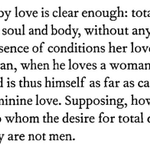
ALT Quote from Nietzsche in Beauvoir's The Second Sex: "What woman means by love is clear enough: total devotion (not mere surrender) with soul and body, without any consideration or reserve... In this absence of conditions her love is a faith; woman has no other *faith*. Man, when he loves a woman, *wants* precisely this love from her and is thus himself as far as can be from the presupposition of feminine love. Supposing, however, that there should also be men to whom the desire for total devotion is not alien; well, then they simply are not men.

ALT Letter from Jenny Westphalen to Karl Marx. The part I've placed between brackets is highlighted in the image: "since your last letter I have tortured myself with the fear that for my sake you could become embroiled in a quarrel and then in a duel. Day and night I say you wounded, bleeding and ill, and, Karl, to tell you the whole truth, I was not altogether unhappy in this thought: for [I vividly imagined that you had lost your right hand, and, Karl, I was in a state of rapture, of bliss, because of that. You see, sweetheart, I thought that in that case I could really become quite indispensable to you, you would then always keep me with you and love me.] I also thought that then I could write down all your dear, heavenly ideas and be really useful to you."

ALT Text: "To achieve this union, the woman first wants to serve; she will feel necessary in responding to her lover’s demands; she will be integrated into his existence, she will be a part of his value, she will be justified; even mystics like to believe, according to Angelus Silesius, that God needs man, otherwise the gift they make of themselves would be in vain. The more demands the man makes, the more fulfilled the woman feels. Although the seclusion Hugo imposed on Juliette Drouet weighed on the young woman, one feels she is happy to obey him: staying seated close to the fire is doing something for the master’s happiness. She passionately tries to be positively useful to him. She prepares special dishes for him, creates a home for him: your little “nest for two,” she said sweetly; she takes care of his clothes. She writes to him: “I want you to stain and tear all your clothes as much as possible and that I alone should mend and clean them and nobody else.”"

ALT Text: "For him she reads newspapers, cuts out articles, organizes letters and notes, copies manuscripts. She is upset when the poet entrusts part of this work to his daughter Leopoldine. Similar characteristics are found in all women in love. If need be she tyrannizes herself in the lover’s name; everything she is, everything she has, every second of her life, must be devoted to him and thus find their raison d’etre; she does not want to possess anything except in him; what would make her unhappy is that he demand nothing of her, and so an attentive lover invents demands. She first sought in love a confirmation of what she was, her past, her personage; but she also commits her future: to justify it, she destines it to the one who possesses all values; she thus gives up her transcendence: she subordinates it to that of the essential other whose vassal and slave she makes herself."

ALT Text: "It is to find herself, to save herself, that she began by losing herself in him: the fact is that little by little she loses herself; all reality is in the other. Love that was originally defined as a narcissistic apotheosis is accomplished in the bitter joys of a devotion that often leads to self-mutilation. At the outset of a consuming passion, the woman becomes prettier, more elegant than before. “When Adele does my hair, I look at my forehead because you love it,” writes Mme d’Agoult. This face, this body, this room, this me, she has found a raison d’etre for them; she cherishes them through the mediation of this beloved man who loves her."

ALT Text: "But later, she gives up all coquetry; if the lover so desires, she changes this face that had once been more precious than love itself; she loses interest in it; she makes what she is and what she has the fief of her lord; what he disdains, she disavows; she would like to devote to him each beat of her heart, each drop of blood, the marrow of her bones; this is what a dream of martyrdom expresses: to exaggerate the gift of self to the point of torture, of death, to be the ground the beloved treads on, to be nothing but that which responds to his call. She vigorously eliminates everything the beloved finds useless. If this gift she makes of self is totally accepted, there is no masochism: few traces of it are seen in Juliette Drouet. In her excessive adoration she sometimes knelt before the poet’s portrait and asked him to excuse the mistakes she might have committed; she did not angrily turn against herself. But the slide from generous enthusiasm to masochistic rage is easy."

ALT Text: "The woman in love who finds herself before her lover in the same situation as the child before his parents also recovers the feeling of guilt she experienced around them; she does not choose to revolt against him as long as she loves him: she revolts against her self. If he loves her less than she desires, if she fails to interest him, to make him happy, to be sufficient to him, all her narcissism turns into disgust, humiliation, and self-hatred that push her to self-punishment. During a longer or shorter crisis, sometimes for a whole life, she will be a willing victim; she will go out of her way to harm this self that has not been able to satisfy the lover. Then her attitude is specifically masochistic. But cases where the woman in love seeks her own suffering so as to get revenge on herself and those where she seeks confirmation of the man’s freedom and power must not be confused."

ALT Text: "It is a commonplace—and seems to be a reality—that the prostitute is proud to be beaten by her man: but it is not the idea of her battered and enslaved person that exalts her, it is the strength, authority, and sovereignty of the male on whom she depends; she also likes to see him mistreat another male, she often pushes him into dangerous competitions: she wants her master to hold the values recognized in the milieu to which she belongs. The woman who gladly submits to masculine caprices also admires the proof of a sovereign freedom in the tyranny that is wielded over her. One must be careful to note that if for some reason the lover’s prestige is ruined, his blows and demands become odious to her: they are only worth something if they manifest the beloved’s divinity."

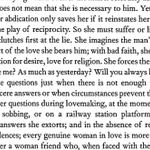
ALT Text that ends in the middle of a sentence, continued in the next image: "In that case, it is intoxicatingly joyous to feel oneself the prey of a foreign freedom: for any existent the most surprising adventure is to find oneself sustained by the diverse and imperious will of another; one is tired of inhabiting the same skin all the time; blind obedience is the only chance of radical change that a human being might experience. So here is the woman slave, queen, flower, doe, stained-glass window, doormat, servant, courtesan, muse, companion, mother, sister, or child depending on the lover’s fleeting dreams, the lover’s imperious orders:..."

ALT Text, continuing from the previous image: "...she complies with delight with these metamorphoses as long as she does not recognize that she still has the same taste of submission on her lips. In love as well as in eroticism, it appears that masochism is one of the paths the unsatisfied woman takes, disappointed by the other and by herself; but this is not the natural slope of a happy resignation. Masochism perpetuates the presence of the self as a hurt, fallen figure; love aims at the forgetting of self in favor of the essential subject."
ALT Quote from Nietzsche in Beauvoir's The Second Sex: "What woman means by love is clear enough: total devotion (not mere surrender) with soul and body, without any consideration or reserve... In this absence of conditions her love is a faith; woman has no other *faith*. Man, when he loves a woman, *wants* precisely this love from her and is thus himself as far as can be from the presupposition of feminine love. Supposing, however, that there should also be men to whom the desire for total devotion is not alien; well, then they simply are not men.

ALT Text: "Closed off in the sphere of the relative, destined for the male from her earliest childhood, used to seeing him as a sovereign, with whom equality is not permitted, the woman who has not suppressed her claim to be human will dream of surpassing her being toward one of those superior beings, of becoming one, of fusing with the sovereign subject; there is no other way out for her than losing herself body and soul in the one designated to her as the absolute, as the essential."

ALT Text: "Since she is, in any case, condemned to dependence, she would rather serve a god than obey tyrants—parents, husband, protector; she chooses to want her enslavement so ardently that it will seem to her to be the expression of her freedom; she will try to overcome her situation as inessential object by radically assuming it; through her flesh, her feelings, and her behavior, she will exalt as sovereign the one she loves, she will posit him as value and supreme reality: she will efface herself before him. Love becomes a religion for her."

ALT Text: "Many examples have already proven to us that this dream of annihilation is in fact an avid will to be. In all religions, the adoration of God is part of the devotee’s desire for his own salvation; by giving herself up entirely to the idol, the woman hopes he will give her possession both of herself and of the universe contained in him. In most cases, it is first the justification, the exaltation of her ego, she asks of her lover. Many women do not abandon themselves to love unless they are loved in return: and the love they are shown is sometimes enough to make them fall in love. The young girl has dreamed of herself as seen through the man’s eyes: it is in man’s eyes that the woman believes she has at last found herself."

ALT A ball of dough resting in my outstretched palm in the middle of my living room/kitchen (there’s no walls in-between).

ALT The cover of the album “Are We Not Horses” by the bank Rock Plaza Central. It’s a concept album about robotic horses that get duped by humans into waging a war against angels and they work through their “sin” and their crises of identity in the songs, along with finding warmth in the comfort and love of one another.


ALT Anonymized email from my advisor. It's generally pleasant. It's just titled "dissertation meeting" and reads "Dear Sterling, I hope your semester is not too busy and that you are enjoying a well deserved break this week. Let's schedule a zoom meeting to catch up. I could meet later today or tomorrow afternoon if you have time. All the best, [name removed]"

ALT Dissertation text (parts in brackets are notes to myself): "To conclude this investigation into the promises and limits of Husserlian eidetic analysis, though, I'd like to end with two suggestions about the practicality of such analysis. Even if the method of eidetic variation is historical, culturally sensitive, open-ended, and so on, the amount of historical opposition to eidetic analysis can make it difficult to imagine how the process of imaginative variation can help us to understand anything about our social existence. As a counterweight, I'd like to offer a suggestion for how this process of imaginative variation is useful, first, for understanding some aspects of contemporary feminist theory [family abolition and social reproduction] and, second, for understanding the possibly 'transhistorical' character of truths in the work of Alain Badiou. [the whole intro to Logics of Worlds]"

ALT Tweet and a retweet. The original tweet says "I dare you to name a non-alcoholic drink that's an absolute 10/10" and the retweet says "Diet coke when you feel sad".

ALT Tweet that was too long that reads: "Was talking about heteropessimism and how rigid gender norms ruin the potential of heterosexual coupling and brought up an IG reel I saw with a bisexual guy who tried to present as straight and let the truth slip out when they fangirled over TSwift. Do you know how embarrassing it is to mention/perform that and be met with total silence and all cameras off? Miserable."


