
Cofounder of Hoid (SR007), prev: CS @ Cambridge https://nitter.cf/t.co/3hyJX4WIJh
Joined October 2023
- Tweets150
- Following168
- Followers213
- Likes184



And like in classic ML, you should always look at the data. Unintuitively, data isn't the codebase but the agent traces

Sufficiently advanced agentic coding is essentially machine learning: the engineer sets up the optimization goal as well as some constraints on the search space (the spec and its tests), then an optimization process (coding agents) iterates until the goal is reached.
The result is a blackbox model (the generated codebase): an artifact that performs the task, that you deploy without ever inspecting its internal logic, just as we ignore individual weights in a neural network.
This implies that all classic issues encountered in ML will soon become problems for agentic coding: overfitting to the spec, Clever Hans shortcuts that don't generalize outside the tests, data leakage, concept drift, etc.
I would also ask: what will be the Keras of agentic coding? What will be the optimal set of high-level abstractions that allow humans to steer codebase 'training' with minimal cognitive overhead?
Honestly Diogo is such a fresh change in the way he speaks. I think most CEOs have converged in how they do storytelling and its pretty boring. Diogo breaks that pattern

So Diogo Almeida is one of the most fascinating CEOs I have ever interviewed.
born in the Philippines
2008: wins bronze for the Philippines at the International Mathematical Olympiad
2013: starts his career as a software engineer at Amazon
2017: joins Google Brain, working on cutting-edge deep learning research
2018: leaves Google Brain and takes roughly 18 months off to figure out what makes him happy
travels the world, experiments with improv, art and meditation
becomes a top-30 League of Legends player
discovers that none of it makes him particularly happy
2020: joins OpenAI when it's still a relatively obscure research laboratory
helps develop reinforcement learning from human feedback (RLHF), the technique that transforms how people interact with AI
2022: co-authors the landmark InstructGPT paper
the work becomes foundational to ChatGPT
November 2022: ChatGPT launches and becomes one of the fastest-growing consumer products in history
2023: contributes to GPT-4, one of the most important model releases in AI history
but starts questioning the fundamental assumptions behind the technology he helped build
2024: leaves OpenAI while ChatGPT is exploding in popularity
people think he's crazy for walking away
co-founds TypeSafe AI with Erik Gafni and Sasha Sheng
spends two years in stealth developing an entirely new class of AI models
September 15, 2026: launches Jev, TypeSafe's first System One model
Company makes $100M in revenue in the first 7 days of launch
raises a reported $40M seed round led by DCVC
October 2026: a reported $870M Series A at a $7.5B valuation, backed by a16z
argues that the next breakthrough in AI will come from making intelligence cheap, reliable and autonomous
My notes from my discussion with @CompleteSkeptic below:
1. Why Jevons' Paradox Does Not Cut It. We Are Going to 10x That
Diogo expects a "mega Jevons paradox", with usage that dwarfs the token consumption of LLMs and AI running in the background everywhere. He expects people to stop seeing AI as something that "slops crap at them" and start seeing it as something that makes life better.
2. Why SaaS Incumbents Are Better Positioned Than OpenAI and Anthropic in Many Application Spaces
SaaS companies know their customers' workflows and have the scale to fund the upfront engineering that real automation requires. Diogo argues their edge comes from being closest to the problems, not from distribution. Teams inside products like TurboTax know where to improve the interface, while OpenAI and Anthropic are "still living in their ivory tower."
3. Why We Do Not Hire From OpenAI
Diogo sees getting into OpenAI as an anti-signal and says its researchers love algorithms and scaling but hate data. Data is a low-status topic at most labs, and the few people focused on the right task would want to pursue their own. That leaves researchers obsessed with algorithms, which he likens to throwing money in the furnace.
4. How the AI Bubble Could Burst and Where the Demand Shock Could Be
Part of today's AI demand is driven by FOMO, from people believing they are getting good results. Diogo finds many buyers miscalibrated and overestimating what AI can do. Once they face the realities of its capabilities, demand could fall quickly.
5. What Metric Did ChatGPT Optimize for in the Early Days?
Before Claude Code, ChatGPT was optimized for monthly active users rather than the best chatbot experience, which is how sycophancy emerged. Companies are now optimizing for the MAU equivalent in coding agents. Without a dedicated model, Diogo doubts they will produce a comparable one soon.
6. Why the Talent Market Is Not Crazy for Us and We Don't Pay for Mercenaries
TypeSafe pays people good amounts but not the highest, which filters out hired guns. Diogo says Anthropic is suffering from mercenaries because it pays more than anyone else, and an entire market now exists to prepare candidates for Anthropic culture interviews.
7. We Wanted Sonya Huang More Than We Wanted Sequoia
Diogo did not want Sequoia's money and brought the firm in because of Sonya. He values her particular shape of brilliance, which offers a perspective no other advisor gives him. One TypeSafe value is to make great decisions slowly, and he sees her as a valuable thought partner for that.
(links in comments)
1
85
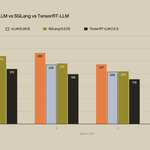
vLLM and SGLang teams are fighting an unfair game right now. They gave the whole world an impressive baseline for performance and now people are starting to specialize inference for specific model+hardware+workload. This is the future of inference

2
3
127
Megakernels work really well on multi-GPU models with a lot of inter-GPU communication. Gains are actually pretty capped on single GPUs. vLLM and SGLang do a pretty good job there
100
If Jensen's affairs make you want to switch from NVIDIA, come to Hoid to get the fastest inference on any hardware

Nvidia CEO Jensen Huang's email to Nvidia employees:
To my colleagues at NVIDIA,
I owe my family and all of you an apology.
I was unfaithful to my wife. My actions hurt her and our children. There is no excuse for what I did. I am deeply sorry.
Throughout my life, my family has given me love and support. They deserve my honesty and loyalty. Instead, I let them down and damaged the life we built together. I take full responsibility for what I did and the hurt I caused, and I accept the criticism that comes with it.
To my wife and family: I love you. I know an apology cannot undo what I have done. I hope our family will heal and that, over time, I can earn back your trust.
To my colleagues at NVIDIA, including those I have worked alongside for decades, and to our board, partners, and shareholders around the world: you deserve better from me. Leading NVIDIA is the privilege of my life. My responsibility is to serve you and be worthy of your trust. I have fallen short of that responsibility. I am fully committed to NVIDIA and will work to earn back your confidence.
Regarding the national security concerns raised in news reports, NVIDIA’s Board of Directors has initiated an independent investigation. I support the investigation and will cooperate fully. I love our country and our company. I am committed to protecting NVIDIA and supporting America’s national security. I am proud and grateful to be an American.
My family bears no responsibility for my choices. I do. Please give them privacy.
Jensen
1
6
350
People are hating on @VictorTaelin but he has
1. already built something people want (Bend)
2. says he will figure out the business later
I am very bullish on you, keep going!

guys I get it, my deck is bad, I'm retarded and a terrible person
I don't have anything to say in my defence
I'll take a break from social media, think about all of this and be back only if I have something worthy of your time
sorry :(
2
158
Finally a model that even my 2018 samsung can run

Today we release Mirage: A 22 MB visual-language model that runs scene descriptions + object detection + OCR + segmentation + spatial relations analysis + extractions + decisions, in a single pass.
It can do all that in 74 ms on Samsung Galaxy S26 NPU or 107 ms on its CPU.
Mirage has a 7.8M encoder + a 40.8M decoder at 2bits, and describes images in English, German, French, Spanish, Italian, Dutch and Polish.
We trade general language capacity, to compete top small VLMs today (SmolVLM2-500M, LFM2.5-450M and Florence2-230m) on these tasks.
On 256 VQAv2 questions, feeding Mirage's structured output and full trace to text-only Qwen3-0.6B raised its score from 9.3 to 31.3 out of 100, without fine-tuning either model.
Read more and benchmark it yourself here:
cactuscompute.com/blog/mirag…

3
141
We're publishing our blog post about building megakernels that make LLMs run at the limits of physics.
Megakernels let you squeeze every last bit of performance out of your GPU. Unfortunately, they're also notoriously hard to make (performantly).
We're building a megakernel factory, and this is just the beginning. Everyone deserves top-notch performance from the hardware they buy.
Link to the blog in the comments!

There is a giant discrepancy between teams that know how to make inference fast (like OAI) and everyone else. Hoid is all about removing that diff

Up to 8x faster, and now you know why ⚡️@openai GPT-6 Astra Ultrafast runs on NVIDIA
Read the story: nvda.ws/3W2bZ5H
6
174
vLLM team showed the value of megakernels on TPUs. Most GPU workloads don't run megakernels because its really hard to make them performant. We're about to change that

Our first TPU megakernel for Kimi K3 reaches 709 tokens/s on low-concurrency decode, against 450 tokens/s for our GB200 baseline, both with DSpark speculative decoding.
To our knowledge, this is the first TPU inference megakernel. The whole model runs in a single Pallas kernel, and without spec decoding it is roughly 1.4 to 2x the GB200 baseline at batch sizes 1 through 8.
We are open sourcing it today.
1/2
The biggest benefit of frontier models is that people stopped complaining about how hard it is to install cuda
2
9
363
Don't let the model size fool you, this is compacted intelligence at its finest
We release Needle 3: A Sliceable 8-29MB automation foundation model that can match DeepSeek V4 Flash.
One set of weights, every depth from 2 to 20 layers a model of its own, 25-121M parameters at CQ2-bit, built on our Simple Attention Networks and running locally at up to 4k tokens/sec decode speed on a Raspberry Pi 5.
Needle does not chat. Every turn is a function call: give it the tools your app exposes and it picks the right ones and fills every argument from what the user said, or hand it a schema and it returns a typed record. Ask for something no tool covers and you get an empty list, not a guess.
That trade is lets 121M parameters trained on 360B tokens of structured data beat models 10x their size on mobile tool calls and match 2-3x bigger models on structured JSON extraction.
It runs on mobiles, wearables, smart home devices, small robots and microcontrollers, with prebuilt engines for macOS, Linux, Windows, Android, iOS, watchOS, tvOS, the browser and WASI hosts. Try it in your browser: cactuscompute.com/needle
5
374
Pavle Padjin retweeted

OpenWhispr v1.10.0 ships with a speed upgrade!
Orukeet wins 61 of 74 benchmark splits; Parakeet wins 13.
Hoid's latest OpenWhispr PR: 171 → 110 ms for Orukeet (36% lower warm median). Apple M5, 11-second clip, before/after optimization.

step aside @nvidia, there's a new top dog in speech models: orukeet.
trained by @OrukLabs, optimized by @hoid_ai, and available on day zero in @openwhispr (100k+ downloads).
25 languages. Open weights + code.
Pavle Padjin retweeted

step aside @nvidia, there's a new top dog in speech models: orukeet.
trained by @OrukLabs, optimized by @hoid_ai, and available on day zero in @openwhispr (100k+ downloads).
25 languages. Open weights + code.
Pavle Padjin retweeted
language is a superposition over possible meanings
we're testing quantum architectures for speech models at @OrukLabs
one challenge is that quantum memory can hold the answer but still lack a way to reveal it. our preprint shows how entanglement itself can store information.
