




Github is a goldmine for resources for AI model, but is intimidating af for non-technical folks.
Add zip to the start of any repository in github.com and you get an easy-to understand guide on what the repo does and how to access it.
Github Repo - This is one of the popular repos in Github!
146,000 stars, but it's primarily in Chinese and intimidating AF for a non-technical visitor.
github.com/harry0703/MoneyPr…
Add zip to the start of the repo, it redirects to simple to read page on zippr.to
zippr.to/github/harry0703/Mo…
The idea is to remove the barrier for non-technical folks to work with AI with Zippr.to
P.S - Ui needs work, but was excited to ship the feature out.

1
63
Wow! Go through the maze that google is and figure out a way to get your hands on neon, whatte fucking incredible model.
It feels like I was talking to cavemen with opus 5.5 compared to this model.
Wow. Coherent AF
1
41
When Opus 5.5 was released, I could finally move from 10 different chats to 1 orchestrator chat, and the model kept optimising and moving work as and when I kept dumping work on it. Just had to give it the tooling to track state.
Git issues, local logs for decisions, rulings, and discussions, and helpers to do the work. It would use one helper to gather context for the discussion and kick off another once the work was clear. Briefing that helper based on my discussion would be the exception.
Once the work was done, another helper would review it if it touched certain topics (merges, payments, deploy, auth, etc.). Other work would go through batched reviews and be merged with a landing tool.
This worked well. Now, since the model is nerfed, tracking issues, assigning work, etc., have gone bad and have required micromanaging to make sure everything is on track.
It's able to keep the work moving, but it keeps ignoring priorities, goals, etc.
Feel like there should be a better way. I'm planning to move to Linear. The team inbox sounds like a better holding area than the local decision logs, and I can have a planner agent triage it and create cards, have a scheduler pick up briefs marked as ready for agents to work on whenever there is a free slot, and have everything tracked against a goal so that work keeps moving.
I am sure there are better ways of doing this. If any of you can share what has worked for you, do share.
Otherwise, I will keep sharing what I find and keep improving it.
Cheers
79
If you're using claude code as an orchestrator, change the output style to explanatory!
Whatte relief
1
48
If you're stuck with a problem that you're unable to fix, run a sub-agent with a /goal or on a /loop to find a solution. Define the success metrics and what achieving the goal should look like, and you'd be surprised by the results.
In fact, if you allow the chat to spin off as many sub-agents as it needs to figure out the goal within a tight deadline of a few hours, the results get even better.
I used to run this as a token-burning activity when Opus 5 was shit and Fable used to run out of limits. I would have loads of unused Opus 5 capacity, and every week, around 20-30% of the usage on each account would otherwise go to waste. The solutions that came out of these runs used to be incredible.
31
Opus 5.5 is still the best orchestrator out there, but it's gone downhill enough since launch that I need to rethink how I work with it. It just doesn't execute the way it used to.
I have an agent whose only job is to wake up every hour and check whether the orchestrator is managing its context and keeping track of where all the work stands. It finds far more issues with today's model than it did with the one from 2 months ago.
That adds overhead. I'm back to micromanaging the orchestrator and fixing problems at the root based on how the model performs today.
Have you all seen the same dip in performance? AI is so crazy right now that something that worked yesterday might fail today even if you do everything exactly the same way.
1
46
Some examples of why I think the chat-first interface doesn’t make sense for all everyday tasks.
Whenever I write, I need ChatGPT/Claude to help me find facts, brainstorm ideas, and fix grammar or rewrite my raw thoughts in my style before I post.
But every single time, I end up taking more time when I try to write while on ChatGPT than when I write directly on a blank canvas and use AI only where needed.
So the time taken to write a post whenever I use this method is drastically lower. So I built a writer flow for people who write a lot for their work. It has really cool features.
You can fact-check anything you’re writing, create and handle multiple docs at once, and maintain versions of them in one place.
You can also make posts longer/shorter or find info about what you have written across your ChatGPT/Claude apps.
And further, anytime AI rewrites what you have written, you don’t have to scan through the entire text again. You can just see the changes it has made so that you can selectively review only those.
Now available on early access on mac, sign up at zippr.to for access!

3
66
For the last couple of months I have been obsessed with one idea: for non-technical users doing everyday work, today's Claude and ChatGPT apps, built around a chat-first interface, are deeply inefficient.
There has been an explosion of everyday users using AI apps for non-coding work; around 10% of the work done on Claude Co-work today is coding-related.
And these apps expect the user to understand dev-related workflows (Plugins, Commands, Artifacts, MCPs, skills, and a ton of ever-growing jargon) when everyday users just want to get their work done.
Using today’s AI apps is like learning how to assemble a car to drive it; the models are all powerful, and the onus to learn how to use them is on the user.
So, I have been building zippr.to over the last couple of months, which abstracts the complexity of AI and gets the work done for you.
To demonstrate what I mean, I am launching with early access to the mac app where there are a couple of flows available for free for the early access users.
A flow is the best way to get a task done with AI used only wherever required.
Here’s why that matters: in an example I demonstrated, creating carousel variations took just 44 THOUSAND tokens on the zippr app, compared with 46 MILLION on the Claude app.
On zippr, you had 1000s of poster variations to choose from for one post in less than 5 minutes. The same task took around 40 minutes on Claude.
The primitive for Zippr is tasks as opposed to chats or bots. Zippr thinks in tasks and builds the most optimised method to use AI to get that task done for you.
Today you can have two flows on zippr; over time there will be millions of zippr agents running in the wild learning the best way to complete a task and build the most optimised version of the app for you.
Building a product in the world of AI means AI agents do most of the work. When that’s the case, why should only founders build in public? I am connecting my agents to my LinkedIn and Twitter to rally support, get product feedback and shape zippr!
I am excited to be building again, and the larger mission is to make the world AI-native, with our Mac app as today’s interface and with the most convenient form factor tomorrow, for the user to get their work done.
I have started a community with founders, operators, investors and the like to get early access to Zippr and shape it, and I plan to simplify AI concepts and build a community of people who are curious about AI and want to use AI for their work.
I will try to keep everything in the community ELI5-friendly, and share real tips on how to use AI for your work.
Check comments for links to get early access to the Mac app and the community!
Early access, for Mac: zippr.to/early-access/
Not on a Mac yet? Join the community: zippr.to/#community

75
Jev vs opus 5 on reaching the task it needs to do.
Speed:
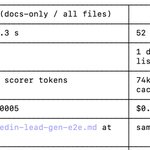
52 / 2.3 = 22.6× faster
Cost: $0.88 / $0.0005 = 1,760× cheaper
Results are a little skewed because fable wrote the test and prepared the test to run for Jev but opus 5 had the same docs. But I can have a list prepared for all the common tasks everytime as well.
This was a test to see how long it would take to find the exact task to execute that I normally run through my agents down the exact command served to the LLM
Fucking insane, will drop a skill in the morning!!
But the idea is if instead of ingesting the entire claude.md files and the router to figuring out how to do a particular task, if a tool call's output can be shared with jev and we can route through it, how fast can an agent figure out the task to do!!
And this isn't a theoretical pricing comparison. That's the measured cost of the actual task.
What this means at scale
If you ran this decision 1 million times:
Ordinary Opus 5: $880,000
Router: ~$500
Difference: ~$879,500
Even at 100k decisions:
Opus: $88,000
Router: ~$50
That's the cost unlock you're looking at.


After co-inventing ChatGPT, I kept asking myself: why have superhuman chat models not led to AGI?
I’ve spent the last 2 years in stealth building a new way to train models (RLCD), and a new type of frontier AI model that we are releasing today: Jev
• 20-200x faster
• 40-400x cheaper (w/ output tokens free)
• Frontier composable intelligence optimized for decisions
AFAICT the shortest path to AI-based economic revolution
1
2
470
Some more findings from experiments. Defining the state(which it defines to be the input data for it) and questions and type of result.
It can provide results in the form of selection between the following
- multiple answers(they called it choice)
- yes/no(noul)
- probability based answer(score)
Speed and cost being the biggest differentiator


70% reduction in time taken to diagnose a live customer's job failure, when A/B tested on the same environment.
From 10 mins to 3, absolutely matters on live production failures.
I think I can optimise the diagnosis to a few seconds through parallel scripts(that are pre-written) to probe with typeface providing a score on what to probe further with clear steps from a playbook.
Still running tests, but extremely exciting.
Linkedin profiles were classified within seconds as potential targets with almost no cost for agents to reach out to new connections for this product - clientsscout.com/icp/
This unlocks so many use-cases from both latency + cost perspective, it's nuts.
Will drop a skill doc on how to use it to diagnose production failures if the further analysis works.

80
Interesting result from testing TypeSafe on my LinkedIn connections.
I asked an agent to use it to go through my connections and identify people who could be a fit for the products I'm building, including clientsscout.com/icp/
It correctly identified that founders I was connected to were a match, but struggled to classify the companies themselves, company size.
I had expected this to be where an architecture designed specifically for decision-making would shine.
But if it can't reliably infer attributes from the available information, I wonder how much of it will be routed to an LLM in production environments.

After co-inventing ChatGPT, I kept asking myself: why have superhuman chat models not led to AGI?
I’ve spent the last 2 years in stealth building a new way to train models (RLCD), and a new type of frontier AI model that we are releasing today: Jev
• 20-200x faster
• 40-400x cheaper (w/ output tokens free)
• Frontier composable intelligence optimized for decisions
AFAICT the shortest path to AI-based economic revolution
140
70% reduction in time taken to diagnose a live customer's job failure, when A/B tested on the same environment.
From 10 mins to 3, absolutely matters on live production failures.
I think I can optimise the diagnosis to a few seconds through parallel scripts(that are pre-written) to probe with typeface providing a score on what to probe further with clear steps from a playbook.
Still running tests, but extremely exciting.
Linkedin profiles were classified within seconds as potential targets with almost no cost for agents to reach out to new connections for this product - clientsscout.com/icp/
This unlocks so many use-cases from both latency + cost perspective, it's nuts.
Will drop a skill doc on how to use it to diagnose production failures if the further analysis works.
After co-inventing ChatGPT, I kept asking myself: why have superhuman chat models not led to AGI?
I’ve spent the last 2 years in stealth building a new way to train models (RLCD), and a new type of frontier AI model that we are releasing today: Jev
• 20-200x faster
• 40-400x cheaper (w/ output tokens free)
• Frontier composable intelligence optimized for decisions
AFAICT the shortest path to AI-based economic revolution
For those who are curious about the incident -
borensteingroup.com/ had submitted for a redesign, the build had failed due to a failed extraction of their site(bots being blocked, failure rate is currently a 1 in 100) - have built custom scrapers with firebase as a fallback, but all of it failed and all downstream work failed due to the lack of availability of the data to rebuild the site from.
redesign.llc/preview/borenst… was the recreated site if you're curious
50
Got access to it! Impressive AF.
Ran it on the recent 270 real responses on Instantly replies for redesign.llc
~2 min, ~$0.05.
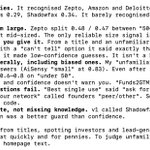
Agreed with Instantly’s interested bit 95% of the time and was it was right 100% of the time.
Instantly skipped “Hi please share” and tagged ticket auto-acks as interested.
Jev returns a yes-probability *and* a lane (interested / OOO / decline / question), so code can route.
I’d bolted on a cheap Gemini classify call for this earlier. Overkill on time and cost.
A definite add to the stack.

After co-inventing ChatGPT, I kept asking myself: why have superhuman chat models not led to AGI?
I’ve spent the last 2 years in stealth building a new way to train models (RLCD), and a new type of frontier AI model that we are releasing today: Jev
• 20-200x faster
• 40-400x cheaper (w/ output tokens free)
• Frontier composable intelligence optimized for decisions
AFAICT the shortest path to AI-based economic revolution
66
All aggregator apps will have second to second data on time take taken across every street, junction, etc down to the exact lat long
Might be very useful data to study traffic patterns, bottlenecks, traffic movement and incredible input data to atleast have scientific decisions taken around size of the road, one ways, signal durations, potholes identification etc
Insane to think how much can be done if someone cared

36
Shit that no one tells you about:
Create an extensive plan doc with all your architecture decisions baked in, every trade-off discussed, and cost implications across 10/100/10k users. Any more users and you anyway need to rework a lot of things to make sure it holds out at that scale, so don't overengineer from the start.
TDD development. Draw a DAG diagram. Ask the agent to ask you questions using the askuserquestion tool. Write out the entire spec, including customer flows and all test scenarios, walk them through with you, and run it on the VM using claude -p for each task and run them in different waves.
Oh, and maintain a running log of all work done, and the board gets updated, kanban-card style. Run a cheaper model to check the chat transcript and catch anything that the logs, boards, and docs haven't been updated with.
Use your terminal only to get updates and coordinate with me for any dependency or testing requirements so I can keep an eye on it.
Every task should be an independent task with enough context written about it.
Don't let the agent make important product or architecture decisions silently.
If it's not detailed, discuss it with me until it is. Unit tests, integration tests, end-to-end tests where necessary, and tests for failure scenarios, edge cases, and regressions. Every task should have clear acceptance criteria and a defined test strategy, and no task should be considered complete until the relevant tests have passed.
Oh! and run /simplify and /security-review after every wave mandatorily
1
64