

22 | founder @groundamentals | investment research @16Alpha_Fund | @SSCBS co’25 | writing about finance, economy, businesses, fitness, vc, whimsies
Delhi
Joined October 2025
- Tweets2.1K
- Following725
- Followers364
- Likes3K



Pinned Tweet
retail investors, aspiring equity analysts, business & market/macro nerds thanks me later groundamentals.com


$ANT showing slides for their roadshow would be a recession indicator

1
132
the best in the business

Hedge funds don't want you to see these…
screwstreet.com - for US market degens
stockssena.com - for Indian market traders
Bookmark both. You'll thank me later…


4
187
Pranami Hayaran retweeted

Hedge funds don't want you to see these…
screwstreet.com - for US market degens
stockssena.com - for Indian market traders
Bookmark both. You'll thank me later…

brewed up insights #195
Is Mastek's RBI fine a warning sign? Not really
on 16 November 2026, Mastek told the exchanges that the RBI had fined it ₹11.02 lakh for breaking FEMA, India's foreign exchange law, from 2004 to 2016. so the RBI caught a software company out? not quite: Mastek asked to pay.
Mastek builds and runs software for clients abroad, with 67.8% of its revenue in the July to September quarter from the UK and Europe. it pays some staff in shares through stock options, including people at its companies outside India. shares given to staff abroad count as foreign investment, so the RBI wants forms filed on time.
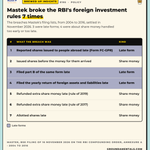
Mastek's filing lists 7 breaches: 3 late forms (Form FC-GPR, which reports shares issued to people abroad, its part B, and the yearly FLA return of foreign assets and liabilities) and 4 slips with share money: shares issued before the money arrived, extra money refunded late under 2 rules, and shares allotted late.
Mastek took the route called compounding, which the RBI describes as "voluntarily admitting the contravention, pleading guilty" and paying to close it. the amount comes from a price list, not a judgment: ₹10,000 for each late FLA return, and ₹30,000 plus 0.30% to 0.75% of the money for a late allotment or refund. the law allows up to 3x the money involved.
so the bill is small, 0.10% of the ₹105.7 crore profit Mastek made in that quarter alone, and it is not news of fresh trouble. it is the price of closing slips that stopped a decade ago. what it does show is that for 12 years, a company paying staff abroad in shares did not keep up with the RBI's paperwork on them.


3
97
brewed up insights #194
Happy Forgings' owners sell shares because a rule forces them
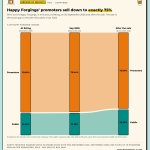
on 16 November 2026, Happy Forgings said 4 of its promoters (the owners who control it) will sell up to 3.44% of the company in the market over the next week, taking them from 78.44% to exactly 75%. owners selling usually reads as a view on the price. this one reads as a deadline.
Happy Forgings, founded in Ludhiana in 1979, forges and machines heavy steel parts such as crankshafts for trucks, tractors and industrial machines. the sellers are founder Paritosh Kumar, managing director Ashish Garg and 2 HUFs (a Hindu family's own tax entity) in their names.
the rule: a listed company must keep at least 25% of its shares with the public, anyone outside the promoter group. one that lists with less gets 3 years to get there. Happy Forgings listed on 27 December 2023 with 21.4% public, so its clock runs out on 27 December 2026.
the promoters waited. their stake slid only from 78.6% to 78.44%, from new shares staff got through stock options, not from sales. on the 6 November results call an analyst called the pending sale a "supply overhang" (a block of shares the market knows is coming); the managing director said it would be done "within the time frames". the notice came 10 days later.


128
brewed up insights #193
Biocon's US cancer drug approval won't earn it a rupee before 2028
Biocon won US approval on 16 November for Pebrilzo, its copy of Roche's breast cancer drug Perjeta. new US sales, then? not soon. a patent settlement with Genentech (Roche's US arm), filed a month earlier, fixes the earliest US launch at July to September 2028, at least 19 months away.
Biocon makes biosimilars: near-copies of drugs grown from living cells, sold cheaper once patents end. Perjeta treats breast cancer driven by HER2, a protein that makes tumours grow fast, about 20% of new US cases. Roche's US business sold $1,702mn of it in 2025.
but Roche is moving patients on. Phesgo, Perjeta and Herceptin in 1 injection under the skin, is in Roche's words the treatment preferred over Perjeta and Herceptin, and its US sales rose 70% to $1.1bn in 2025. Pebrilzo copies only Perjeta, a drip. by 2028 part of the market Biocon is waiting for may have moved.
so the first money comes from elsewhere. the settlement allows launches in the EU and UK from January to March 2027, the same quarter that supplies start to Brazil's public health system under a 10-year contract worth about $400mn in all. Biocon gets milestone payments and a share of revenue, not the whole sum.
so the 16 November approval will not bring Biocon any US sales before 2028. Its first sales of this drug can start in Europe and Brazil in early 2027. and by the time Biocon can sell in the US, more patients may have moved to Phesgo, the injection Roche now prefers over the Perjeta drip.


1
65
brewed up insights #192
The RBI shut 49 lenders, and 9 were the same address
on 16 November 2026 the RBI named 49 NBFCs (non-bank finance companies, licensed to lend or invest as their main business) whose licences it had cancelled in October. 43 of the 49 are in West Bengal, 41 in Kolkata alone.
a crackdown on lenders gone wrong? the list reads more like old paperwork being cleared. 9 of them give the same room in Kolkata's Poddar Court as their office. 13 have held their licences since 1998, and only 1 got its licence after 2014.
the RBI gives no reason. the law lets it cancel a licence when a company stops the business, breaks the licence's conditions or will not show its books, and only after a hearing.
nor is this a one-off. the RBI's June list had 124 of 135 in West Bengal, and August's 43 of 59. January was Delhi's turn, with 33 of 35. the RBI seems to be clearing its register one region at a time.
a deadline may add to it: every existing NBFC needs ₹10 crore of its own money (net owned funds) by 31 March 2027. so the list says little about loans going bad, and a lot about a register that kept decades-old Kolkata licences on its books.


49
brewed up insights #191
Senco Gold's record Diwali came from new stores, not more shoppers
Senco Gold, a Kolkata jewellery chain with 215 showrooms, says it sold a record ₹2,426 crore of jewellery in the 41 festive days to 11 November, 26% more than a year earlier. a jeweller sells gold by weight at the day's price, so its sales rise with gold even when shoppers buy no more.
so shoppers bought a lot more? not at the older stores. sales at showrooms already open a year ago rose 17%, and the gold price rose the same 17%. those stores seem to have sold about the same weight of jewellery, just at higher prices.
all retail sales rose 25%. the 8 points above the older stores came from showrooms too new to count, 10 of them opened in these weeks. diamonds grew by quantity too, volume 18% and value 26%, but they are only 9.6% of sales.
it is a slowdown, too. from July to September, older-store sales rose 30%, and Senco said that quarter gained because Shradh, a period in the Hindu calendar, moved into the October quarter this year. so some festive buying seems to have come early. a year ago Senco's October update gave the weight of gold it sold, up about 4%; this one gives none.
for a jeweller, the gold price alone can make a season a record. whether more people are buying shows in weight at the older stores, and this Diwali it barely moved. the growth that is Senco's own came from new showrooms and diamonds.


92
brewed up insights #190
Is 12.29% wholesale inflation reaching your bills? Not yet
wholesale price inflation in India rose to 12.29% in October 2026, from 11.39% in September, the commerce ministry's Office of the Economic Adviser said on 16 November. wholesale prices are what businesses pay for goods in bulk, before they reach shops.
so prices are rising everywhere? not in October. the yearly rate climbs with whatever got pricier in the latest month, and this time that was mostly 1 thing. factory goods, 63% of the index, did not move: their index stayed at 110.2. fuel and power, only 14% of the index, gave about 92% of the month's rise.
it came in 2 parts. mineral oils, the refinery fuels from diesel and petrol to jet fuel, gave about 57%. electricity gave about 25%: the wholesale price of power rose 4.9% in a month, and coal-fired power was the biggest single item behind the whole index's rise.
that flipped electricity's yearly rate from minus 0.43% to 8.06%. part of the flip is last year's dip: power got 3.4% cheaper in October 2025, its lowest month since the series began in April 2023, so this October is measured against a low base.
homes have barely felt it yet. in the consumer price index for October, out on 12 November, household electricity, gas and other fuels cost 3.71% more than a year earlier, against 32.84% for wholesale fuel and power. and factory prices as a whole stayed put. so for now the costlier diesel, jet fuel and power seem to stop with the businesses that buy them in bulk: airlines, transporters, factories and power distributors.


59
brewed up insights #189
Urban unemployment fell to 6.7% in October as more women found work
unemployment in urban India fell to 6.7% from 6.9% between September and October, says the monthly jobs survey of MoSPI, the statistics ministry, out on 16 November. the rate is the share of people working or looking for work who found no work at all in the past week.
so urban India is hiring more? not overall. the share of urban adults with work slipped to 47.1% from 47.2%. the fall came from women.
urban women's unemployment fell to 8.7% from 9.2%, while the share of them working or looking for work held at 25.9%. so women found work rather than giving up the search. their working share rose to 23.7%, from 22.7% in May and June, its highest in at least 13 months.
urban men went the other way. their working share fell to 70.7% from 71.0%, but their unemployment rate stayed at 6.0%, so the men who stopped working also stopped looking. on its own, that would have pushed the urban rate up, not down. men were at the same level in June, July and August, so September looks like the odd month.
MoSPI puts the sampling error on October's urban rate at about 0.2 points, the size of the whole fall. a single month says little about urban hiring. the steadier sign is urban women, whose working share has risen 4 months in a row.


34
the US department of commerce and DOJ have put out a joint statement on their investigation into megaspeed, a singapore-based company suspected of involvement in semiconductor export control violations.
the interesting bit is Nvidia’s involvement. the US commerce department sought Nvidia’s records of direct and indirect sales to megaspeed in may 2025. a month later, Nvidia put the company on its ‘no-sell’ list.
US officials also conducted an on-site inspection and end-use check at megaspeed, before the DOJ took over the lead role in the criminal investigation.
essentially, this is another reminder that the AI chip race isn’t just about who makes the most powerful chips. it’s also about who gets access to them, where they eventually end up, and how far governments are willing to go to control that access.
3
94
couple goals.

Alice Huang and her husband operated on two tracks pointed at the same goal of vaulting China’s AI capabilities ahead of the U.S. Her job: cultivating a relationship with Nvidia's CEO. His job: building a government-backed data-center empire across China. on.wsj.com/4jkVlHJ

1
4
183
just a usual day with the most W people @16Alpha_Fund 🫡

Backtesting is a word everyone in finance uses.
Very few know what it actually means.
A backtest is picking up an idea or hypothesis and validating it by testing it on historical data. Done badly, it’s just a very convincing chart. It’s a way to test whether alpha actually exists or is mere data driven overfitting.
And today, anyone can make one.
AI can write a strategy and backtest it in an afternoon. It can even produce a P&L that looks as real as a broker statement.
So when someone shows me a backtest, these are the questions I ask:
> Was it tested on out of sample or unseen data?
> Does it include the costs, slippage and execution latency?
> Has it held up in different markets regimes, or only in the last good year?
> What was the max drawdown, and could you have sat through it?
> What is the AUM capacity for any strategy before alpha starts to decay?
That’s why every strategy we build runs on our proprietary capital, in real market conditions, for 12 to 18 months before it goes anywhere near the fund.
And we have been very successful with our approach.

1
4
211
ever seen a stock go up 5,000% in six weeks? well, indonesia has a rather interesting case.
PT Abadi Lestari Indonesia (RLCO), a relatively obscure food company, went from IDR 168 at its december 2025 IPO to IDR 8,700 by january 2026.
a Bloomberg investigation alleges that nominee accounts and coordinated buy/sell orders were used to artificially inflate trading volumes, create an illusion of liquidity and potentially engineer MSCI index inclusion.
the idea being that higher market caps and trading volumes could attract passive institutional money.
even more bizarrely, Samuel Sekuritas reportedly published a research note projecting nearly 50,000% upside after the stock had already gone parabolic. the brokerage has denied involvement in market manipulation.
the story resurfaced on november 17 after Bloomberg reported fresh denials from Samuel Sekuritas and its owner, Eunice Satyono, who rejected allegations of illegal transactions behind RLCO’s rally.
this is also unfolding against the backdrop of MSCI proposing to reclassify Indonesia from an emerging market to a standalone market over concerns around transparency and investability.
91