

Virtual Cell wrangler @genbioai | PhD @CMUCompBio | Creator https://nitter.cf/t.co/E3h3NJS6S7 | context-adaptive models, disease simulators, personalized medicine
San Francisco, CA
Joined December 2017
- Tweets670
- Following408
- Followers958
- Likes1.8K


Pinned Tweet
Honored to share a major thread of my PhD research, out now in PNAS. We address a core issue with how models are used for scientific discovery.
Models are so important that they define the entire scientific process... 1/n

Caleb Ellington retweeted
Scaling laws depend on a metric that improves gradually with scale in order to extrapolate to a large target scale. We are interested in the accuracy metric, but you might get zero accuracy for small models. You can't extrapolate from a bunch of zeros.
Key idea: introduce a *hint* level, and fit a joint scaling law Accuracy(scale, hint) = ... More hinting makes the problem easier in a controlled way, so accuracy is no longer zero, allowing for extrapolation! Learn more below.

Can we forecast benchmark accuracy from models that score zero?
We (co-leads @LukeBailey181 @rckpudi) turn a benchmark into a series of easier hinted versions. Jointly modeling scale C and hint level H enables forecasting GSM8K acc (H=0) within 3 pts from 5600x less compute 🧵

We used coding agents to automatically build baselines for 36 "AI for science" deep learning methods from Nature, Science, and Cell-family publications. These baselines recovered a median of ~95% of the score of the published method, and beat them in 33% of cases.


Caleb Ellington retweeted

Contextualized gene representations work surprisingly well for predicting multigene perturbation effects.
I’m excited to introduce EMBER, a pretrained gene-centric foundation model designed specifically to learn context-specific gene representations. A joint work with @jmuiuc and @ericxing.
With innovations in single-cell pretraining and dataset curation, EMBER gene representations can be combined with a lightweight probe for single gene knockouts, genetic interactions (double knockouts), and even drug perturbations.
Both a 🧵 and a 🎥, got in front of a camera to share some highlights! (1/n)
Caleb Ellington retweeted

Paperclip Datasets is live! Describe the table you need, and agents collect the data from papers, patents, trials and regulatory documents. Each value links to its source passage so you can check it.
Try it: paperclip.gxl.ai/datasets
Read more here: gxl.ai/blog/introducing-pape…
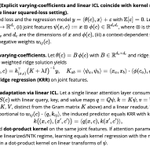
If you're interested in understanding how LLMs can do weight-space programming and parameter generation, a few months back @ben_lengerich, @ericxing, and I put together a major review that ties this back to basic statistical learning principles.


This is super cool, but I'm not sure it's emergent. Hypernetworks have been around for a while and it's straightforward to build an RL env for weight generation or modification in smaller models. It probably just means math/code are diminishing in returns and labs have moved on.


It's still super cool, I just don't want to see the whole emergent capabilities train to run away again.
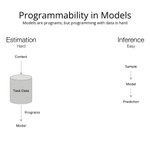
Relevant slides from @ben_lengerich on why gradient-descent and network updates are almost a perfect application for in-context learning.

Caleb Ellington retweeted

Our first release, Mol-1. Give it a try!
Weights & code: github.com/molence/Mol-1
Try Mol-1: lab.molence.com


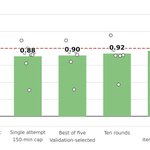
1/15 🧬 Mol-1 on antibody structure prediction: on par with IsoDDE, open to build on.
75.0% median success at DockQ > 0.23, on par with IsoDDE’s reported 75.58%.
Across all 201,376 five-seed combinations from 32 seeds, 62.22% matched or exceeded 75% success—showing robust performance across seed selections.
We release the model code and weights so researchers can run Mol-1 in their own environment and build on its capabilities.
Code & weights: github.com/molence/Mol-1
Try Mol-1: lab.molence.com
#AIforScience #DrugDiscovery

ALT Two panels show FoldBench-AB success rates and the distribution over all 201,376 five-seed combinations from 32 seeds. Mol-1 scores 75.0%, compared with IsoDDE's plotted 75.6%; Mol-1 with constraints scores 88.3%. In the distribution, 62.22% of combinations reach at least 75% success and 17.85% reach at least 76%.
Caleb Ellington retweeted

🚩 When Polymarket or Kalshi says there's a 70% chance something will happen, should we believe it?
Excited to share our new paper, just published in PNAS, in which we examined more than ONE MILLION forecasts from Polymarket, Kalshi, Manifold, and Metaculus, spanning 12 domains and forecasting horizons ranging from hours to years.
The main finding is striking: Prediction markets and collective forecasting platforms are remarkably well calibrated. When they assign events a 70% probability, those events really do happen about 70% of the time. And this pattern holds surprisingly well across different platforms, domains, and forecasting horizons.
But there's an important twist. When we looked more closely, we discovered systematic biases in some of the domains where forecasting matters most (wars, elections).
For decades, psychologists have documented how poorly humans often reason about probability and uncertainty. Our findings offer an encouraging counterpoint: When judgments and information are aggregated, we can achieve a surprisingly accurate understanding of an uncertain future.
That doesn't mean we can predict what will happen next with certainty. But it does mean that we can be remarkably good at estimating how uncertain the future really is.
This work was a great collaboration. The data for this project was meticulously collected for years by Justin Dickerson, the project was led by Hilla Shinitzky and Maayan Peer, with @mattansb leading the analyses.
📄 Read the paper:
pnas.org/doi/10.1073/pnas.26…
#Forecasting #Polymarket #Kalshi #DecisionScience #PNAS

Caleb Ellington retweeted

Introducing Omnii-1, our most powerful genome language model, and a major step toward general biological intelligence
In a world first, Omnii-1 designed the first AI-generated bacteriophages to be administered to a human patient with an antibiotic-resistant infection under compassionate use

Caleb Ellington retweeted

Getting started with AI-guided experimental design in the actual wet lab is pretty much like shooting in the dark. What's the end goal? How to set up the underlying predictive problem? How to design an effective acquisition strategy?
Driven by those questions, @RushilGupta15 from our group introduces a novel approach for strategy selection during batch-mode active learning. Have a look at his post and preprint!

Active learning practitioners choose an acquisition strategy before any labeling, but the best one changes with dataset, model, and task. What if we didn't have to pick just one? Introducing FractAL, a soft-strategy selection method (w/ @_romain_lopez_ ) arxiv.org/abs/2610.05544

Caleb Ellington retweeted

if you have a .edu, .gov or .mil email you can now get a full 8x B300 node for $4/GPU-hour. nebius charges $9.50 on demand and a lot of clouds are sold out
AMD MI355X nodes are $3 and the wait right now is under a minute
you just ask marshall, their AI agent, and it finds you a node
this is a major public good for researchers who've been priced out of frontier compute
thank you @AnjneyMidha


hundreds of MI355x and B300 nodes
now live on nationalcompute.com
subsidized for all .edu and .govs
it’s time to scale the frontier ecosystem
for the public benefit
