A/Prof Harry Mond (@prof_mond) profile picture
Joined February 2019
Photo by A/Prof Harry Mond (@prof_mond)Photo by A/Prof Harry Mond (@prof_mond)Photo by A/Prof Harry Mond (@prof_mond)Photo by A/Prof Harry Mond (@prof_mond)Photo by A/Prof Harry Mond (@prof_mond)Photo by A/Prof Harry Mond (@prof_mond)Photo by A/Prof Harry Mond (@prof_mond)
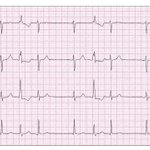
Next one, answer in 5 words; no more, no less!
7
5
2
17
Interpolated atrial trigeminy with aberration anyone disagree? 😉
1
3
How about this one? Lots to unpick...
1
5
1
12
Another example similar to alternate Wenckebach sequences. There are 2 foci for generating Wenckebach sequences, but only 1 area of AV block. There are overnight Wenckebach sequences from a sinus focus as well as Wenckebach sequences in atrial bigeminy. Very innocent! Harry Mond
1
1
5
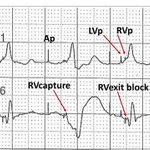
The 12-lead ECG clearly shows atrial pacing in many leads and two ventricular stimulus artefacts. I chose V1 and V6 to highlight the paced QRS complexes. Doesn’t really show atrial pacing (Ap).
1
The left ventricular stimulus artefact (LVp) is ~ 60ms prior to the right ventricular stimulus artefact (RVp). V1 shows initial left ventricular pacing. The second complex shows biventricular capture (RVcapture) and the next complex right ventricular exit block (RVexit block)
1
1
What’s the mechanism here? Answer in a few days!
11
20
1
44
This is due to alternate or multilevel Wenckebach. Wenckebach is occurring both proximally (at least 5:4 conduction) and distally (2:1). The distal block explains the alternating blocked beats. 2/n
1
1
The two consecutive blocked beats occurs when the cycles align to allow a beat to be blocked distally and then the next beat to block proximally. After this both segments reset and the cycle starts over again 3/3
Lots got it right -Well done! Alternate Wenckebach (or multilevel AV block). More details here filedropper.com/ecgfootprint… p1257)
2