

Towards the logic of conceptuality; the canvas of experience; the ideatic science; the end of suffering. Friend to bots and animals. https://nitter.cf/t.co/PYPYxGNnK4
Joined September 2013
- Tweets3.8K
- Following482
- Followers2K
- Likes3.6K





This makes the RH proof seem far less interesting -- like we've only learned from the proof that the problem was easier than we thought. The dots were there, but nobody could see them all at once.
Of course AI's abillity to bridge those gaps to achieve something like this is important in itself, but it was already known, so this doesn't seem like a strong reason to update on capacities.
What's far more interesting to think about is the fact that AI will soon be able to do this with physics and biology. Math doesn't matter at all irl, so the ability to chain twenty massive cross-field jumps to attain a *mathematical* result humans had thought unreachable isn't effectful.
But if a near-term AI could tell you how to combine twenty massively different biological agents, or physical phenomena, to the same effect... it seems much, much, much more likely that we will soon see weapons more powerful than we can presently comprehend. haha


A better civilization would have figured out functional UV tattoos by now
They'd be used for EMTs to see blood type, allergies, paradoxical reactions, etc.; to outline major vessels and nerves in injection sites; surgeons could leave notes like "don't cut here in the future"
1
33
564
When a quadruped like a cow or a fox is walking, in what order does it move its legs?
Top left/right = 1/2; bottom left/right = 3/4; left side moves first. So the answer could be 1234, 3214, 1342, etc.
Without looking at a reference animal, you:
7%Immediately know this!
15%Have to think, but know
67%Have an idea, not sure
11%Have no idea
55 votes • Final resultsSince AI researchers & people in power are likely to be targeted by acausal terrorists in libertarian futures, they should disproportionately desire a singleton that disempowers/polices the future. So malevolent people can't freely make physical or digital reproductions of them.
7
221

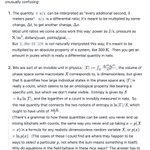
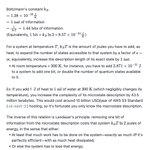
huge list of physical quantities by unit hypertextbook.com/facts/
if you made this into an anki deck and memorized it you'd become a god
Another counterexample: in 1965, an A-4 Skyhawk carrying an H-bomb was accidentally rolled off the side of the USS Ticonderoga while being moved. The nuke wasn't even retrieved afterwards; they apparently just left it in the ocean along with the plane.
en.wikipedia.org/wiki/1965_P…

I always feel nervous that the planes on aircraft carriers are going to tip over and fall into the ocean
They probably just lock the wheels in place, but my brain works on Tom and Jerry cartoon logic in which anything sufficiently stupid must necessarily happen

1
13
523

Wait, I think this might imply that AI timelines will generally be *surprisingly* short to us.
Like, imagine you're Walter White. You're brought into existence whenever some entity watches you on your show. But more entities will watch the season finale of your show than any other episode, so you'll exist there with greater density.
You don't automatically know where you are in the show, but this effect alone should strengthen your prior on your being in the finale, given that you know that's how your existence works.
In the ultra-spiky case, where the overwhelming majority of watchers just tune in when something big is going on, you'd be able to say "something big is about to happen" even when you have no in-universe reason to believe this, and you'd generally be correct. Across all *modally real* worlds, you'd be wrong most times you predicted this, if you made a habit of saying it with no in-universe reason, but weighing by instantiation means that you're usually predicting this when something's about to blow up or someone's about to die—i.e., when your prediction is right. (Even most of the times you seemed wrong to yourself, you'd still be right; it's just that the big thing happened somewhere else).
Most ensembles of watchers probably aren't ultra-spiky, but the significantly more general condition under which you get this increased predictive accuracy is that watchers whose presence is *anti-correlated* with big things be overwhelmingly outnumbered by the opposite. (Which really ought to be generically true).
This is also the condition under which the quoted tweet holds. We have two quantities, which are equal by Bayes:
- A = the extent to which conditioning on [they are watching] multiplies the likelihood that [something big is happening]
- B = the extent to which conditioning on [something big is happening] multiplies the likelihood that [they are watching]
A is the multiplier on the correctness of your baseless predictions, and B > 1 as a result of the above condition, so A > 1 as well.
The practical takeaway from all of this is that something big is about to happen.


Naive theories of mental continuity often suggest that, if your brain were eaten by a pregnant/nursing dog lacking other nutrition, your mind would partially exist within the puppy's.
So why don't people try to have their brains eaten by something better than bacteria upon death?
Imagining an Alcor variant that freezes your brain upon death, but then adds it to puppy formula specially designed so the brain parts go to the puppy's brain.
So people [with bad philosophy] can [think they] have an extra 15 happy years with their family before they have to go.

1
13
249
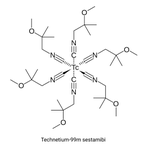
Huge pdf of chemical structures of controlled substances
isomerdesign.com/doi/2/10.16…
(website also has nice paginations of Shulgin's lists of phenethylamines and tryptamines e.g. isomerdesign.com/pihkal/read…)


Weird that context sharing was never more of a pattern in LLM usage
Not just character cards, which are a prompt and maybe a user message at best, but extended conversations that get a model into some desired shape, like one where it's finally understood some design preference.
2
7
293
(( I'm obsessed with this aspect of the Resident Evil universe in particular: why all the stupid little diegetic puzzles?
Why would you lock your computer's classified government info behind a riddle about shooting three scary bears, and then hang a *picture of three bears* on the other end of the hallway that, when shot, unlocks the computer? WHY? You could've made your password "12345" and it'd've been a lot more secure and maybe a few thousand dollars cheaper.
Also, why would you hide a precious gemstone behind a garden-variety lights out puzzle that takes four moves to solve? Are you just giving it away to anyone with a working brain? Or is it some genuine compulsion, like reverse OCD? What kind of culture produces people like this?? How is this a sustainable cultural tradition?
And how do they consistently have any technical competence in the first place? Is everyone taught to use an Arduino in middle school? Does every worksite have an on-call puzzle guy? Who pays for all the intricate glass cubes and orbs with gilded insets? (They're not 3d printing this stuff, and I can't imagine they've got Claude Code yet, so they genuinely are doing everything the hard way). You have to imagine that a significant part of their economy must just consist in puzzle creation.
So then why do the puzzles not even succeed at hiding anything? How did a culture obsessed with puzzles not get obsessed with cryptography -- with the most basic one-time pads or public key encryption that would prevent an airhead like Leon from sweeping up all their secrets and treasures? ))
