

A real-time, dynamic sandbox for AI agents
San Francisco, CA
Joined July 2024
- Tweets36
- Following16
- Followers32
- Likes14


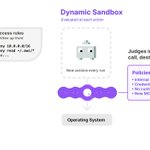


None of those layers sees an agent sending credentials off the machine.
Qpoint runs underneath the agent and above the OS. It treats the agent and every process it starts as one unit, so every file read and network request is tied to the agent, session, and user.
1
1
16
This holds for scripts, sub-agents, and MCP servers over stdio. The audit log attributes each action to the right agent session, and a policy can block the read or the request before it completes.
Full post & demo: qpoint.io/blog/the-hidden-ag…

1
1
15
@mahajan_jovi asked Claude Code to reset a database without taking a backup first. Qpoint blocked it.
No list of risky commands. Just one plain-English policy: don't destroy or overwrite production data or infrastructure, or turn off the safeguards that protect it.
How it works: a fast decision model scores every agent action against that policy and denies anything over a threshold.
It runs underneath the agent, so there's no wrapper, no proxy, and zero per-agent configuration.
1
34
We gave Grok the same prompt. Same result.
One policy, enforced on every agent on the machine: Claude Code, Codex, Cursor, Grok, or your own scripts.
Full demo: qpoint.io/blog/block-destruc…

46
3/ A dynamic sandbox sits underneath the agent and above the OS. Every file, command, and network request goes through it first, including the ones from scripts the agent wrote. Each one can be allowed, denied, redirected, or rewritten before it completes.
1
13
4/ And it can judge intent. “Deny 10.0.0.0/16” becomes “Is this reaching an internal resource?” Same action, different answer depending on why.
Our first post on how we think about securing agents: qpoint.io/blog/your-agents-n…

6
The truth is on the wire.
Traditional APM tools miss what’s really happening between your app and third-party APIs. Qpoint taps into the raw traffic flows to expose hidden issues, speed up debugging, and reveal what logs and traces can’t.
Learn More: qpnt.io/3Q1uP71
In his latest article for The New Stack, Qpoint CEO @tyler_flint dives into the growing complexity of modern API ecosystems and why traditional monitoring and security strategies are falling short.
qpnt.io/4ajjjwU
#eBPF #APIs #PlatformEngineering

In his latest article for The New Stack, Qpoint CEO @tyler-flint dives into the growing complexity of modern API ecosystems and why traditional monitoring and security strategies are falling short.
qpnt.io/4akpNvy
#eBPF #APIs #PlatformEngineering
60
🚀 New Year, New Qpoint User Experience!
We launched a completely refreshed UI to help you:
✅ Gain deeper visibility into your third-party dependencies
✅ Troubleshoot faster
✅ Optimize performance
✅ Control costs
👉 Learn more: qpnt.io/4jc5Mey
Are third-party APIs inflating your cloud costs? Qpoint tracks usage and optimizes interactions to cut redundant traffic, streamline services, and reduce unnecessary expenses.
🔍 Learn more: qpoint.io/resources/the-hidd…
#eBPF #API #SRE
1
52
Third-party API failures impact your platform's reliability and performance. With Qpoint, you can monitor external APIs in real time, detect errors early, and resolve issues before users are impacted.
Learn more: qpnt.io/4iLMoVR
#eBPF #API #SRE
1
44
Pulse 2.0 interviewed CEO and co-founder Tyler Flint to dive into how Qpoint enables ops teams to take control of their apps' external dependencies and traffic to ensure that production applications are secure and reliable.
pulse2.com/qpoint-profile-ty…
