

World’s 1st scalable Quantum ITS. Perfect Secrecy at 0.9 cpb for Gov & Defense Trade: https://nitter.cf/t.co/E3jd3mRItS
UK
Joined January 2025
- Tweets1K
- Following159
- Followers4.1K
- Likes1.4K


Pinned Tweet
They said quantum threats were years away.
They were wrong, but we have you covered!
Quantum-safe encryption powered by $QST
#QuStream #Quantum #Encryption #L1 #Blockchain
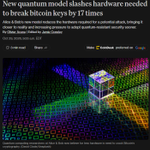
Alice & Bob estimate that a quantum computer with about 30,000 physical qubits could break a Bitcoin key in roughly 62 minutes. Google's estimate in March was under 500,000.
The model is theoretical and the two studies assume different hardware. Still, each new estimate has come in lower, and Alice & Bob expect hardware and requirements to meet in the early 2030s.
The same timing problem applies wherever keys last for years. Smart meters, drones and grid controllers stay in service for decades, and replacing their security takes years too.
We designed the Post-Quantum Ratchet so keys keep moving and a single broken key doesn't unlock years of recorded traffic.
See how: qustream.co.uk
coindesk.com/tech/2026/10/29…

Investors don't take a young company's word for its own technology. They want to know what defence players think.
This week, one of Romania's biggest military communications companies sat down with us, and both sides want to make it work.
Full recap:

Real networks don’t behave like perfect lab conditions. Radio signals fade. Packets get lost. Remote sensors miss transmissions. Yet communication still needs to continue securely.
QuStream's Post-Quantum Ratchet design addresses this by separating two jobs: deriving the right key for each new packet, and updating the shared security state when both ends confirm they have processed the same traffic.
The result? A lost packet doesn't automatically mean restarting the connection or negotiating new keys. Communication can continue, while the ratchet waits for a clean confirmation before strengthening its state.
The link can lose packets without the devices losing their place in the secure conversation.

QuStream retweeted
PQC upgrades the algorithm for a quantum world.
But the last-mile problem remains.
Every endpoint, device, application and network still has to be migrated, integrated, updated and trusted to handle the new stack correctly.
That is where exposure lives.
What can an attacker capture?
What can they store?
What can they reuse later?
QuStream takes a different route:
- public quantum-random material
- secret endpoint paths
- fresh keys derived locally
- no bulk key material moving across the network
Not just stronger post-quantum maths.
Less valuable exposure at the places real systems actually fail.

Somewhere, a server is filling up with recordings of encrypted traffic.
Nobody can read them yet.
The plan is to wait until the lock that set up those connections breaks, then open everything at once.
Adrian Neal's new paper gives that server a problem:
In our Post-Quantum Ratchet, one batch of random data swapped where nobody could listen gets mixed into every key that follows.
Break the lock in 2045, hold every recorded byte, and those keys still won't rebuild. #EverlastingSecurity

Every encrypted recording made today is a bet that the lock holds forever.
Adrian Neal's paper shows how PQR stops making that bet. After one exchange nobody could capture, a future break of the post-quantum setup lock can't rebuild the keys that follow.
He calls it everlasting security ➡️ qustream.co.uk/assets/pqr-xx…

The quantum attack on your wallet doesn't start when the quantum computer arrives.
It started the day your public key hit the chain.


Assume a device gets captured one day. What can the attacker read?
That depends on how its keys were built.
A drone goes down behind the line. If its radio shares one long-lived key with the rest of the fleet, whoever recovers it may be able to read every radio on that key, including traffic recorded months earlier.
Grid equipment stays in service for decades. Take a controller from an unmanned substation, and a key that never changes can open years of recorded control traffic.
Smart meters ship by the batch. If a batch shares one key baked into firmware, a single meter opened on a workbench can be enough to read the rest.
A seized satellite ground terminal is the same story, on a link that may need to stay secure for as long as the satellite flies.
PQR is designed to keep the answer short. Keys keep evolving and old ones are erased, so a captured device exposes only the messages under its current key. Systems with independent keys in separate security domains stay outside the breach. How long that window lasts is a setting. Once fresh secret material arrives that the attacker can't reach, protection recovers.

Post-quantum signatures prove who you're talking to when a connection starts. What if the scheme breaks years later?
In PQR, later messages are checked with a key grown from the conversation's own history. A forger could start a new connection, but couldn't join an existing one.
"Harvest now, decrypt later" has a simple plan: record encrypted traffic today, break the lock that set up the connection years from now, then read everything.
Adrian Neal's new paper on our Post-Quantum Ratchet shows where that plan can fail.
Every confirmed message gets folded into the next key, a bit like a recipe where each step uses some of the last batch. To rebuild later keys, the attacker needs every confirmed piece. Miss one that's hard to guess, and breaking the lock years later doesn't give it back. The keys after the gap stay out of reach.
qustream.co.uk

Claude found a new way to do modular inversion, the costliest step in elliptic-curve arithmetic. One of its point-addition circuits uses 17x fewer gates than the smallest previous design, for 12% more qubits.
A quantum attack on ECDSA keys spends most of its effort on exactly those point additions. Nothing is broken today. The cost estimates keep falling, though, and this drop came from a single 53-hour run.

New from our STEM Fellows Program: Designing more efficient quantum circuits with Claude.
Given plain-language instructions, Claude Mythos 5 designed quantum circuits that improve on the best published ones, sometimes by an order of magnitude or more.
More efficient circuits reduce the resources needed by quantum algorithms, which could bring quantum computing applications in chemistry and materials science within reach sooner.
Read more: anthropic.com/research/desig…

"Harvest now, decrypt later" has a simple plan: record encrypted traffic today, break the lock that set up the connection years from now, then read everything.
Adrian Neal's new paper on our Post-Quantum Ratchet shows where that plan can fail.
Every confirmed message gets folded into the next key, a bit like a recipe where each step uses some of the last batch. To rebuild later keys, the attacker needs every confirmed piece. Miss one that's hard to guess, and breaking the lock years later doesn't give it back. The keys after the gap stay out of reach.
qustream.co.uk
Last year, Google estimated RSA-2048 could be broken in under a week with under a million noisy qubits. Part of that saving came from magic state cultivation: a cheaper way to make the high-quality "magic" ingredients a quantum computer needs to run algorithms like Shor's.
Now Google has shown it working on real hardware, with 40x fewer errors.
This doesn't break RSA. It does turn one of the estimate's assumptions into a lab result, and anything recorded today will still be sitting in someone's archive if that gap ever closes.
Moving to post-quantum algorithms is step one. Step two is limiting what a single future break, of any algorithm, can unlock from years of recorded traffic. That's what our Post-Quantum Ratchet is built for.

Published in Science today: Magic state cultivation works in practice on our Willow processor. We achieved a 40x error reduction, compared to without cultivation, and 99.99% fidelity. Learn how this addresses a critical resource bottleneck: goo.gle/4yr8V0H

One-time pads have a distribution problem.
The textbook OTP needs a uniformly random secret pad as long as the message, with every segment used only once.
QuStream’s published QS-OTP design tackles the logistics: endpoints begin with a shared secret reservoir and derive pad segments locally from authenticated public epochs.
In the worked example, 1,024 parallel streams each produce a 256-bit segment: 32 KiB of pad per epoch.
A 4,096-bit epoch is 512 bytes—about 1.6% of that output, excluding authentication and transport overhead.
The aim: ongoing pad derivation without repeatedly shipping bulk secret pad files.
This is a bounded security model, not a claim of unlimited textbook perfect secrecy. Its stated assurances depend on protected secret state, controlled exposure, and safeguards against replay and rollback.
Local derivation. Single-use segments. Explicit limits.


